Howdy! How about a lively morning cartoon to go with your fruity pebbles? Zoetica’s recent post on the lamentable declension of MTV’s programming reminded me of this little gem:
Created as a senior project by animator and RISD legend, Christy Karacas, “Space Wars” aired internationally on a charming, offbeat MTV show called Cartoon Sushi back in 1997. The content and mood of Cartoon Sushi was sort of a cross between Liquid Television and Spike & Mike’s Sick and Twisted Festival of Animation. Sadly, it barely lasted a year on the air. Suprise, surprise.
A couple of years later, Karacas joined forces with Stephen Warbick to unleash BAR FIGHT upon an unsuspecting world. The film “was rejected from every festival it was ever entered in” and it’s a bit… well, let’s just say it’s more a Better Than Beer experience –or possibly Better Than Dimethyltryptamine– than anything else. Still, it’s under the cut if you think you’re feeling up to graphic, color-saturated gore and toilet humor this early in the morning.
Nowadays, we have no shortage of psychedelic, stream-of-consciousness mindbuggery from Karacas/Warbick; their show Superjail! premiered on Adult Swim last year. (Bless you, Cartoon Network, for picking up where Liquid Television left off.)
Charley Bowers ain’t even half as widely known as Ray Harryhausen, Georges Méliès, Winsor McCay, Buster Keaton, Jan Švankmajer, Ladislaw Starewicz or Willis O’Brien, but damn it, he should be! WACK-A-DOODLE-DOOOO:
It’s a Bird, featuring Charley Bowers and a scrapyard metal-eating, proto-Seussian “Metal Bird.” Directed by Harold L. Muller. (Thanks to longtime Coilhouse friend Mark P. for the heads up on this one!)
Once championed by the likes of Andre Breton, quite possibly an early inspiration to the likes of Theodor Seuss Geisel and Chuck Jones, this gonzo animator and comedian had fallen into obscurity by the time of his death in the mid 40s. Bowers’ work didn’t resurface until decades later, when a French film archivist sleuthed him out. Via mediascreen.com:
Raymond Borde of the Toulouse Cinemateque began the search after discovering a collection of rusty canisters simply labeled “Bricolo.” After discovering that Bricolo was the name given to an American comic named Charley Bowers, Borde began to scour the world archives for Bowers films. As usually the case in film preservation, Bowers films were located throughout the world in the archives of France, the Netherlands, and Czechoslovakia and only one film found in Bowers’ own native country of the United States. Eleven of Bowers’s twenty shorts are still considered lost films.
Bowers’s original claim to fame was as the animator and producer of hundreds of “Mutt and Jeff” animated films from 1915 until the early twenties. In the mid-20s, Bowers switched from pure animation to a hybrid mixture of live action and animation… comedy shorts starring himself as an obsessive inventor of gadgets, gizmos, contraptions, and crazy machines. Bowers continued with these shorts until after his first talkie short — “It’s a Bird” from 1930 (much admired by surrealists like Andre Breton). After “It’s a Bird,” Bowers dropped off the map, heading to New Jersey, working in advertising and industrial shorts, and drawing cartoons for local New Jersey newspapers. He reemerged in the late thirties as the animator for a short subject about oil for the New York World’s Fair (the film was also the first film produced by Joseph Losey). But after a few other animations in the early forties, Bowers contracted a debilitating illness and died in obscurity in 1946.
Fairly recently, Image Entertainment produced a lavish two-disc collection The Complete Charley Bowers: The Rediscovery of An American Comic Genius, which includes nearly all of his surviving films. They’re a frisky mixture of live-action slapstick, stop motion, uncanny SFX, talking cockroaches, Rube Goldberg shenanigans, and more.
In Now You Tell One, possibly Bower’s most over-the-top and mind-boggling film, a “gentlemen’s Liar’s Club” known as The Citizens United Against Ambiguity gathers for a storytelling contest. Wonky stop-motion animated cats and mice battle for dominance; bizarre botanical grafts yield impossible fruits; elephants and donkeys appear to stampede the Capitol building.
In Bowers’ world, a maternal Model T Ford hatches dozens of baby cars; a rapacious ostrich gobbles up inorganic matter and dances to a phonograph; a mad inventor labors to invent the world’s first “no-slip banana peel”; a sentient, white-gloved robotic creature runs amuck in what one reviewer refers to as an extraordinary “comical-bizarro poetic representation of the industrial age.”
The man’s talents as an actor/comedian may not have been on par with his idols Keaton and Chaplin, but his imagination certainly was. This is gloriously demented stuff deserving of far more cinematic acclaim.
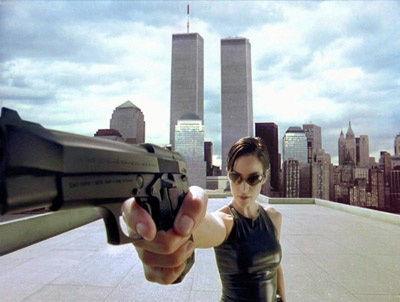
The Matrix turned 10 last week. It debuted March 31, 1999, though us plebs had to wait til April 2 to see it.
It’s easy to forget, in the wake of two disastrous sequels and equally lackluster (except for the Animatrix) tie-ins, exactly how radical and groundbreaking a pop culture artifact the first movie was.
Try, for a second, to look at the original trailer. Imagine you know absolutely nothing about the movie inside:
Pretty f’in cool, no?
To date myself, I was 16 at the time and came out of the theater utterly energized. I wasn’t the only one. William Gibson dubbed it “an innocent delight I hadn’t felt in a long time.” Darren Aronofsky raved that it heralded a new age in sci-fi. Neil Gaiman and Poppy Z. Brite wrote stories to fill out the movie’s universe.
It became a phenomenon, immensely successful and influential beyond anyone’s expectation. Hell, conservative scolds even blamed the movie’s anarchistic heroes for the Columbine massacre.
The Matrix worked because it managed to blend philosophy, allegory, action and fashion into one glorious, fun package.
Apocalypse Meow is the Americanized title of Cat Shit One, a dark and befuddling manga series by Motofumi Kobayashi. Published in the late 90s, the book features a team of fuzzy wuzzy widdle bunny wabbits in an American special ops team battling the forces of cutesy wootsy wily Viet Cong kitty cats on a wide variety of historically accurate, often graphically violent recon missions. Characters are depicted as different species according to nationality; Yankees as rabbits, the Vietnamese as cats, Frenchmen as pigs, Koreans as dogs, Australians as koala bears, etc.
Yyyyeah. Cute Overload it ain’t. Or Watership Down, for that matter. And now, it would seem that Anima Studio has produced an equally gory animated trailer/short based off the manga. Only this time, special ops team Cat Shit One is in the Middle East, fighting… Taliban camels? Taliban camels wearing… turbans?
Oh god. Oh my god. Ohmygodwhatthefuckbarbeque, even.
Replete with M4A1 annihilation and bargain basement Nusrat Fateh Ali Khan-soundalike ululations. Keepin’ it classy.
Clip via Sean Dicken. Thanks for the nightmares, Sean.
For those of you who have yet to “taste the unko“, Kago has produced some of the most disturbing manga imagery you’ll ever see short of Suehiro Maruo‘s or Keiji Nakazawa‘s… only his output is as likely to give you a bad case of The Totally Inappropriate Giggles as make you gag. These new animations, while crude in comparison to his more elaborate illustrated work, will likely do both.
Well, that struggle has been won and now, through the public television program Reel 13, you (or anyone in the world with an internet connection) can see the entire movie.
Sita is a full-length film, produced by a single artist working on a shoestring budget, on her home computer and backed almost entirely by the film’s enthusiastic audiences around the world. Paley and her allies have now overcome the considerable hurdles, including archaic copyright laws put in place to keep exactly this sort of truly independent, eclectic art from standing on its own two feet.
Get some popcorn. Click. Watch. Enjoy. This is a bold day: something big just changed.
P.S. – Also, for y’all television-watching Yankees out there, it will be broadcast in the NY area on Channel Thirteen/WNET at 10:45 pm on Saturday, March 7.
When I was wee, I didn’t play with Barbies. I preferred toy soldiers, plastic dinosaurs, Briar horses, Transformers, etc. Admittedly, I related to these objects a bit differently from my guy pals. I’d still knock my toys around as enthusiastically as the little boys who lived up the street, but at playtime’s end, something shifted in my psyche. A deeply ingrained maternal instinct compelled me to soothe and calm my action figures, tucking them into snug swaddling “nests” I’d make from stockings and underoos. The walls of my room were often lined with balled-up socks that had the heads of D-Day soldiers and T-Rexes sticking out of the top. I’d sing to my podlings, “flying” them slowly through the air to help them fall asleep. My parents looked on in confusion and dismay. (But hey, at least I wasn’t finding new and interesting ways to vivisect Malibu Stacy.)
This pointless and meandering trip down memory lane is brought to you by the discovery of Alex Poutianinen’s ridiculous short film Rise and Fall of the Nazi Dinosaurs, as well as my desire to bump that potentially libelous Danzig post down as swiftly as possible. Yay, internets!
Yeah, yeah… we know. Whether you choose to call it Commercially Dictated Affection Day, Lupercalia, or Just Another Epic Lonely Fart-Sucking Excuse For a Personal Pity Party, Valentine’s Day can be full of fail. We’ve all done our share of hatin’ on it. But hey, know what? It really is a gorgeous world out there, and as the Troggs once said, Love is All Around.
Coilhouse Magazine & Blog feels a little bashful asking you this. Um. Don’t feel obligated or anything, but… will you be our Valentine? We think you’re pretty swell. It’s okay, you don’t have to decide right away.*
But tell us, who do you love?
Felted “Love is a Battlefield” Hand Grenade from NifNaks.
It’s Lewis Carroll’s birthday, so don’t just do something – stand there! The author who opened and bent our young brains before science fiction had its turn would be turning 177 today. This is also the man who singlehandedly affected my entire life by inspiring my mother to name her only child after his Alice. It’s a long story, but I think she knew what fate awaited me as a result. To commemorate this special day, a somewhat unsettling clip from the very first stop-motion Alice In Wonderland. Made in 1951 by puppeteer and animation magician Lou Bunin, this one precedes the Jan Švankmajer version.
Bricey, bless you. I don’t know where you discovered Mark Gormley, but he’s going to make our more adventurous readers extremely happy. The rest of you may want to stick with Panties With a Dick Hole and My Chemical Bromide or whatever else the kids are listening to nowadays, but for my money, none of that slick, overproduced teenybopper fare can compete with an honest, well-crafted song, a soulful voice, and cable access video stylings featuring a beautiful (if mildly befuddled) bikini model. Mark Gormley sends me over the moon: