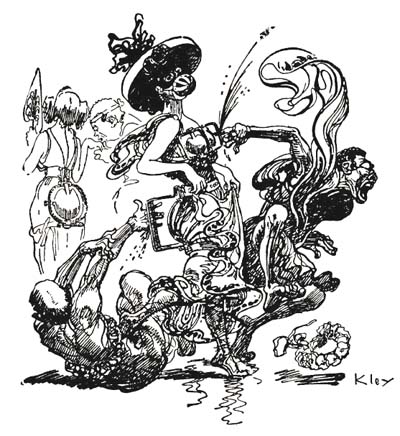
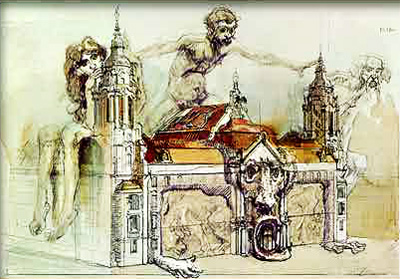
The greater the draftsman, the more the artist can suggest with the least number of pen strokes. He knows beforehand where each line will touch the paper and why. Each line and dot will convey large areas of figure or scene, and the true artist/draftsman can relate his imagination to the viewer. Add to this one other quality the rare attribute of satirical humor and you have one of the greatest draftsman of this century: Heinrich Kley. -Donald Weeks
It’s amusing that Heinrich Kley earned his college degree studying the “practical arts” when one considers the decidedly impractial nature of the artist’s most famous work. Although Kley’s technical prowess always set him apart, his early paintings of landscapes and still life subjects are nothing to write home about. It wasn’t until the turn of the 20th century –while Germany scrambled to catch up to the rest of the swiftly industrializing world– that Kley’s own work took some fascinating turns.
Posted by Meredith Yayanos on December 15th, 2007
Filed under Art, Books, Fairy Tales, Industrial | Comments (3)

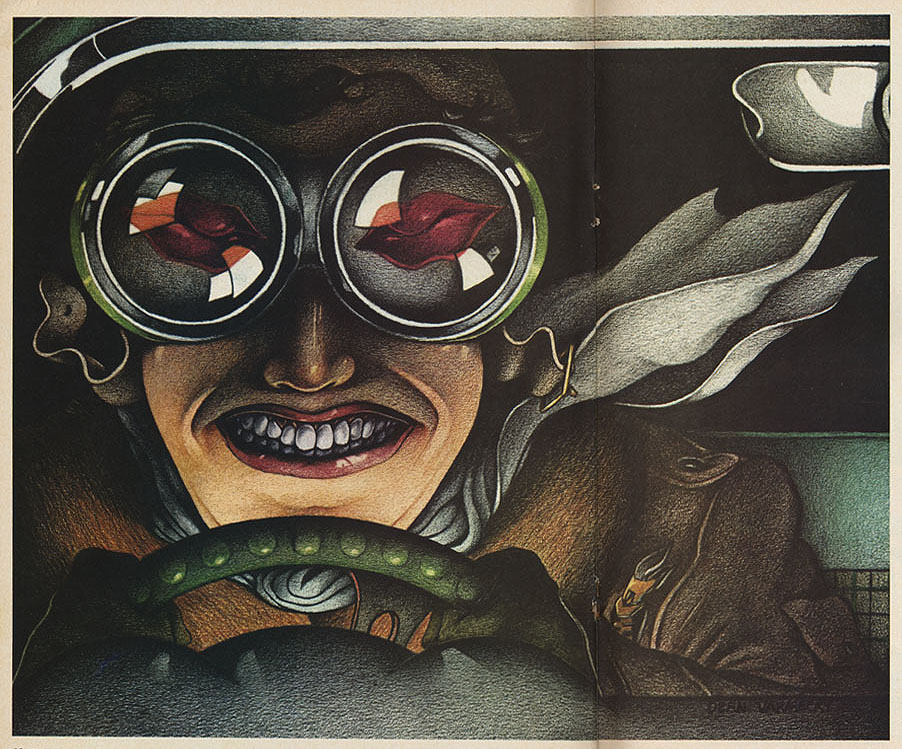
An illustration from a 1974 Penthouse for the first paragraph of Crash by J.G. Ballard. If you’re somewhat depraved and not familiar with Crash, or have only seen the [excellent] Cronenberg film based on the book, I suggest you look into it.
Over the profiles of her body now poised the metallized excitements of our shared dreams of technology.
Of note:
Posted by Zoetica Ebb on October 19th, 2007
Filed under Art, Books, Madness | Comments (3)
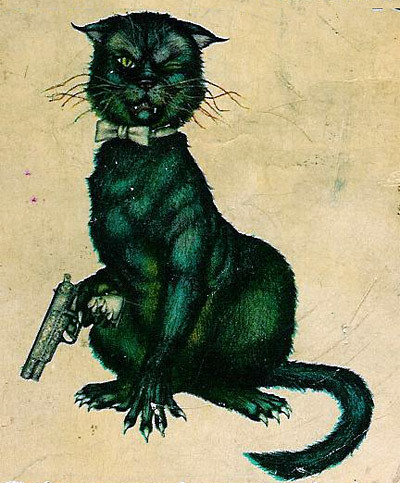
Everyone I know who has read it has told me that it altered them forever, and I’m always surprised that it’s not known more in the West. Zoetica and I had to fight over who would blog about our favorite book, The Master and Margarita, so we’re collaborating on this entry.
“One hot spring, the devil arrives in Moscow, accompanied by a retinue that includes a beautiful naked witch and an immense talking black cat with a fondness for chess and vodka. The visitors quickly wreak havoc in a city that refuses to believe in either God or Satan. But they also bring peace to two unhappy Muscovites: one is the Master, a writer pilloried for daring to write a novel about Christ and Pontius Pilate; the other is Margarita, who loves the Master so deeply that she is willing literally to go to hell for him.” – Synopsis for the Katherine O’Connor translation
We didn’t really fight, tovarish Nadya exaggerates.
Bulgakov worked on The Master and Margarita, the crowning thorn of his life’s work, until 4 weeks before his death with his own Margarita at his side.
Of note is the book’s structure of two parallel stories – the story of Master and Margarita and the story of the final days of Jesus Christ, as written by the Master [more or less Bulgakov’s alter ego]. The book was banned for many years, published only in small sections in literary magazines. The original controversy and ban were due to thick political subtext in Bulgakov’s descriptions of Pontius Pilate – a thinly veiled Stalin, and bitter satirical illustration of Stalin-era Moscow and its politics.
Posted by Coilhouse on October 19th, 2007
Filed under Books, Russia | Comments (6)
Posted by Meredith Yayanos on October 18th, 2007
Filed under Art, Books | Comments (5)
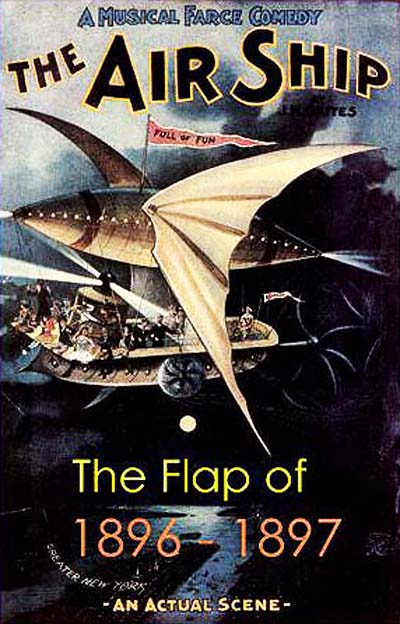
From late 1896 through early 1897, a full ten years before the flight of the first known powered dirigible, thousands of people across America claimed to see strange lights in the night sky, heard voices and music emanating from a mysterious airship. Some accounts described a cigar-shaped gasbag, others noted vast flapping canvas wings and large wheels like a paddle steamer’s. One early eye witness even insisted he’d glimpsed two men suspended in the ship’s undercarriage, furiously working bicycle pedals. From Sacramento to Chicago, folks from all walks of life strove to convince skeptical journalists that what they’d seen was not, in fact, an elaborate hoax.
The most carefully researched book written to date about the phenomenon is probably The Great Airship Mystery by Daniel Cohen. Cohen gives a well-rounded account of the circumstances and evidence before concluding –quite sensibly– that the airship probably never existed. (Bummer.)
Several other authors have offered up far more juicy theories. Michael Busby maintains in his own book Solving the 1879 Airship Mystery that a secret society of mad genius inventors joined forces to build a handful of highly advanced aircraft worthy of Jules Verne, each of which, after being viewed by countless drunken farmhands in the Midwest, inexplicably crashed and burned over the Atlantic ocean.
Noted ufologist/parapsychologist/journalist John Keel includes the sightings in the book UFOs: Operation Trojan Horse as compelling evidence for his long-standing hypothesis that certain “non-human or spiritual intelligence sources” have been staging elaborate events for centuries to manipulate and misinform the human pysche. (Other examples he cites include the fairy folklore of Middle Europe, vampire legends, black helicopter sightings, poltergeist phenomena and UFOs.)
Although the initial sightings in the US ended in 1897, several more sightings occurred in England, Europe and New Zealand from 1909 through 1913. In 1912, vaudeville superstars Elsie Baker and Billy Murray penned a little ditty about the airship fervor entitled “Mysterious Moon” and recorded it on wax cylinder.
A comprehensive list of newspaper clippings from 1897 newspapers can be found here. Wikipedia’s got a good entry on the subject as well.
Posted by Meredith Yayanos on August 28th, 2007
Filed under Books, Conspiracy theories, Crackpot Visionary, Cryptohistory, Culture, Music, Sci-fi, Surreal, Ye Olde | Comments (9)