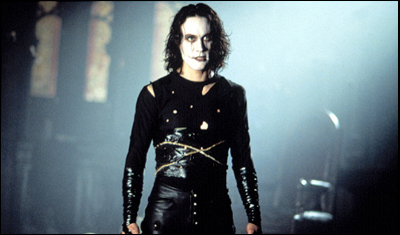
Nick Cave’s participation in the remake of the new Crowhas been confirmed, and I’m finally starting to get excited. The Crow, a film based on James O’Barr’s eponymous comic book series, was a sort of holy grail to me and my darque little crew back in the early nineties. Unapologetically dramatic, The Crow had everything an angsty kid could want: love, destruction, hot bloke in makeup, great villains, pretty girls. There was one year when I watched the film at least five times.
Now, I haven’t actually seen it in over ten years, for fear that it won’t hold up. I’m told it doesn’t. Still, the concept of a shiny new remake of my childhood/adolescence favorite is an uncomfortable one. Nostalgia and Brandon Lee’s death on the set veil The Crow in shimmery, inviolate mystery, and, had it been anyone other than Nick The Stripper doing the re-write, I would have probably shunned it. As things stand though, I think there’s reason to get at least a little fired up, especially with new rumors of Cillian Murphy possibly signing on to play Eric – almost as weird as casting Brandon Lee! If only Stephen Norrington could be replaced… Yes, then I can almost picture it. Until we know more, let us remember The Crow that once was. I leave you with a question: who would you cast as the ideal Eric?
Inspired by the music we had the idea of making a decaying world. One single camera movement from left to right, showing a landscape, looping 9 times. Day becomes night and even the seasons go by. After we finished the production, we decided to reverse the whole video. This gives you a seemingly happy end, but you know what’s going to happen. There are no lyrics and we did not pay attention to the title of the song, we just felt this was the right thing to do.
A beautiful video from circa 2008, a lifetime ago on the internet. The song is from the album A Memory Stream which can be purchased here, among other places.
Felix Meyer and Pascal Monaco present 35mm, an animated short featuring minimalist representations of 35 films in 2 minutes. Think of it as an animated film quiz to perk up your afternoon.
A film for violin nerds on today’s FAM. Tom Slade directs 4, a film that follows four different violinists on four different continents playing one of the world’s most well known compositions, Antonio Vivaldi’s The Four Seasons.
4 begins in Spring in Tokyo, with violinist Sayaka Shoji, segueing into Summer in Australia and violinist Niki Vasilakis before moving on to New York in Autumn with Cho-Liang Lin and finally ending in Finland in Winter with Pekka Kuusisto. It’s a quite a journey, though I’ll admit to being partial to Autumn as there really is nothing like New York City in the fall. The show-stopper here, however, is Finland. The scenery on display in this last act is nothing short of stunning.
All of it is accompanied by a beautiful piece of music. Vivaldi was a mainstay for me growing up. My grandmother had studied the violin and graduated from Juilliard before marriage and WWII sidelined those dreams. She had inherited the love of the instrument from an uncle who was a member of the Budapest Philharmonic Orchestra. She had, for a time, tried to pass this love and ability down to me, an endeavor she would abandoned in despair, her oldest grandchild seemingly devoid of any musical talent. Her violin, as it is for many who play I would assume, remains her most prized possession. She has, apparently, stipulated in her will that it must never be sold as doing so will, no doubt, bring down some ancient Hungarian curse upon our family.
The musical aspect, then, was what I found most intriguing about this film for while I love The Four Seasons the musicians here are in possession of a wealth of knowledge that I am completely ignorant of. They make for a fascinating lecture on just what is going on in each movement, what events transpire and what each instrument represents, all facets of the music I was never aware of.
It’s a meditative film, made slightly ominous by each musician noting how the weather seems to be changing. But regardless of such politically charged observations it remains delightfully calming — a soothing musical travelogue. The perfect film for a Friday afternoon.
We don’t often run sale notices on Coilhouse, least of all for the big franchises, but I’ll feel supremely guilty if I don’t share this bit of news with our readers: right now through August 1st, go to any Barnes & Noble (or shop online) and save 50% on every single Criterion film they have in stock. DVDs and Blu-rays. Grey Gardens, Throne of Blood, Picnic at Hanging Rock, Branded to Kill. A massive 25-disc Kurosawa boxed set for 200 bucks. Fellini, Bergman, Cassavetes, Gilliam, Herzog, Hitchcock, Welles, Brakhage, Tarkovsky, Wenders, Tati, and that’s just the very tiniest sampling of names and titles. Everything Criterion still has in print is selling for half off. Holy shitballs.
Offhand, it’s difficult to come up with a more beloved or awe-inspiring catalog than the Criterion Collection. While I can rarely afford these discs at full price, they’re never anything less than a revelation, and I cherish every one I own. It’s film curating of the highest caliber. If you already know, you friggin’ know, and you’re probably on your way out the door. If you don’t know, may I suggest checking out the selection at B&N immediately? You won’t regret it. GO, GO, GO. YEEEEE…
PS: Oh, and while you’re there, feel free to swing by the magazine racks and snap a phone picture of Coilhouse #05, should you happen to find one! (We’ve all been getting a huge kick out of seeing them in the wild.)
Hot, steaming pantomime on order today for the FAM as we present The Triplets of Belleville (Les Triplettes de Belleville), the surreal animated adventure from 2003, written and directed by Sylvain Chomet.
Triplets tells the story of Madame Souza who is raising her son, Champion. Noticing his sadness one day, she purchases for him a dog named Bruno and though this does cheer him up, his joy is short-lived. It is only after she realizes his interest in bicycle racing and gives him a bicycle of his own that Champion finds real happiness. Fast forward and, years later, Champion has become a world-class cyclist, competing in the Tour de France. It is during this race that a mafia boss kidnaps Champion and two other cyclists, bringing them to the town of Belleville in North America and hooking them up to a virtual-reality cycling machine, allowing patrons to gamble on the races. Madame Souza and Bruno follow, of course, attempting to rescue him from the mafia’s nefarious clutches; meeting along the way the titular triplets, a trio of retired cabaret singers.
It’s a strange arc, then. Triplets starts off easily enough, slow and methodical, but upon the kidnapping of Champion things surge into overdrive, getting progressively weirder and the two don’t quite mesh as well as they perhaps should. It’s almost like they stitched together to different films. That said, this observation does little to detract from my enjoyment of the film. Chomet has created a beautifully realized world here with his characters barely uttering a single word. The version above features no English subtitles, an omission you will hardly notice. Every emotion and thought is spoken with subtle, expressive animation. In addition, the movie features an outstanding soundtrack inspired by the jazz of the 20s and 30s (the film even goes so far as to reference both Django Reinhardt and Josephine Baker in the first few minutes.)
In animation at least, I find myself drawn to pantomime. It strikes me as a testament to an animator’s talent, this ability to abandon the spoken word. In that way it’s interesting to note that Pixar, who’s Finding Nemo beat out The Triplets of Belleville for best picture has begun incorporating this aesthetic more in their recent films, most notably Wall-E (perhaps my favorite from them). Chomet’s new film, L’Illusionniste will see a release in the States in December and I find myself just as anxious as when I first saw a trailer for The Triplets of Belleville. I just can’t see his oeuvre losing its charm.
Introspection and retrospection reign supreme on this day, the Ninth day of July in the year of our Lord Two Thousand and Ten. Today the FAM presents Krapp’s Last Tape starring John Hurt and directed by Atom Egoyan for the series Beckett On Film for Irish broadcaster RTÉ, British broadcaster Channel 4, and the Irish Film Board and which began showing in 2001. The project’s aim was to film 19 of Samuel Beckett’s 20 plays; the exception being the early play Eleutheria which at the time remained unperformed and, in fact, was only staged for the first time in 2005, 58 years after Beckett wrote it. Along with Hurt and Agoyan, Beckett On Film featured an impressive stable of acting and directorial talent. Seriously, look at that list.
We, however, are here to focus on one. Krapp’s Last Tape is the story of Krapp, who is celebrating his sixty-ninth birthday and, is his habit, has hauled out his reel-to-reel tape recorder in order to review the tapes he has made upon every instance of the “awful occasion”. Those are the words used by Krapp, but the Krapp of 30 years previous and from whom we learn the majority of what we know about the man. It is this man, pompous and sneering, who narrates most of Krapp’s life and Krapp sneers along with him, laughing along condescendingly with his 39 year-old self at the idealism and naivete at the 20 year-old man he used to be. We learn from this incarnation of his mother’s death and the women he has loved.
But even Krapp at 39 cannot escape the bitterness that he hurls at his youth. At 69, there is little else left in him but bile and regret; his last book has sold next nothing, his sex life revolves around the periodic visits of an old prostitute. He has no years left for idealism. The only future for Krapp is death; and now in full light of that realization he retreats to the dim memories on those tapes. As the tape ends he can only sit frozen, the only sound the hiss of the reel as it runs down.
The most famous production of Krapp’s Last Tape, no doubt, is 1972 for the BBC, starring the late, great Patrick Magee. In fact, Beckett wrote the play specifically for McGee, it’s original title being “Magee monologue”. I must admit that, much as I love Magee’s work, Hurt seems almost as if he was born for this role. Watching him is hypnotic, every movement seems to take incredible effort and it seems as if he’s willing he joints to creak. Hurt is also in possession of an incredibly expressive face and he uses it to great effect here, betraying the sadness and despair of character with a subtlety that keeps the whole affair from becoming maudlin. It also contains the only instance in which I have laughed at the slipping-on-a-banana peel gag.
It would be hard for most to rank this as Beckett’s greatest play, especially when compared to his most famous play, the incomparable Waiting For Godot, but there is a reality present in Krapp’s Last Tape that is absent from the tale of Vladimir and Estragon that I find deeply affecting. Much of Beckett’s life is reflected in Krapp’s Last Tape and at the time he wrote it his outlook was, one could maintain, quite grim. Perhaps therein lies crux of my position. It’s effectiveness may hinge on just how much of one’s self one sees reflected here.
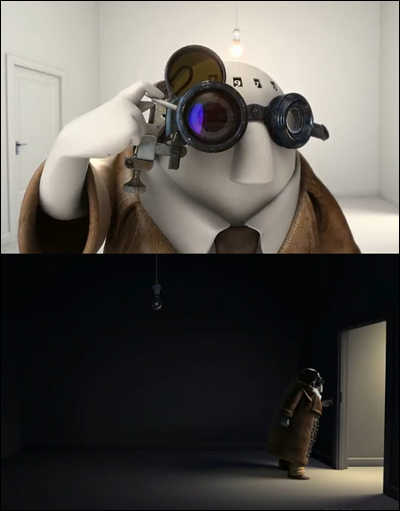
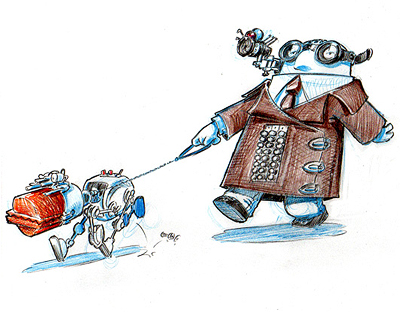
French sculptor and Coilhouse Issue 02 featured artist Stéphane Halleux is trying his hand at a new medium – animation. In response to countless questions, pleas, and threats he’s created a digital character after one of his leather and scrap metal sculptures, Monsieur Hublot. There is no word yet on the release date of the eponymous, seven-minute short, but we do know that Mr. Hublot [named thusly as a nod to Jacques Tati’s tragically inept Monsieur Hulot] is a bachelor accountant suffering from a host of obsessive-compulsive ailments. He lives in a small, gadget-packed apartment with his robotic dog, loves his leather trench coat and despises noise.
Together with Zelit Productions, Stéphane hopes to eventually develop the project into a feature-length film. Meanwhile, a frame-sponsoring system is in place, allowing interested fans to take part in the short’s development at up to 9EU per frame. From the Monsieur Hublot website:
In exchange, among other things and depending on the amount of images sponsored, they will get updates on the film’s production, a print of one of their sponsored images signed by Stéphane Halleux, the opportunity to appear in the the credits, etc. As for ourselves, this quid pro quo will enable us to complete the financing of the short film and to prepare the release of the feature film.
I love this idea!
Two charming animation tests from Monsieur Hublot have been released into the wild, so far. Watch below as the character gets his bearings and faces off with a light switch, then check out his outfit in more detail.
It’s another summer holiday weekend, here in the United States. Independence Day weekend no less, the 4th of July being the day when Americans get inebriated and spend the day basting themselves in the hot juices of meats, both various and sundry. Such is the joy we feel when we think about how we could still all be English. We at the FAM are here, however, with you pre-basting. We are unbasted, clean and virginal at least for the moment though this will no doubt soon change. For now, however, you may sit near us and enjoy today’s offering knowing you will be unsullied.
Today the Friday Afternoon Movie presents the first four episodes of Satoshi Kon’s weird and wonderful television series Paranoia Agent (Mōsō Dairinin) from 2004, which represents the entirety of the Complete Collection’s disc one, entitled Enter Lil’ Slugger. Paranoia Agent begins with a mysterious attack on Tsukiko Sagi — a character designer best known for the incredibly popular pink dog Maromi — by an assailant who will become known as Shōnen Batto (Bat Boy in the original Japanese and Lil’ Slugger in English). Soon detectives Keiichi Ikari and Mitsuhiro Maniwatwo become involved as more people report attacks by a boy on golden skates, armed with a golden baseball bat.
What follows is tried and true territory for Kon, beginning all the way back in 1997’s Perfect Blue and, some might say, culminating in 2006’s Paprika. Given it’s thirteen episode run, Paranoia Agent gives him the most room to explore it. Kon’s work is primarily concerned with the examination of the lies we tell ourselves and pop culture. It’s the symbiotic relationship between these two aspects of day-to-day life that form the crux of all his films and is firmly entrenched in the story of Paranoia Agent. Indeed, the main thread that emerges, connecting all the attacks by Lil’ Slugger is that all the victims are attacked during a time of great stress and, moreover, seem almost relieved once an attack has occurred. It is this commonality that will eventually lead the detectives to the truth, long after the case has almost completely destroyed both men’s careers and personal lives.
Kon is a masterful storyteller and he proves it here. Nothing is out of place in Paranoia Agent, each episodes fitting in neatly with the others at a measures pace; taking time here and there to focus on events happening at the periphery of the case, only to deftly weave them back in. Best of all unlike many television mysteries of this sort, anime or otherwise, Kon is aware of the importance of a satisfactory conclusion; and while there are still some smaller aspects left open for interpretation, the main plot of the series is lead to a logical, if surreal, conclusion. The rules of Kon’s world may be different from ours, but they are well defined and his tale adheres to them.
Five years out from the English release I still find new things to enjoy in Paranoia Agent. The animation is top notch, the story is of a caliber rarely seen on television, and the acting (at least the Japanese) stays away from what most people think of when they think of Japanese animation. This may be one of the few cases of FAM in which I feel I need to be outright evangelical about the piece on display. Paranoia Agent is a series worth your time. Even if you don’t like anime you should give this a shot. More so than any other director, I feel that Satoshi Kon manages to transcend the medium. The stories he tells, by and large, do not require animation but he uses it to spectacular effect. Few others choose to use it to examine the human psyche in such detail beyond having androids ponder the subtleties of being human in opaque pseudo-philosophical prose. This isn’t a story about what it is to be human; but about just how hard we make it for ourselves.
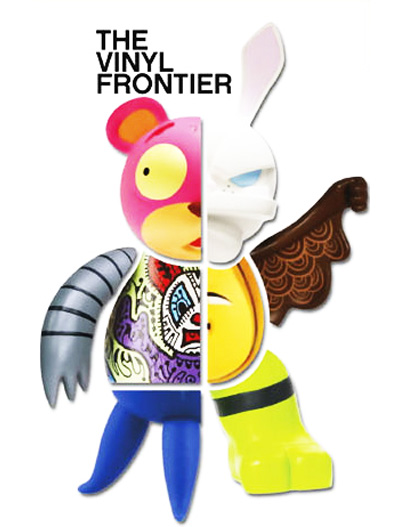
ROLL CALL. Who among our readers has a vinyl toy addiction? We know you’re out there, setting aside monthly Kid Robot allowances, religiously reading JUXTAPOZ, chuckling appreciatively at the inclusion of a Nathan Jurevicius figurine in Splice, etc.
You’ll be interested to know about an independent feature film exploring the American vinyl toy movement, its creators and collectors, called The Vinyl Frontier. Directed by Daniel Zana, it’s the first comprehensive documentary on the subject. Via Spread Art Culture:
Brilliantly shot on location [over the course of several years] in studios, homes, convention centers, and offices around the country, The Vinyl Frontier is sure to be a favorite in this year’s festival season. Featuring such heavy hitters as Tristan Eaton, Ron English, Gary Baseman, Dalek, Frank Kozik, Tim Biskup, and many more.
The Vinyl Frontier will be having its world premiere at the San Francisco Frozen Film Festival (July 2-3) at the Roxie Theatre. Tickets are available for Friday, July 2, 8PM (an array of artists involved with the film will be in attendance after screening to take part in an audience Q&A) or Saturday, Jul 03, 9:20 PM.