Andreas Hykade’s frenetic short film, set to a thumping, grinding soundtrack, is a voyage through the history of animation viewed through a prism of potent hallucinogens. Part of the the 6th annual NFB Online film contest from The National Film Board of Canada, in association with the Cannes Short Film Corner, it’s disturbingly hypnotic and I’ve watched it through two or three times this afternoon, in the grip of a powerful stupor.
For your consideration: Alexandre DUBOSC‘s short stop-motion filmFood About You — to celebrate the 50th anniversary of the Annecy film festival — in which a chocolate cake is made in the traditional manner.
And so another week comes to an end. Time to wrap up those last few loose ends in your in-box and head home for crazy a weekend of amphetamine-fueled debauchery. I mean, it’s Mother’s Day this weekend and all… No? Well, maybe just a weekend of yard work and staid outdoor activities like barbecue and bocce. Pro Tip: a few uppers could enhance said activities. Just sayin’. What? Don’t give me that look. You think you’re better than me? I will cut you! God, why is it so hot in here.
Whew, ok, let’s all just take a deep breath and try to discuss today’s FAM while ignoring the sounds of grinding teeth. Today’s film, no doubt soon to be yanked from YouTube, is Dark Days the documentary by British filmmaker Marc Singer from 2000. It follows a group of homeless people who make their homes in the abandoned subway tunnels beneath New York City, specifically The Freedom Tunnel under Riverside Park. His first film, Singer made Dark Days after moving to New York and making friends with number of the people who made up the Freedom Tunnel community.
For my part I found Dark Days by way of journalist Jennifer Toth — another British immigrant, coincidentally — whose book The Mole People: Life in the Tunnels Beneath New York City Mr. Singer may have read as well. Published in 1993, it is perhaps the best known book on the subject, and also happens to feature residents of The Freedom Tunnel. It’s an engrossing read and has perhaps done the most to fuel the urban myths of organized, underground tribes of homeless. This is no doubt due to the sensationalistic nature of Toth’s account, much of it relying on unverifiable claims. Her credibility was not helped by what turned out to be a laundry list of geographical inaccuracies relating to almost every location she describes.
Surely then, Singer’s film does a better job of showing the reality of the situation. Despite the hip-hop aspirations that coat every surface — from the preoccupation with graffiti to the DJ Shadow soundtrack — the focus is decidedly on the individuals who make up this small community; shot in stark, grainy black and white that perfectly suits the subject matter. It’s a story simultaneously bleak and heartwarming. Such is the nature of all stories that are true.
In an effort to flesh out its library, today the FAM presents Un Chien Andalou (An Andalusian Dog), the 1928 film by surrealists Luis Buñuel and Salvador Dalí and the quintessential “art film”. Most famous for its opening scene, in which a man, played by Buñuel, slices open the eye of a woman with a straight razor, Un Chien Andalou is an almost perfect summation of the Surrealist movement. Things happen in Un Chien Andalou, their relationship to one another dictated by the logic of dreams. Scenes lurch violently along in time and characters exhibit a confusing, rapid-fire succession of emotions. It’s a movie that is open to a vast range of interpretations, and in true Surrealist form Buñuel rejected every one of them, stating, “Nothing, in the film, symbolizes anything. The only method of investigation of the symbols would be, perhaps, psychoanalysis.”
Despite the director’s expectations — they supposedly attended the premier with pockets full of rocks should a horrified audience become violent — the film was well received. In a sad twist, both of the leading actors of the film eventually committed suicide. Pierre Batcheff overdosed on Veronal in a hotel in Paris in 1932, and Simone Mareuil doused herself in gasoline and burned herself to death in a public square in Périgueux, Dordogne in 1954. In the ensuing years since its debut Un Chien Andalou has been recognized as a seminal moment in the history of cinema, a staple of any film buff’s diet. Now the FAM can rest easy, knowing that there is at least some modicum of credibility found herein should it be placed under the glaring eye of some future, internet historian.
Just in time to put you off your lunch, the Friday Afternoon arrives with 2009’s Food Inc, the scathing documentary/critique of America’s food industry. Directed by Robert Kenner and co-produced by Fast Food Nation author Eric Schlosser, Food Inc is of the variety that both infuriates and terrifies in equal measure. It must be pointed out, however, that if you are already up on the subject matter, or have already read Fast Food Nation, there isn’t a whole lot that is new here. Still, for those uninitiated in the horrific practices of companies like Monsanto and Tyson it can be an eye-opening experience.
Recently, it was shown on PBS for their POV segment — it can be viewed on their website until this coming Thursday, should the YouTube version get pulled — and was followed with the delightfully Lynchian Notes on Milk (Click that link to watch. Do it!) a short film looking at the rise of milk in America.
So get to watching, dear readers, and get a better picture of the horrible stuff we put into our bodies everyday. In the meantime I’ll get back to my Big Mac, because nothing tastes quite like Creutzfeldt–Jakob.
Update: Reader rbk points out that PBS is not viewable in America’s hat, Canadia. Therefore, filthy Canucks should go here.
Kim Beaton and her digitigrade leg extensions. Photo by Dionwrbear.
The booming film industry here in Wellington, New Zealand (a.k.a “Wellywood“) has attracted phenomenal talent from all over the world. Creatives come from as far away as Los Angeles, London, Johannesburg, Vancouver and Tokyo to work on films like District 9, Avatar, and the LotR series. One such transplant is Kim Beaton, a multi-talented artist/inventor from Seattle who was recently hired by Weta Workshop to do conceptual design work on the upcoming Hobbit films.
Kim is a vibrant, intensely focused person who always seems happiest when she has multiple projects in development: large scale sculptures, community arts outreach programs, armor design and production, you name it! She’s also an accomplished inventor. In fact, many of you may already be familiar with one of her patents– last summer, two YouTube videos were posted of Kim striding through downtown Seattle in a pair of startling, stilt-like “reverse leg” extensions. The clips quickly went viral.
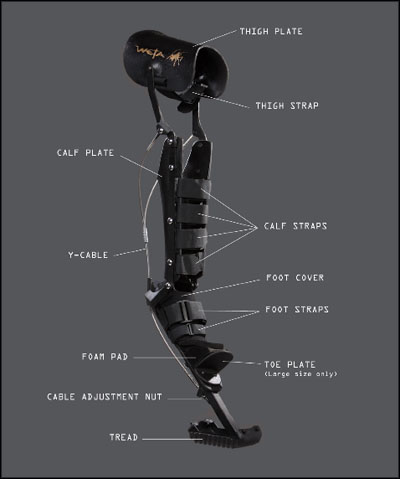
Upon arriving here, Kim was encouraged by Richard Taylor (5-time Academy Award winner and co-owner/co-director of the Weta Companies) to continue honing the digilegs’ design in the workshop. After several months of development and fine-tuning, the company is selling Kim’s professional design, now christened Weta Legs, for $945 U.S. dollars a pair. From the official site: “Weta has made many pairs of digitigrade leg extensions in the past for stunt men and creature performers in the movies and on the stage, but this is the first time we can offer [this] leg to anyone.” In fact, it’s the first time any company has put a line of digilegs into mainstream production.
A heads up to performers, costumers, burners, party monsters, cosplayers, designers and filmmakers– this is big. I’ve had the opportunity to test Kim’s prototype myself. They’re incredible. They’re comfortable. They’re FUN. I mean, really, really fun. Watch this instructional video (featuring Kim and a woman who has never been in stilts or extensions of any kind before in her life) to hear and see a bit about why her particular adaptation of the digitigrade concept is so unique and easy to acclimate to wearing.
As far as I know, there’s nothing else remotely like them available on the market. It’s very exciting news for Kim, for her company, and best of all, for all of the non film industry folks out there who can finally own a pair of these. Recently, Kim spoke with me at length about the history of digilegs, as well as her past community collaborations and several other upcoming personal projects. I hope you’ll enjoy getting to know this incredible woman and her work as much as I have.
Please describe the Weta Legs. What sets your invention apart from other kinds of stilts or leg extensions?
They have been called the Holy Grail of costuming. How do you build a device that will give a person the backward leg of a dog or horse? They are referred to by all sorts of names: digilegs, digitigrades, faun legs…
What does digitigrade mean?
A digitigrade is an animal that stands or walks on its digits, or toes. But this is not easy to say unless you like tongue twisters, so it was shortened to “digileg”. They’ve also been called “dog legs” or “reverse stilts”. Originally, we called them leg extensions, because they’re not really stilts, but we want to give them one name that is pretty easy to say. Hence, Weta Legs.
One mustn’t get too put out by who one’s friends choose to play with.
So goes the story of Ian Worrel’s short animated film, Second Wind featuring an old man and his giant feline traveling companion. It’s a beautiful six minutes, rife with expressive animation and a haunting score. Just the thing to perk up a boring Wednesday afternoon.
The act of “sweding” a movie — creating an amateur version of a feature film — was coined by Michel Gondry in his film Be Kind Rewind and it is something that you may have seen popping up on the internet in the film’s wake. I can assure you that you have not seen anything approaching the surreal sensibilities of this version of Blade Runner filmed by “The Dokkoi Company”. Beginning simply with the words “2026. The Replicant ran away. The Bladerunner chases it.” what follows is a crazed, whirlwind tour of Ridley Scott’s film, replete with a strangely evocative score that sounds like it was created using kazoos, a toy car hanging from string, and the copious use of crude, paper masks. It’s a tour de force of interpretive reenactment, and they even went so far as to create a version for the more recent Final Cut. Worth it for the penultimate rooftop scene alone; not unlike the film it apes.
There can be no doubt that the fine folks at The Asylum are fans of the special breed of 50s era science fiction; an era in which the mysterious atom reigned supreme. So intrinsic to the conclusion of WWII, viagra a symbol of American dominance and ingenuity, healing and a portent of The Future the atom was also viewed with fear, and whole oeuvres were built around the concept of atomic energy run amok, creating vast, horrifying menageries of over-sized, irradiated monsters. What else but fanatical love for this bygone age could explain the existence of films like Mega Shark Vs. Giant Octopus or the soon to be classic Mega Piranha starring former pop icon Tiffany and former Brady Buncher Barry Williams? How else would one explain the decidedly sub-par visual effects except as a desire to retain the essence of those films? This, dear readers, is devotion. This is love. Now to patiently await the remake of Them!.
The Floria Sigismondi wet dream that is iamaiwhoami (Jonna Lee?) has finally taken the next step in her personal YouTube evolution, from feral avant garde video antihero to fully-fledged electro chanteuse, and she is lovely.
It’s fairly straightforward –albeit spooky– electronica. The song’s driving melody is even a bit reminiscent of those daffy chugging synths Limahl used for the Neverending Story theme song, with an added dash of Deep Breakfast. And yet? “o” is putting the same loamy glow in my bones that initial exposure to Goldfrapp, Julia Frodahl, Karin Dreijer Andersson, Björk, Julee Cruise and female surrealists like Dorothea Tanning and Leonora Carrington once did. I remain intrigued as ever.