Earlier this summer, Warren Ellis (yes, that one guy we reference every ten minutes on COILHOUSE, shaddup) posted some cogent thoughts on what he describes as the end of “The Patchwork Years” on the internet: “Nobody needs another linkblog… There are already thousands of them. The job of curation is being taken care of. Look ahead.” He’s right. I’m as guilty of rehashing as the next blogger, but yeah. Generally speaking, we could do with far less circle-jerk turd-polishing online.
Paraphrasing the feisty theater renegade Maya Gurantz, those of us in any position to create new media should be baking new bread instead of quibbling over stale crumbs. At the very least, we existing curators should be doing helluva lot more cogitating instead of regurgitating the same tired old ones and zeros. (“Hey dood, check out this awesome link via BoingBoing via Fark via Digg via Shlomo McFluffernutter’s Livejournal feed. Cut, paste, click.”)
More on internet culture’s addiction to shorthand tastemaking at some later date.
Meanwhile, even in these postulated-out, post-patchwork years, it’s still very possible to be galvanized by some vital new curator. Fellow bay area sasspot Whitney Moses emailed me a while back about a blog called Genderfork, run by Sarah Dopp.
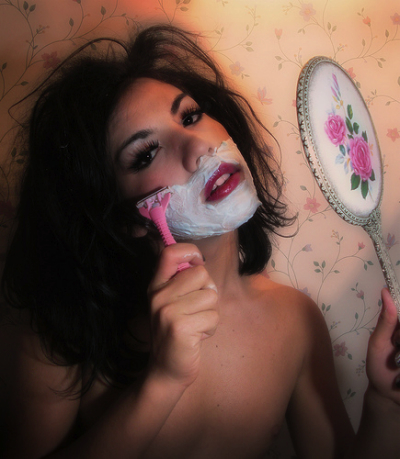
Genderfork is an exploration of androgyny and gender variance through artistic photography and personal essays. Dopp has two personal goals for the project:
To compile all of the genderforking resources, imagery, and ideas that I come across on the web into one beautiful repository. I want to experience a sense of cohesion with these concepts — they all too often feel scattered and disparate.
To encourage a conversation around the grey areas of gender with friends, with strangers, and with strangers who need to become friends.
…because I think we can all agree: Gender is a loaded word.
Loaded, and how. That’s why complex arguments revolving around gay marriage and partnership rights can become so volatile so quickly, and why debate rages endlessly on between gender-abolitionist feminists and their less radical sisters. It’s why surprisingly empathetic reportage on 20/20 examining the lives of transgender children feels like a huge victory, and why my co-editors and I fought tooth and nail to find a way to publish Siege’s Neogender piece in Coilhouse Issue 01, if only in a limited capacity.
MTV was once amazing! Not to go there or anything, but what I miss most are the cartoons. Aeon Flux, The Maxx, Liquid Television (Nietzsche Pops!), and yes, even Beavis and Butthead had its moments (like when they watch the music video for Bull in the Heather and think that Kathleen Hanna is a 5-year-old who can’t dance). But the show that came back to haunt me this year? Daria. Smart as a whip and cynical as a roomful of reporters, Daria “misery chick” Morgendorfer was my age when the show first aired, and quickly became my hero. Recently, I decided to revisit the show now that 10 years have passed, and happily found that it’s as funny and true now as it was back then.
This time around, my favorite characters aren’t Daria and her artsy sidekick Jane, but the adults. Hands-down, my favorite character is Mr. DeMartino, the Chrisopher Walken-inspired history teacher with some anger-management issues and a serious gambling problem. A classic example of DeMartino’s temperament can be seen in early on in Fizz Ed, an episode in which the school runs out of budget and seeks sponsorship from a cola company. Then there’s Helen – Daria’s workaholic lawyer mom, whose parenting techniques backfire terribly but hit the mark when it matters.
Until the music liscencing issues get worked out, the show survives only in bootlegs. In the meantime, the legend lives on; if the obsessiveness/slash quotient of the fan art is any measure of a work’s impact, then Daria rivals Harry Potter. Actually, the show itself presented a myriad of character alter egos at the end of every episode during the credits. Every week, familiar denizens of the Daria-verse transformed into R. Crumb characters, historical figures, athletes, dinosaurs and canned vegetables. Amidst her turns as Mother Goose and Bella Abzug, Daria was sometimes shown in a more realistic context: a journalist, an author, a talk show host. Watching the credits roll, I always wondered: what will happen to Daria when she leaves high school? Is life really better after that? What will she be? What will I be? Now, I kinda know.
If you can’t judge a magazine by its cover, it’s not doing its job. This month, major magazines work hard for the money:
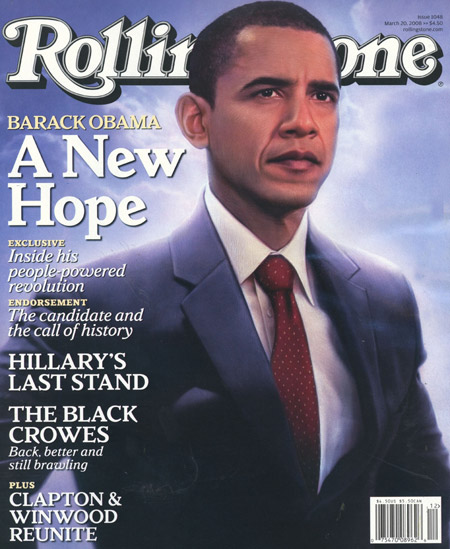
Rolling Stone released a very iconic Barack Obama cover. Just him and his flag pin. No name, no slogan and no eye contact. Pure faith and devotion. Compare to their last Obama cover, which made him look like a wax dummy of a superhero.
Again Obama, this time as an illustrated character on the cover of The New Yorker, sporting his Al-Qaeda gear and giving his sidekick, Angela Davis Michelle, the fearsome terrorist fist jab. The best comment on the controversy surrounding this cover comes from Gawker: “this obvious and heavy-handed satire has enraged Democrats and liberal media critics because now they are pretty sure this nation of child-like imbeciles will believe it to be an un-retouched photograph from the FUTURE.”
Predictably, this cover of Psychology Today caught my eye. Some nice use of type, but guess what? She’s wearing the corset backwards. How could something like be allowed to happen in 2008?
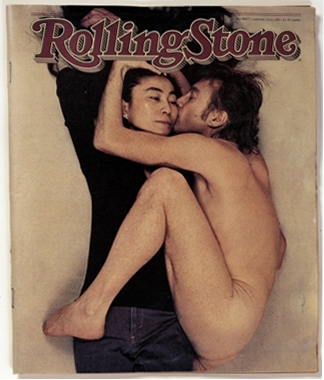
See, we’ve been thinking about magazine covers a lot over the past few months. Deciding together as a group on the cover of Coilhouse Issue 1 was a very intensive process. That decision’s been made, but to help myself think about what makes for a good cover in the future, I’ve started compiling a personal list of favorite covers, which I now share with you. I’ve excluded the undisputed heavyweight champions (John Lennon and Yoko Ono, Andy Warhol in a Campbell’s Soup Can, etc.) from my list. It’s going to be a Top 9, with the first 3 being posted today as part of a series. Enjoy!
This cover of Russia! Magazine is sexy, sexy, sexy. It’s also a cheeky remix of a controversial banned photograph titled An Era of Mercy. Two of Russia’s top male models were employed for this shoot, with real spacesuits on loan from the Memorial Museum of Cosmonautics. The hip new Russian culture magazine also does a great job with its cover lines: Issue 2 has a bear dancing with Marilyn Monroe on the cover and entices you with the promise of “Eight More Bears Inside.”
While it’s my sincere hope that the wondrous Coilhouse Gushfest: Getting to Know You continues unabated, I can’t keep sitting on my hands with this one. Grace Jones has just released a new video for “Corporate Cannibal”, the first single off her forthcoming album, Hurricane (which features collaboration with Tricky, Brian Eno, and others). May Day is more heart-stoppingly badass than ever before:
Rawr. As previously mentioned on CH, Ms. Jones is my choice for It Girl of the 80s. Hell, let’s make her It Girl for ’08, as well. She’s sixty, she’s sexy, she’s scary as hell, and we should all bow before her fabulousness.
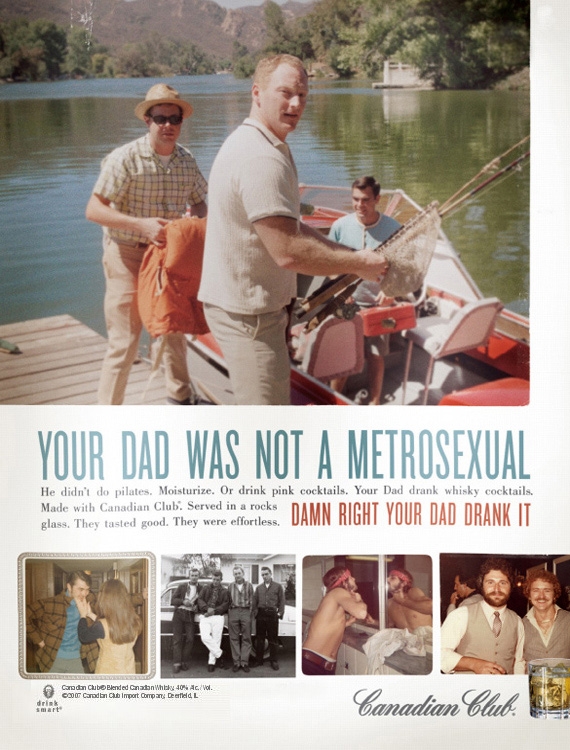
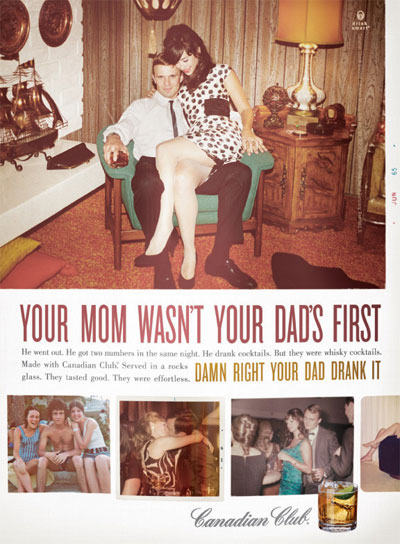
It all started when Energy BBDO created the “Damn Right” ad campaign below for Canadian Club Whiskey. The ads featured vintage photographs from the 60s and 70s, with the running slogan “Damn Right Your Dad Drank It.” The headlines were “Your dad was not a metrosexual,” “Your dad had a van for a reason,” “Your mom wasn’t your dad’s first,” and “Your dad never tweezed anything.” The press release for this campaign proclaimed that “the thought-provoking campaign challenges consumers to embrace their dads [sic] classic masculinity, most visibly expressed through their choice to drink Canadian Club whisky cocktails.” Some choice copy:
Your Dad Was Not a Metrosexual. He didn’t do pilates. Moisturize. Or drink pink cocktails. Your dad drank whiskey cocktails. Made with Canadian Club. Served in a rocks glass. They tasted good. They were effortless. DAMN RIGHT YOUR DAD DRANK IT.
But the people weren’t havin’ it. The first thing that was pointed out on many blogs when this campaign launched is how “Your dad wasn’t your mom’s first” wouldn’t have quite the same ring to it. Graffiti appeared on the Van poster: “and that’s why your mom left him.” And the parodies of the nostalgic views of masculinity poured in… “Your dad didn’t use condoms when he was in Saigon.” “Your Dad smoked while pumping gas.” “Dad didn’t call it ‘Date Rape,’ it was just a ‘Date’.”
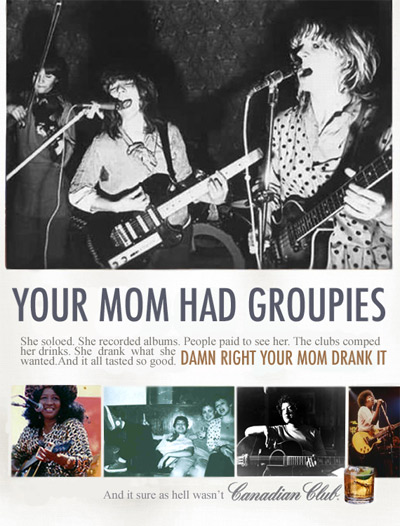
But the best was when blogger Michelle Schwartz created this template, which let people really go to town, resulting in the ads below and in many more here. The revised taglines proclaimed, “Damn right your mom drank it! And it sure as hell wasn’t Canadian Club.”
I love the fact that the web lets us respond to advertising so actively and directly. It was definitely amusing and somewhat therapeutic to see these responses emerge. Paradoxically, they probably made this campaign more successful in terms of branding/awareness than ever projected. So victory is bittersweet – unlike the drink, which will forever taste rotten to me.
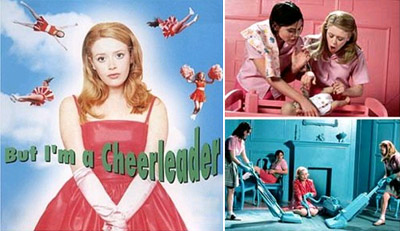
Brothers and sisters, I have a terrible confession; I was once A GAY. Lord have mercy! Lucikly, my parents had the good sense to ship me off to Love in Action, an ex-gay recovery camp for teens in Memphis, Tennesse. I learned many things at this camp; that homosexuality doesn’t exist, that men with bios like this and this make great mentors for kids, and that a 4-week course called WIVES’ TRACK can change your life forever. The reason I’m telling you all this is because I recently re-watched the 2000 film But I’m a Cheerleader and I was outraged. Outraged! How dare they ridicule something as holy as conversion therapy?
The entire cast is going straight to Hell: RuPaul (as camp counselor, completely out of drag), Clea Duvall (thou shall not tempt me!), Mink Stole, Natasha Lyone (damned since ’86 for appearing in Pee-Wee’s Playhouse), Bud Cort (Harold from Harold and Maude – here in a dad role, and I can’t believe how much he’s aged), and all the rest of them. Inspired by that filthy pervert John Waters, the film’s mockery of gender identity and the sacred institution of marriage is unforgivable.
The team that created this film has a new film out called Itty Bitty Titty Comittee. Lord Jesus, it hurt to even type that! As soon as I get the chance to see this one, expect an angry write-up. In the meantime, I urge you all to focus your anger at Singapore for frowning upon cosmetic products that promote Our Lord. For shame!
I never thought I’d ever see my two favorite music scenes, riot grrrl and industrial, intersect more than than when I saw Bonfire Madigan open for Laibach in 2004. There she was, pink hair in pigtails and stripey socks and her screeching cello, with ominous black banners of gear-contained NSK crosses hanging on either side. But that very special industrial-meets-riot-grrrl moment was matched (if not surpassed) when I received a link from a group called Experiment Haywire this morning:
Does that sound like Kathleen Hanna’s long-lost EBM project or what? It’s not polished, but neither was riot grrrl, and that’s exactly what made it charming. The musician behind Experiment Haywire, Rachel, has also started a record label called machineKUNT. While I’m not crazy about the name (I just hate that spelling! I hate it!), the idea is great. Their first release, a compilation called “Extreme Women from the Dark Future,” features various female EBM musicians. It’s a nice contrast the dumb, misogynistic “Shut Up and Swallow” bullshit of bands like Combichrist.
The idea of women in industrial music isn’t new; they were there from the very beginning. Most female EBM musicians who came before, such as Shikhee from Android Lust, deliberately made their gender a non-issue in interviews. That was a powerful and positive statement of a different sort, but it’s interesting to see someone, perhaps for the first time, make gender the primary focus of their industrial/EBM project.
And just because I love it, since we’re on the topic of riot grrrl, here are Jem and the Holograms performing Le Tigre’s Deceptacon:
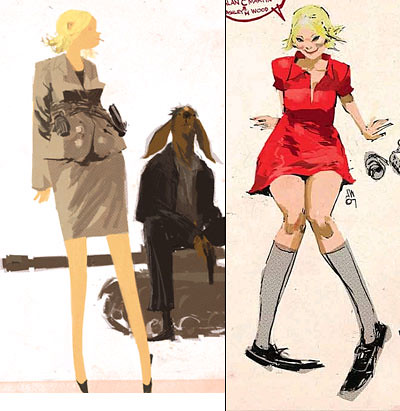
That was the Tank Girl of the 90s, the one I fell in love with. We didn’t hear from her for over a decade, but this year she re-emerged in The Gifting, a new series by Alan Martin (the original creator) and illustrator Ashley Wood. What does the Tank Girl of 2007 look like? Alan Martin had the following to say:
Here’s the emerging new look for Tank Girl. We were concerned that she didn’t make her re-appearance in the same, tired old clothes that she bowed out in some twelve years ago. What was alternative, upsetting, anarchic, and just plain odd-ball back then has since become common place. Mainstream media smothers us daily with punky chic, and modern day babies can be seen sporting spikey hairdos and Travis Bickle T-shirts. The uniform of the cultural revolutionary has been sold to The Man. So how to rebel? How give the finger to the fashion fascists? Normal is the only way ahead. Dress like a high school teacher from the mid-eighties, or pick clothes from your boring aunty’s wardrobe. The only way left to rebel is to dress like you’re not rebelling. We hope to bring a whole different flavour to Tank Girl, as she borrows ideas from past cultural reference points (Fay Dunaway in Bonnie & Clyde, anyone?).
I’ll come out and say it: I love Ashley Wood’s amazing drawing style, but the new Tank Girl look doesn’t really do it for me. Maybe I’m being way too nostalgic, but it’s also possible that what I’m reacting to is the idea that so many people have decided to rebel by not-trying-to-look-rebellious that it’s starting to look like an easy way out of any real effort. I’m not saying that to undermine Martin’s very important message (see our Hot Topic Rebranding post), but it may be possible that so many people have caught onto the “rebel by looking normal” notion, and so many are using it to lazily avoid any attempts at interesting self-expression through clothing, that I’m just hoping that the pendulum swings back to the other side. You know, the side with the band-aids and corrugated tubing and knee pads.
But I guess I should get over it and enjoy the story. Comic book characters change, if it’s a good comic. When Maggie from Love and Rockets gained weight and creator Jaime Hernandez insisted that this was the way that Maggie was meant to be, I thought that was incredibly touching and honest. It’s impossible to keep up a certain look forever, and the story can be just as interesting once that look is gone.
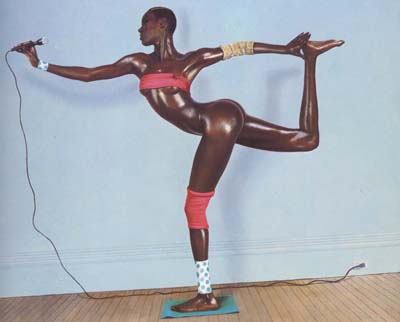
As far as I’m concerned, Grace Jones was the It Girl of the 80s. Her partnerships with Jean-Paul Goude and Keith Haring yielded some of the most iconic, otherworldly images of the decade.
photo by Jean-Paul Goude
She was valorous, donning multiple personas that confronted racial and sexual stereotypes, her “jungle cat” performances lampooning primitivist readings of the black female body in much the same way Josephine Baker‘s send-ups in banana/tusk skirts had half a century earlier. She played a mean accordion, rocked a buzz cut like no other, was witty and elegant, but did not hesitate to smack a bitch when the occasion called for it.
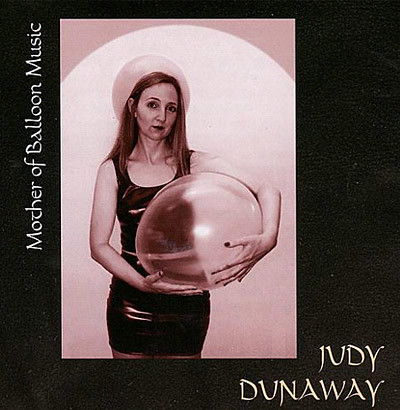
Initially, exposure to composer/performer Judy Dunaway and her “virtuostic balloon-playing” broke my brain. But after the giggle fit subsided, I realized I was genuinely in awe of the woman, for many of the same reasons I’ve long adored Harry Partch, Hans Reichel, Clara Rockmore, and Klaus Nomi. Like them, Dunaway is utterly fearless in her approach to her craft, and unflinching in the face of inevitable backlash from both her classical and avante-garde contemporaries. (It takes ovaries of steel to play Lincoln Center with nothing but an amplified balloon between your knees, ah tell you whut.)
Her Etudes No.1 and 2 for Balloon and Violin (2004) are particular favorites of mine, perhaps because they’re what my own stuffy classical violin instructor would undoubtedly have dismissed as “good musicans behaving unforgivably.” I’m at a loss to accurately describe the music… imagine what an orgy of parasitic wasps being slowly pressed to death between two lubricated sheets of mylar might sound like. New York Press writer Kenneth Goldsmith likened Dunaway’s live performances to witnessing “Cab Calloway in Munchkinland… Olivier Messiaen on helium.”
Dunaway’s own statement of purpose is more straightforward:
My own work … does not come out of a void. Creating a large body of work for balloons has allowed me to develop a vocabulary outside the realm of oppressive classical heritage. It has raised the ordinary and mundane to the status of high art. I have fetishized this simple cheap toy in my music, as the violin has been fetishized for centuries by Western European-influenced composers. In an era where the progress toward a woman’s control of her own body is threatened, I have coupled myself to a musical instrument that expresses sensuality, sexuality and humanity without inhibition.