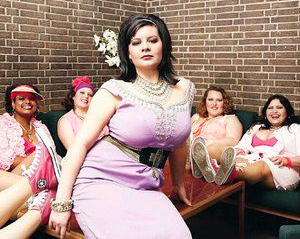
It’s past 1 AM, I’m munching on a buttery, cheesy bruschetta, and listening to Miss Platnum’s “Give Me the Food.” The song has an unusual theme for an R&B tune: a celebration of eating! “I like my coffee with a lot of cream, I like to eat late at night, I like scrambled eggs after a sweet dream, I like potatoes – deep fried,” sings Miss Platnum.
The Romanian-born, German-based singer laughs off dieting: “I don’t care what people say about my weight, so if you want to take me out for a date, make sure there is enough food on my plate.” In addition to the great message and fun music video, it’s just a ridiculously catchy song. Miss Platnum’s powerful voice and witty delivery instantly make their way to the heart, even if you (like me) generally don’t listen to R&B. Watch the video, after the jump. Via Gala Darling.
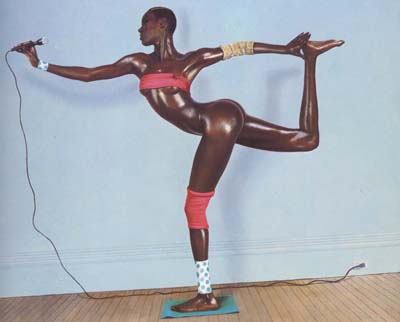
As far as I’m concerned, Grace Jones was the It Girl of the 80s. Her partnerships with Jean-Paul Goude and Keith Haring yielded some of the most iconic, otherworldly images of the decade.
photo by Jean-Paul Goude
She was valorous, donning multiple personas that confronted racial and sexual stereotypes, her “jungle cat” performances lampooning primitivist readings of the black female body in much the same way Josephine Baker‘s send-ups in banana/tusk skirts had half a century earlier. She played a mean accordion, rocked a buzz cut like no other, was witty and elegant, but did not hesitate to smack a bitch when the occasion called for it.
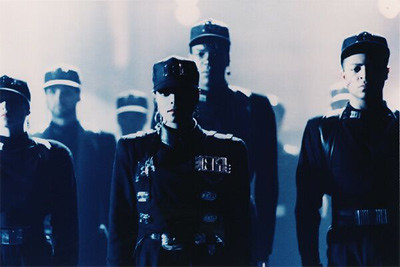
I didn’t even know there was such a thing as industrial music when I stumbled onto Janet’s Rhythm Nation 1814 film in my pre-teens, but I knew that I’d made a very important discovery. Later there would be the mix tapes and the radio shows that exposed me to my favorite music in its true form, but until then, isolated in suburbia and still learning English, Janet’s video was my first glimpse into the aesthetics of my favorite musical genre.
Having re-watched Rhythm Nation today, I have come to a very important conclusion: Janet Jackson is even more ÜBER than I initially thought. Here’s why:
The uniforms! God, the uniforms. Those gloves with the riveted metallic plates? Hot.
“We are a nation with no geographic boundaries, bound together by our beliefs.” NSK State, anyone? Laibach, take note: Janet beat you to it by 4 years.
The entire clip takes place in a steamy factory that recalls Test Dept’s Total State Machine.
Despite the strong percussion and electronic elements, I’d be pushing it if I claimed that this awesome song was industrial. But you know what? Janet created this socially-conscious record on her terms, in the face of a record company pressuring her to only sing about love and relationships. Who knows what this could have been, had there not been that pressure at all?
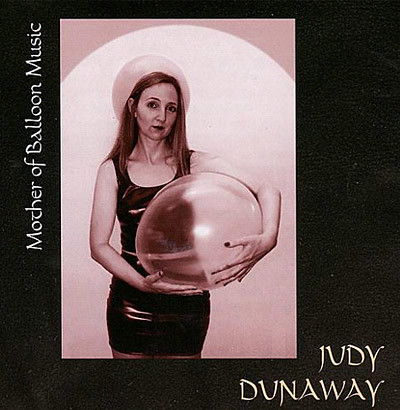
Initially, exposure to composer/performer Judy Dunaway and her “virtuostic balloon-playing” broke my brain. But after the giggle fit subsided, I realized I was genuinely in awe of the woman, for many of the same reasons I’ve long adored Harry Partch, Hans Reichel, Clara Rockmore, and Klaus Nomi. Like them, Dunaway is utterly fearless in her approach to her craft, and unflinching in the face of inevitable backlash from both her classical and avante-garde contemporaries. (It takes ovaries of steel to play Lincoln Center with nothing but an amplified balloon between your knees, ah tell you whut.)
Her Etudes No.1 and 2 for Balloon and Violin (2004) are particular favorites of mine, perhaps because they’re what my own stuffy classical violin instructor would undoubtedly have dismissed as “good musicans behaving unforgivably.” I’m at a loss to accurately describe the music… imagine what an orgy of parasitic wasps being slowly pressed to death between two lubricated sheets of mylar might sound like. New York Press writer Kenneth Goldsmith likened Dunaway’s live performances to witnessing “Cab Calloway in Munchkinland… Olivier Messiaen on helium.”
Dunaway’s own statement of purpose is more straightforward:
My own work … does not come out of a void. Creating a large body of work for balloons has allowed me to develop a vocabulary outside the realm of oppressive classical heritage. It has raised the ordinary and mundane to the status of high art. I have fetishized this simple cheap toy in my music, as the violin has been fetishized for centuries by Western European-influenced composers. In an era where the progress toward a woman’s control of her own body is threatened, I have coupled myself to a musical instrument that expresses sensuality, sexuality and humanity without inhibition.
Musician/filmmaker Joshua Zucker is one of very few folks whose tastes I trust implicitly. Episode 13 of his thematic Roadside Picnic podcast just went up. As always, it’s an astonishing mix of sounds and genres, lovingly and seamlessly compiled. Put on your best pair of headphones, and drift.
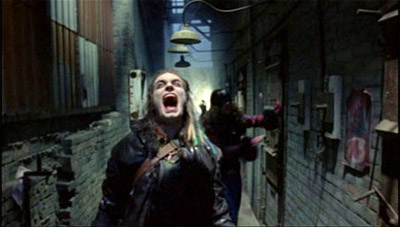
Yes, you read that headline correctly. The Bloody Digusting News website reports: “last night at the 2007 Scream Awards Paris Hilton was nearly booed off the stage once again, but by the time they finished showing the first ever footage from Darren Bousman’s Repo! The Genetic Opera all of the boos had turned into cheers.” This rock opera about organ repossession takes us to the year 2056, in which a worldwide epidemic causes organ failure on a massive scale, enabling a biotech firm called GeneCo to begin renting out genetically-perfect organs to those who can afford them. The nature of the program is similar to a car lease, and the firm sends out a repo man if the recipient can’t make payments. In addition to Paris Hilton and Nivek Ogre, other talents involved in the project, on and off the screen, include singer Poe, Daniel Ash from Bauhaus, Yoshiki Hayashi from X Japan, Bill Mosely and Sarah Brightman. Ogre plays Pavi, the younger son of the evil mastermind behind GeneCO, and Hilton is cast as Amber Sweet, a “sexy aspiring opera diva and scalpel-slut will stop at nothing to get her moment in the spotlight.” Is this to be the Rocky Horror Picture Show of our generation? I sure hope so!
The brilliant songwriter was fond of slathering himself in various forms of goop and leaping into his audiences, as well as “playing instruments with his head”, but apparently the world just wasn’t ready for that sort of thing back in 1982. Despite being a huge influence on later luminaries of the gothic/industrial movement, Fad Gadget remains relatively obscure.
Photo via Ben Heaney over at http://www.digitalviolin.com.
This was originally a guest-blog written several years ago at the request of my dear friend Warren Ellis, for Die Puny Humans (may it rest in peace). Now with visual aids!
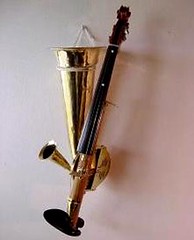
I have a new beau. Well, not so new. He’s probably quite a bit older than I am, actually. A big, brass Stroh violin, aka a phono-fiddle:
Photo via Ben Heaney over at http://www.digitalviolin.com.
The phono-fiddle is much louder than a conventional violin, but its timbre is thinner, with eerie phonographic overtones. Vibrations from the strings are conducted to the center of an aluminum disc that acts as a diaphragm (like a very old-fashioned amp), propelling the sound back out through the large horn and smaller ear trumpet.
Sometimes, the Stroh sounds like a human voice playing through a hand-cranked Victrola. Other times it sounds like a tenor saxophone gargling a cat…
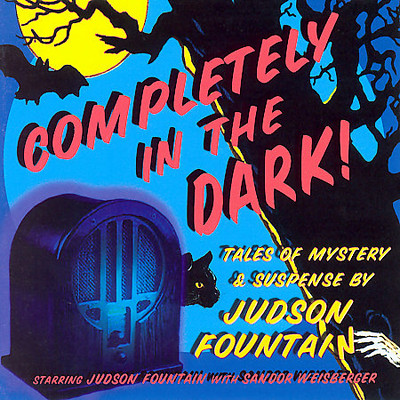
Much like cult legends Shooby Taylor, Lucia Pamela and Gary Wilson, Fountain’s warped genius would not have survived these long decades were it not for the feverish worship of bootleggers. By the time his priceless “radio drammers” were officially released on CD in 2004, Fountain had long-since gained icon status among lovers of outsider music, cartoonists, and (somewhat redundantly) WFMU DJs and listeners.
Judson Fountain (b. 1952) grew up after the heyday of classic radio theater, but as a child heard vestiges of programs that had enthralled his parents. He developed an obsession with suspense-filled shows like The Shadow, Inner Sanctum, and Lights Out! While most Americans were evolving into couch potatoes, Judson embraced radio as the superior theatrical medium, and felt compelled to single-handedly revive the art. That he lacked training, technology, skilled staff and a budget did not deter him. Ed Wood, Jr. made movies; Judson produced radio dramas.
Judson was between 17 and 22 when he produced these extremely primitive affairs. His simple, derivative plotlines employ Halloween kitsch — spooks, witches, haunted houses — as vehicles in morality plays about redemption for the honorable and damnation for evil-doers. The original recordings were pressed on LPs (reportedly about 200 copies of each). The jackets were hand-made, with grainy xeroxes pasted on otherwise blank cardboard sleeves.
Their limited edition CD (produced by foremost outsider musicologist Irwin Chusid and Barbara Economon) is itself growing difficult to score. But you can still grab the tracks off emusic, bless ’em.
Honestly, I hadn’t been missing NYC at all since I moved out west last May. Then the autumn equinox hit. Ever since, I’ve been aching to take a long bike ride through the fiery foliage of Prospect Park.
Gordon and Morrison previously worked together on Morrison’s full length movie Decasia. Both pieces build around a very simple premise; film is a fragile medium. Nearly all of that old nitrate-based film stock is too grimy and scratched, rotting and stinking of vinegar to be of much use to film preservationists. Morrison salvaged 70 minutes of archival footage from someone’s rubbish bin, stitched it together and re-shot film that showed decay or was actively decaying, frame-by-frame, using an optical printer.
The cumulative effect is breathtaking, and for reasons that are difficult to articulate, will always remind me of New York in the fall.