Hey, can we all pool our resources and send fresh bouquets of snapdragons n’ dafferdillies to British ballet choreographer Frederick Ashton every day for the rest of his life? Seriously:
Piggy pas de deux! Jemima Puddle-Duck on pointe!
Must. Stop. Squealing.
The original film version of Tales of Beatrix Potter, shot in 1971, has twice been staged by the Royal Ballet, once in 1992, and more recently in 2007. The score –arranged and composed by John Lanchbery– delightfully interweaves melodies from old vaudeville ditties with more classical forms. The masks, costumes and production design are all so squee-inducingly adorable as to border on the demented. But it’s the incredible range of expression and dynamicism of Ashton’s choreography that brings beloved characters like Mrs. Tiggy-Winkle, Squirrel Nutkin and Hunca Munca so vibrantly to life. I’d give just about anything to see a production of this at the Royal Opera House. Here’s hoping it comes back sooner than later! Meantime, there are tons of clips to watch online, and a DVD to buy.
There are some days on which I have absolutely no intention of blogging. My mind dessicated, dry and wrung out like an old, disintegrating sponge, the words are simply no longer there. They have abandoned the empty husk which once housed them and have relocated elsewhere, out of my reach and away from the harsh, disapproving gaze of the blinking cursor on my monitor.
This was to be one such day and, indeed, it was until I came across this piece, entitled Fluid, by Clair Morgan. Something about it stuck with me and I kept coming back to it; staring at it. I thought about it on my way home. It’s hard for me to pinpoint just exactly what draws me to it. I suppose it’s the precision of the entire affair. The way the strawberries are hung in neat rows except for those that perfectly follow the trajectory of the fallen crow. The arrangement of the crow itself caught at the point of impact; and the carefully squashed strawberries that accompany its terminus. All these, working in concert create a startling sense of movement; of a moment frozen perfectly in time.
Mommy-Four-Legs by Zoetica, part of the Monster show in LA
Calling all Angel City residents! This Saturday, Corpo Nason gallery in Santa Monica is hosting Monster?, a group art exhibit curated by artist and Issue 01 contributor Travis Louie. The show includes several Coilhouse featured artists and friends. The lineup includes the following:
Travis Louie told Erratic Phenomena that many of the artists he chose for the show come from a background of production design- creators whose work is often not recognized the same way that most people can readily identify fine artists. Louie told EP, “we usually see their names in the closing credits of a motion picture, but don’t really know what they actually did for the film we were watching – or as illustrators, we see their work as book cover illustrations, or in magazines like Rolling Stone, Time, Playboy, etc., but the beauty of what they’ve done is taken for granted.”
As an added bonus, the elusive and legendary Kogi taco truck will be there to represent! You may even receive a sneak glimpse of Issue 03 if you find us at the event (and it will be unveiled on this site sometime in the next 10 days). The reception will go from 8 to 11:30pm. Copro Nason is located at the Bergamot Arts Complex, 2525 Michigan Ave T5, Santa Monica, CA 90404. See you there!
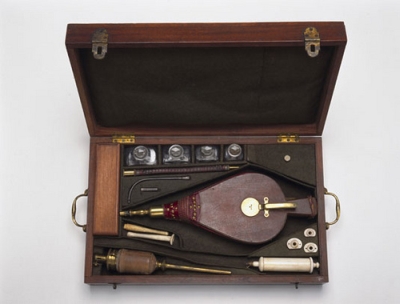
There is, I find, a fascination with outdated methods of medicine. It stems, I think, from a combination of what strikes us now as the humorous ignorance on the part of the medical practitioners of bygone eras and abject terror at the products of said ignorance. Certainly, a quick glance around the web finds a myriad of lists focusing on extremely painful procedures and heinous looking surgical objects meant to cure ailments ranging from appendicitis to hiccups.
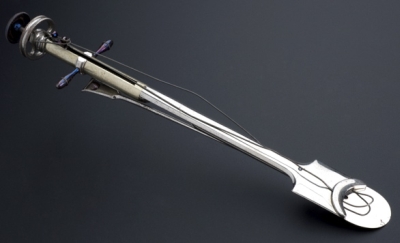
This particular list of “20 Scary Old School Surgical Tools” is no exception and, indeed, it does manage quite handily to fulfill the purpose set forth by its title containing, as it does, a score of surgical instruments of dubious nature and malevolent air. It is rife with miniature scimitars, saws, and horrid contraptions meant only to mutilate and scar as well as less insidious forms of early quackery like the tobacco enema kit pictured above.
The hook here, so to speak, is the sheer brutality these instruments represent. There is no subtlety or delicacy involved; they are meant to create a serviceable opening as quickly as possible so that the doctor could insert their hands inside whatever cavity was their focus. In that regard, it strikes me that, perhaps, the gynecologist’s arsenal remains little changed, a collection of devices used to stretch and pry open their victims as if opening a tin can. Of course, it is also entirely possible that this may merely represent a distinct and grievous misunderstanding of the gynecological craft on my part.
If one were to attend law school one could do a lot worse than New York University. The prestigious institution has a long and storied history. It also has an excellent program which invites well educated law professors from around the world to teach at NYU for a semester. This fall, Thio Li-ann will be teaching a class on human rights. Dr. Li-ann has an impressive résumé with degrees from Cambridge, Harvard, and Oxford. She has served on various law and advisory boards and taught at universities in New Zealand, Australia, and Taiwan. She has written papers on international law and human rights. She has also served in parliament in her home of Singapore where she worked tirelessly to protect the public from sodomy by supporting the continuation of legislation that criminalizes homosexual acts.
That last point seems to have angered some gay and lesbian students, many of whom are members of NYU OUTLaw. The group sent out an email to fellow students drawing attention to statements made by Dr. Li-ann in a speech she gave to Singapore’s Parliament on October 22, 2007 (transcript here; video above) concerning the fate of 377A of Singapore’s penal code which states the following:
Any male person who, in public or private, commits, or abets the commission of, or procures or attempts to procure the commission by any male person of, any act of gross indecency with another male person, shall be punished with imprisonment for a term which may extend to 2 years.
Over the course of her argument Li-ann provides a laundry list of reasons for why this statute must stand and just how its repeal would cause society to collapse into a sweaty pile of diseased, unmarried, sex-crazed perverts who would, presumably, roam the streets raping children and feasting on the flesh of heterosexuals. The scope of her speech is, at times, breathtaking. She argues that homosexuality is a choice and homosexuals can change. She supposes that terms like “sexual orientation” can not only apply to homosexuality but to incest, bestiality, and pedophilia. She is also concerned about health, arguing that sodomy breeds disease with this, astonishing simile: “Anal-penetrative sex is inherently damaging to the body and a misuse of organs, like shoving a straw up your nose to drink.”
She then goes on to provide a handy list of five key steps that supporters of the gay agenda subscribe to in order to push their views and undermine society, one of which looks to lower the age of consent and another which looks to prohibit discrimination based and sexual orientation. These quickly bring her back to, you guessed it, pedophilia; going as far as to quote the “motto” of NAMBLA. She wraps up this particular section with a warning for the ladies:
To slouch back to Sodom is to return to the Bad Old Days in ancient Greece or even China where sex was utterly wild and unrestrained, and homosexuality was considered superior to man-women relations. Women’s groups should note that where homosexuality was celebrated, women were relegated to low social roles; when homosexuality was idealized in Greece, women were objects not partners, who ran homes and bore babies. Back then, whether a man had sex with another man, woman or child was a matter of indifference, like one’s eating preferences. The only relevant category was penetrator and penetrated; sex was not seen as interactive intimacy, but a doing of something to someone. How degrading.
She then goes on to blame the invention of marriage on the Torah, which I find not only ridiculous but highly offensive. One would like to think we’ve progressed far enough to where such antisemitism from an elected official would not be tolerated. It seems that people are still more than willing to blame the world’s ills on the Jews.
NYU has, thus far, not elected to rescind Dr. Li-ann’s invitation to teach, but there are questions that must be asked; the first and foremost of those being whether or not she is qualified to teach a class on human rights, something Cary Nelson, national president of the American Association of University Professors — which has advised NYU on this matter — has doubts: “Academic freedom protects you from retaliation for your extramural remarks, but it does not protect you from being prohibited from teaching in an area where you are not professionally competent […]”
First off, I want to say thank you again to everyone who commented on my home decorating post. I haven’t found time to properly respond to all the helpful comments because I’ve been finalizing the move into that dream apartment I mentioned in the post. What I didn’t mention is that this dream apartment is actually in whole different country. More details on that to come! Incidentally, Mer is also moving to a another country on the other side of the world this summer. Coilhouse will soon be not just international, but TRI-CONTINENTAL. Stay tuned!
In the meantime, a short post about the lost photography of Dima Smelyantsev. Very little is known about him online. What I know of him, I’ve pieced together from what my cousin told me. He was originally from Russia, but lived in New York. He published one book, Untressed. The book contained vulnerable, fetishistic black-and-white portraits of women who had just shaved their heads (though, she notes, Dima himself had long, wild hair). My cousin appeared in the book, though she never signed a release. Sometime later, he died at a relatively young age – his heart just stopped. And with his death, the book gradually disappeared. The only traces remain on used book sites (on Amazon, a lone copy sells for $127) and on the graphic designer’s site. Thanks to the ever-useful Wayback Machine, I was able to find the original publisher’s page for the book, but that’s pretty much it. And that’s a shame, because I really enjoy the photo above. So admire it for what it is – a relic, your only glimpse of something that’s been lost to time.
In the depths of West Virginia a wild man lived amongst the hills and trailers and tar-paper shacks. Fueled by alcohol and possessing a madness born of that place, he made music. He made music about violence and hot dogs; aliens and chickens. And in 2005, not long after being run over by a teenager on an ATV, he died. His name was Hasil Adkins. Some called him Haze.
Julien Nitzberg’s 1993 documentary The Wild World Of Hasil “Haze” Adkins: One Man Band and Inventor of the Hunch is decidedly short, considering the subject matter, and yet it is fitting for a man who took claim for nine thousand songs, many of which are merely seconds long, consisting solely of bestial whoops and screams. He is, perhaps, the epitome of a “cult” musician, little known outside of certain, rigidly defined circles bound in bright lipstick and leopard print, and even then mostly known for having his name dropped by bands like The Cramps. The portrayal here is one of an amiable lunatic, a portrayal which I am unqualified to argue with, knowing as little as I do about the man. Regardless, it is impossible to ignore the dark undertones of his work, perfectly reflected in his surroundings, especially the impromptu brawl between bar patrons at one of his performances. Little doubt is left as to what had inspired him. The man wrote what he knew.
Scarlett Take Manhattan, Molly Crabapple‘s first foray into a full-fledged graphic novel, is out in just two days and is sure to make readers giggle with delight. It’s an audacious prequel to Backstage – a webcomic about seedy vaudevillian adventures set in Victorian New York. And what better way to get the party started than with a bang. A most literal bang, at that – we enter Scarlett’s world as she’s whispering her life story into a beau’s ear while making love. Entirely appropriate for a tale of a woman making her way to the top in a brutal city known for eating its residents alive.
Scarlett Takes Manhattan is a visual delicacy, with detail bursting from every page like yet another fresh-popped bottle of champagne. Molly’s florid style blends with John Leavitt’s writing to reveal 1880s New York’s fleshy underbelly. We peek behind closed doors, over corrupt politician’s shoulders and under ruffled skirts as Leavitt and Crabapple show an uninhibited girl of humble beginnings traipse through manual labor and sex work to become queen of Vaudeville. Sex is celebrated, morality is, surprisingly, maintained and show business gets a new star when the smoke clears.
And now, a special treat our readers! Scarlett Takes Manhattan is peppered with charming Victorian slang. Post your favorite Victorian euphemism in the comments – the sauciest will win a copy of Scarlett autographed by Molly Crabapple.
[Note from the editor: we have a winner! Random Tangent’s reply caught miss Molly’s eye, here it is:
I find ‘buttered bun’ to be much more preferable to ’sloppy seconds’ or ‘cream pie’.
But what kind of brute would refer to a woman’s commodity as ‘crinkum krankum’? That’s messed up.
So if you’re putting Nebuchadnezzar out to grass with a real dirty puzzle, you best mind that you don’t end up having a buttered bun. That dollymop will give you a nasty flap dragon. Once you’ve got a nasty shanker you’d better spend some time in the lock hospital before you knock another botail. It’s not good to go spreading the French disease.
Congratulations and enjoy your signed copy of Scarlett Takes Manhattan!]
Click the jump for two previews of pages from the book, one of them decidedly NOT Safe For Work.
Jimi Hendrix performs “The Star-Spangled Banner” at the Woodstock Festival in upstate New York, 1969. You can hear the bombs, screams and ear-splitting jetfire of Vietnam in that guitar.
At first, I just figured I’d take a minute to mark the occasion of this country’s birth with the above clip of Hendrix’s string/mind/soul-bending rendition of the U.S. National Anthem. It’s been almost exactly 40 years since the footage was shot at Woodstock, during late summer, in the astoundingly eventful year of 1969.
Then I got to thinking a bit more about 1969. Egads, what a dense historical American nerve cluster! Over the course of those twelve months, one seriously heavy, snaking cultural current swept humanity in some exhilarating and alarming directions. Countless aspects of life as we now know it were irrevocably changed, and it all happened overnight.
In a piece written recently for USA Today, cultural anthropologist Jeremy Wallach called 1969 “the apotheosis and decline of the counterculture” and Rob Kirkpatrick, author of 1969: The Year Everything Changedsaid: “I don’t think it’s even debatable. There’s an America before ’69, and an America after ’69.”
To give me and mah feller ‘Merkins something to chew on today besides corn on the cob, here’s a list of just a few of the country’s more momentous occurrences, circa 1969:
The whole world watched, breathless, as the lunar module Eagle landed and Neil Armstrong took his first steps on the Moon. Dr. Denton Cooley successfully implanted the first temporary artificial heart in Texas. Four months after Woodstock, the infamously violent, miserable Altamont Free Concert was held at the Altamont Speedway in northern California, ostensibly bringing an end to the idealistic sixties. In NYC, the Stonewall riots kicked off the modern gay rights movement in the U.S. Members of the Manson Family cult committed the Tate/LaBianca murders, horrifying Los Angeles and goading a prurient media circus. The first message was sent over ARPANET between UCLA and Stanford. L. Ron Hubbard had his organization’s name officially changed to The Church of Scientology, and they started litigating. Confessions of Aleister Crowley: An Autohagiography and the Thoth Tarot Deck were both republished, and Kenneth Anger shot his lesser known –but deeply resonant– film Invocation of My Demon Brother. Barred from reentering the states to hold their planned New York City “Bed-In”, John Lennon and Yoko Ono relocated the event to the Queen Elizabeth Hotel in Quebec, where they recorded “Give Peace a Chance”. Everybody got nekkid in the Broadway muscial production, Hair…
Miniatures have always fascinated me. When I was younger I would save up my weekly allowance in order to purchase detailed plastic models of airplanes and cars which I would wantonly assemble and paint into twisted caricatures of the images featured on the boxes; my desire far outreaching my ability. I remained diligent, however, and eventually I got to the point where I got a job and discovered other things to occupy my time, like crack cocaine and back alley craps games.
My love of miniatures has endured, and I still salivate over the minute details of a well executed model. It is a love that is shared, it seems, considering the rise in popularity of tilt-shift photography, which allows one to turn the entirety of reality into a lilliputian version of itself; and while they are sometimes beautiful, they never quite grab me the same way the real thing does. I think that’s why I like these photos by Slinkachu so much, featuring as they do vignettes comprised of diminutive figures; tiny stories transpiring in a land of giants.