Weekly Ad Uncoiling: eta Travel Irons

I love traveling. I hate ironing. Therefore, I do not, and never will, own a stupid travel iron. Yeah, why don’t I also pack a travel toilet brush and some Toilet Duck and clean my hotel room shitter while I’m on vacation? Irons are for sporadic home use only, and even then, with expletive-filled disdain.

However, these sci-fi movie poster ads for eta travel irons are ridiculously cool. I want to steal them for my own portfolio. I want to hang them in my bedroom. I want to see the movies! It’s Mega-eta vs. Mechagodzilla! Tokyo terrorized by clashing steel behemoths! Monstrous Mega-eta steams through the Japanese capital in search of its robot foe, flattening every Gap store (there are several!) along the way. Irony! The wonderful campaign was created by ad agency Kaspen in Prague (I hate you creative bastards). After the jump, view an updated War Of The Worlds, where an alien armada of irons lays waste to the City Of Light, including an inglorious toppling of the Eiffel Tower. (images via BestAdsOnTV. There’s also a Rome version.)

Art is a Fanaticism that Demands Diplomacy


WWII image taken by Yevgeni Khaldey. Laibach was always present.

Laibach has finally returned to North America for a very short tour. If you’re in Portland or Seattle, I hope you saw them. If you’re in San Francisco, Hollywood, New York or Mexico City, you’re in luck! Click here for tour dates.

There are many reasons why this is my favorite band, and most of them actually don’t have much to do with the music. It’s the stories: weird, fantastical events that surround this band in which art, politics, history, media and human nature intersect in unexpected ways. My favorite Laibach story is this: in 1992, they group established the NSK State, a virtual “state in time.” Citizenship to the NSK State came complete with a very realistic-looking passport, and anyone could apply. Applications could be found at concerts and in the back of certain art books. In 1995, Laibach concluded their NATO tour in besieged Sarajevo. They declared Sarajevo to be NSK territory, so for a brief moment, the NSK State existed in the physical world. During this time, they issued 350 NSK diplomatic passports. What’s remarkable is this: some people were actually able to use these passports to escape occupied Sarajevo. Bosnian passports were not recognized at the borders, but a French soldier who saw the NSK ones let those people through. With their art and performance, Laibach was able to potentially save lives. Compelling – even more so when you consider that their work centers around a deadpan sense of humor.

The music is great too, of course! This entire website was designed while listening to Kapital, and partially inspired by the album’s aesthetic. So, Mildred and I will see you at the LA gig if you’re there. In the meantime, a random assortment of odd Laibach-related links:

On Striped Rights

When I was younger, defining oneself to the outside world as edgy, difficult, different was comparatively easy. There was a pretty straightforward list of symbols and codes in which one could participate or not. Soccer shorts and sneakers meant you were a jock, whether or not you were really interested in playing sports of any kind. Black band t-shirts and a wallet chain meant you were a rocker kid, a badass with an interest in bands with guitars and a disdain for authority. Goth, of course, had the most fun symbols and so many ways to play dress-up. Fishnets, long black skirts regardless of gender, black eyeliner and lipstick, anything made of vinyl, all daringly worn to school where, I now reminisce, nothing was really at stake but one’s own vanity.

You know all of this already. Well, one of my favorite pieces of this code was and has always been the bold black and white striped tights, beloved of alternachicks and goth girls ages 12-32 coast to coast. Any plain black dress and boots ensemble could be made “cool” with a pair of these tights. They were like hipness armor at a vulnerable age when I felt I really needed such a thing. I probably still have my first pair somewhere, full of holes, this pair of tights, this very small thing that made me feel somehow protected from the horror of being mistaken for a slave of dreaded mainstream fashion and therefore boring mainstream thought.

It’s easy to make fun of teenagers. They don’t always get that major fashion brands aren’t purveyors of the new, they’re delimiters of the accepted. Their status as such depends on their continued marketing of themselves as edgy but this is marketing only. If it weren’t the money would dry up and disappear like steam. So I suppose the presence of the Coach advertisements currently papering most of New York amuses me just as much as it makes me feel wistful. The ads feature a close-up shot of a foot, shod in a new $300 Coach black leather Mary Jane style pump, the leg lovingly clad in that familiar black and white striped stocking.

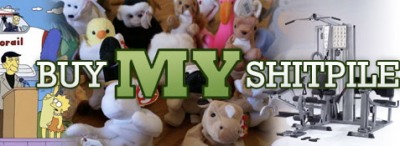
Buy My Shit Pile: The Website


www.buymyshitpile.com

If you’re a halfway sentient and rational human being keeping tabs on the most recent political/financial upheaval in the United States, you’re probably pretty spectacularly depressed right now. I know I am. Thankfully, we’re not quite at this point yet; we can still laugh through our tears. It may be the sick, hopeless laughter of the damned, but hey… whatever gets us through the night.

Fellow gallows bird Kelly Sue just directed me to buymyshitpile.com. The site’s premise is simple:

With our economy in crisis, the US Government is scrambling to rescue our banks by purchasing their “distressed assets”, i.e., assets that no one else wants to buy from them. We figured that instead of protesting this plan, we’d give regular Americans the same opportunity to sell their bad assets to the government. We need your help and you need the Government’s help!

Use the form below to submit bad assets you’d like the government to take off your hands. And remember, when estimating the value of your 1997 limited edition Hanson single CD “MMMbop”, it’s not what you can sell these items for that matters, it’s what you think they are worth. The fact that you think they are worth more than anyone will buy them for is what makes them bad assets.


Recent listing on buymyshitpile.com. “You can own my cat Brent’s furry little balls for $512.87! He isn’t so thrilled about the transaction, but fuel prices have driven cat food’s sky high.”

Notable items listed include “WaMu: $0.01”, “My Liberal Arts Bachelor’s Degree: $20.000”, “The ET Atari 2600 Game: $88.000”, “Nancy Pelosi: $0.75” and “My Dignity: $4,500,00.00”. Truly, this is fiscal responsibility of the highest caliber.

In the coming weeks, whenever I feel like I’m about to crumble under the weight of my own despair, I’ll definitely be visiting/adding to the site, and hopefully selling off my complete run of Hot Dog! children’s magazine for the price it deserves ($156,940.81) in the process.

Mikhail Vrubel and The Demon

The angel bent his gaze severe
Upon the Tempter, eye to eye,
Then joyful soared … to disappear
Into the boundless, shining sky.
The Demon watched the heating wings
Fading triumphantly from sight
And cursed his dreams of better things,
Doomed to defeat, venting his spite
And arrogance in that great curse
Alone in all the universe,
Abandoned, without love or hope

– from The Demon by Mikhail Lermontov

Long ago I promised to return to one of my favorite subjects: madness.  Currently I’m fueled by days of non-stop drawing, surviving on coffee and deviled eggs alone. In other words – the time is right. We’re looking at the madness of prolific Russian painter Mikhail Vrubel. When we left off some months ago, Vrubel was living in Moscow with his beloved wife and son. His massive works in oil, based mostly on Russian folklore, had earned the prolific painter a fair degree of fame and success. The illustrations to Lermontov’s poem The Demon that launched Vrubel’s career receded into the past. Mikhail was working in the theater alongside his wife, painting and designing costumes for her operas, immortalizing the beautiful singer as each of her fairy tale characters. His life was the epitome of creative and family bliss. His new paintings were glowing, as well, due in part to the subject matter and in part to iridescent bronze powder Vrubel mixed into the paint.


The Seated Demon

Nevertheless, Vrubel was compelled to return to the enormous portrait of the Demon. Slowly he began reworking the brooding features, even after the work had been exhibited. Painting thick layers upon layers in an attempt to convey the demon’s pure despair drove Mikhail further away from life, deeper inside himself and his work. The poem’s nihilistic themes seem to have struck the very heart of the artist. Despite his success and marriage, was there a sense of ultimate loneliness permeating Vrubel’s reality? Did the poem reveal a world as he secretly saw it, confirming his latent misery? Was he never genuinely happy, resenting his family life and fame? Perhaps, instead, there was an overwhelming fear of losing what he treasured most, triggered by the loss of his siblings as a child and fermenting inside ever since. Or was it The Demon‘s contempt for the Church that struck a chord? Vrubel’s obsession grew, taking over his body of work and eventually producing a dozen paintings and sculptures dedicated to The Demon. So much paint has been compulsively applied and re-applied that many details of these paintings are nearly indistinguishable, but the Demon’s large, restless eyes and dark features stand out, thoroughly spellbinding. Burning through the viewer, this is Vrubel’s best work, stunning, unhinging and unforgettable.


Details of Demon In Flight and Demon, Downcast

in 1902 Vrubel was briefly hospitalized due to failing emotional and physical health. The Demon had had left him powerless against reality and he was beginning to crumble. Home from the hospital, his health was improving, but recovery was short-lived. Just a year later Savva, Mikhail’s beloved son, died. With grief aggravating an already fragile mind, Vrubel continued his slow decline. He also continued to work, finally abandoning the demon that caused so much agony and returning to portraits and fantasy. I’m particularly fond of this drawing – the concerned visage of the artist’s psychiatrist.
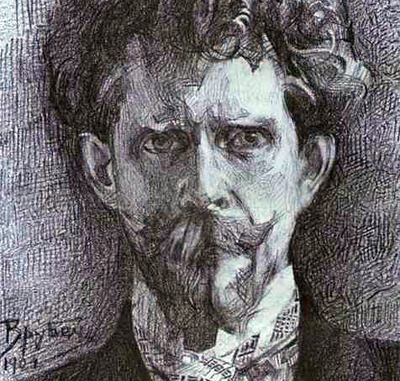

Portrait of Psychiatrist Fiodor Usoltsev

Several years passed until the first signs of every artist’s worst nightmare showed themselves: Vrubel was losing his sight. This was the final blow to his health and spirit. Mikhail Aleksandrovich Vrubel, one of the greatest Russian painters, met his end in the clutches of pneumonia at the age of 54. He purposely made himself sick by standing in cold spring air earlier that year, the Demon, surely, at his side. If you visit Moscow’s Tretyakov gallery, be certain to complete the tour – at end, after halls upon halls of classic Russian art, in Vrubel’s room he waits.

Better than Coffee: “One Step” and 2 Tone

Good morning, rude boys and girls. Just a wee bit o’ Madness to help you start your week off on the right foot…then the left foot… then the right foot…all the way to school:

I’d actually never seen this extra silly extended version of the “One Step Beyond” video before stumbling across it on YouTube recently. Now I’m reveling in a full-on personal 2 Tone revival. Must. Stop. Skankin‘. (I’ve already kicked the cat twice.)

Join me in looking like a right fookin’ idiot getting that sluggish blood pumping with an assortment of rocksteady beats beyond the jump. Oi!

In Search of Takashi Itsuki’s Robotic Amputees

Welcome, IO9 readers who came here from Meredith Woerner’s excellent review of Coilhouse Issue 01. This one’s for you.

via Ectomo and Trevor “Don’t Click It, Mom” Brown, I discovered the android amputee bondage art of Takashi Itsuki. Completed over 20 years ago and originally published a Japanese magazine titled Bizarre (not the “extreme lad’s mag” UK Bizarre or the ye olde John Willie Bizarre), the drawings fascinate Brown in that they predate the EGL style by at least a decade (as is most evident in this image, with the loli-droid’s blunt bangs, lace headdress and oversize bow). Brown initially scanned and posted 5 of the 13 drawings from Itsuki’s “amputee robot doll bondage” series on his blog, and followed up with another post containing rare scans of Itsuki’s long-lost manga.

There’s not much more infromation than that. We know that in the mid-90s Itsuki put out a comic called Yoso no Himitsu (“Secret of the Worm”), based on a Cthulhu mythos story by Robert Bloch, the H.P. Lovecraft protégé best known penning Psycho. That’s where the trail grows cold – at least on the English-speaking Internet. Brown notes that the artist “is (and maybe was) pretty much unknown and unpopular and now forgotten” and that it is now almost impossible to find his manga.

If I never see the manga, I hope that at least the other 8 images from Itsuki’s bot-bondage set make their way onto the web. They’re creepy and hot and haunting all at once. Don’t know if the images’ lilac tone was the way they were printed or an effect added to the scans in Photoshop, but it adds just the right mood, like it’s all happening at dusk, the most magical time of the day. Please, whoever has these, scan more!

UPDATE: Trevor Brown has graciously scanned three more for everyone’s viewing pleasure. See them on his blog. Thank you kindly!

Following the Bunny Slippers down the Rabbit Hole with Peter Ivers


In Heaven Everything is Fine: The Unsolved Life of Peter Ivers and the Lost History of New Wave Theatre by Josh Frank and Rabbi Charlie Buckholtz (New York: The Free Press, 2008)

Every decision you make is the chance to become a hero.
– Peter Ivers

Political correctness notwithstanding, some people are born with a creative pulse and an innate set of skills that set them apart from the rest of us. In Heaven Everything is Fine: The Unsolved Life of Peter ivers and the Lost History of New Wave Theatre is the oral history of one of those people – Peter Ivers – and the cultural milieu he helped create. It’s a celebration of the bizarre, a story of love, and a tale of the magic of creative combustion set at Harvard in the early 1970s and in Los Angeles for the duration of the decade and into the early ‘80s. It ends in murder.

Who was Peter Ivers and why should we care? He was the epicenter of some of the most influential American artists in film, theatre, music, and television of his day: David Lynch, Devo, National Lampoon, Harold Ramis, Francis Ford Coppola, Saturday Night Live, as well as perfomers in the burgeoning Los Angeles punk scene. More than just a lynch-pin, Ivers brought a dazzling array of talents and sensibilities to his work: he was a blackbelt in karate, a yoga enthusiast, and a habitual pot smoker. And it was none other than the great Muddy Waters who called that Jew boy “the greatest harp player alive.”


45 Grave performing “Evil” on New Wave Theatre.

Ivers’s accomplishments and collaborations included: writing the theme of Eraserhead (for which this book was named), dating Stockard Channing, working with John Lithgow on college theater, recording five albums of distinctly strange music for unappreciative major labels (Epic and Warner Brothers), performing in diapers and bunny slippers at Lincoln Center, and, as opener, on separate occasions, for the New York Dolls and Fleetwood Mac (whose fans booed him off the stage). Most of all, Ivers is known for championing all things genuinely queer as the puckish host of New Wave Theatre, an early cable access program showcasing the efflorescence of musical talent then found in the Los Angeles underground.

While some people are takers – they take your ideas, they take your time, they take lives – others, like Peter Ivers, the tragic hero of this tale, are BUILDERS. New Wave Theatre began on Los Angeles cable access and was soon picked up by the USA Network as part of its “Nightflight” programming, making Peter Ivers the Johnny Appleseed of American alternative culture. New Wave Theatre simultaneously created a space for people to shine and projected the generated light into the American living room, inspiring a thousand flickers of oddness across the country.


Ivers interviews the Castration Squad on New Wave Theatre. (Photo via Alice Bag, thanks!) L-R: Tiffany Kennedy, Elissa Bello, Dinah Cancer, Shannon Wilhelm, Peter Ivers and Tracy Lea.

Alan Moore: “I for one am sick of worms.”


Author/sorceror Alan Moore. Photo by Jose Villarubia, via Swindle Magazine.

A remarkably candid  interview with the grand magus of comics writing, Alan Moore, went up today over at the LA Times, discussing, among other things, Moore’s utter contempt for various Hollywood film adaptations of his body of work. Now, I know a lot of folks are really excited to see the new Watchmen movie (based on Moore’s seminal graphic novel, illustrated by Dave Gibbons), and while I’m sorry to piss on the parade, I must admit I’m in complete agreement with Moore that this book in particular (arguably his most influential work to date) is “inherently unfilmable.” I’m glad to see him speaking up. Quoting from the interview:

I find film in its modern form to be quite bullying… It spoon-feeds us, which has the effect of watering down our collective cultural imagination. It is as if we are freshly hatched birds looking up with our mouths open waiting for Hollywood to feed us more regurgitated worms. The Watchmen film sounds like more regurgitated worms. I for one am sick of worms. Can’t we get something else? Perhaps some takeout? Even Chinese worms would be a nice change.

Yes.

I’m fairly convinced that no matter how hard director Zack Snyder tries –and undoubtedly the good man is trying very hard– his adaptation will pale in comparison to the scope, depth and resonance of the original work, just as every other movie based on Moore’s books has failed to measure up. (Sure, V For Vendetta was, well, watchable. Is that really saying much?)

This is not to imply that flicks adapted from other formats are without merit (hell, sometimes they even surpass the original work; Blade Runner, The Handmaid’s Tale, The Excorcist, The Godfather, and The Shining all spring to mind), only that Moore, being a undisputed master of his chosen format, has proved time and time again that one can achieve a sublime kind of storytelling through sequential art that cannot, WILL not be conveyed through in any other medium.

We’ve entered an era ruled by scavengers. We are starving for substance. Obviously, we can’t look to Hollywood schlockbusters to nourish us. Still, the platform of narrative movie making has its own profound and distinctive magic. Here’s hoping that somehow, thanks to the increasing accessibility of equipment and relative price decrease in digital film and editing software, more and more storytellers standing beyond the gates of the sausage factory will be goaded, either by hunger or the pure urgency of inspiration, into making their own moving pictures. Otherwise, we can all just look forward to endless helpings of the same insubstantial, derivative slurry, ad nauseum.

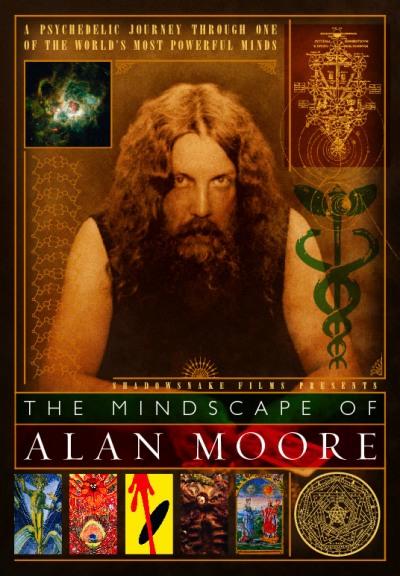
Speaking of substance… I was lucky enough to acquire a copy of The Mindscape of Alan Moore a few months ago. The directorial debut of DeZ Vylenz, Mindscape is the only feature film production on which Moore has collaborated, and given personal permission to use his stories. I can’t begin to tell you what an enjoyable and fascinating documentary it is. It will be officially released on DVD on September 30th.

Alan Moore’s not just one of most important writers in comics; he’s one of the most important writers, period. So really, whether you’re a longtime comics reader or you’ve never delved further than the first issue of Gaiman’s Sandman, the Northhampton Wizard of Words’ body of work cannot be recommended highly enough.

Weekly Ad Uncoiling: Lifebuoy Handwash

Oh buoy. Welcome back Web explorers to the Dr. Moreau School of Digital Art Direction. On the plate today: a tabby croissant. Because “you eat what you touch.” Lifebuoy is just the latest advertiser trying to capitalize on our post-modern germophobia, where washing your hands with simple soap IS NOT ENOUGH. Pet your cat, eat your cat. Take out your garbage, eat your garbage. Wipe your ass, eat your ass. Putting aside my utter distrust of this whole fucking product category, here’s my one sentence review of this campaign: maybe you ad creatives should’ve concentrated on visually dramatizing a believable reason to buy, as opposed to making me think about biology class, and dead cats, and whether or not I have any Pepcid in my Timbuk2 bag (I endorse both of those products). At least the cat-croissant isn’t crawling with worms. Click here for a closer look, and then jump for a second pet experiment featuring a dead hamster muffin.

[Weekly Ad Uncoiling is a guest column by CLIO, ANDY, Mobius, One Show and Bobcat pin (Cub Scouts) award-winning advertising creative director copyranter, who won those pointless awards years ago, and now seriously dislikes the “creative process” and Pinewood derby races.]