The Tarnished Beauties of Blackwell, Oklahoma

Criss-crossing America’s interstates on shoestring music tours, my bandmates and I see scores of battered roadside billboards. They advertise ramshackle sculpture gardens, art brut outposts, World’s Biggest Fill-in-the-Blanks, rustic museums, and obscure historic landmarks. Such attractions are usually located in quiet little towns only a short distance from the highway. More often than not, we make a point to stop, stretch our legs and explore. These spontaneous jaunts expose us to beauty and knowledge we would never have discovered otherwise.

Possibly the most delightful surprise on this last stint with Faun Fables was a visit to the Top of Oklahoma Museum, housed in the somewhat dilapidated (but still glorious) Electric Park Pavilion on Main Street in Blackwell, OK (population 7,700). A grand, white structure with a large central dome, the Pavilion was built in 1912 to celebrate the advent of electricity in Blackwell. Its design takes after styles exhibited at the famous “White City” of the World’s Fair in Chicago in 1893. Its lights, which originally numbered over 500, could once be seen for miles across the windswept prairie.

toom.jpg

These days, the Pavilion could use some serious TLC. Multiple leaks in the dome have endangered the museum’s contents. Plastic tarps enshroud several exhibits. Many items bear marks of water damage. One of the kindly septuagenarian docents who works there followed us from room to room, clucking over the holes in the roof, the rusty stains. These senior preservationists take a lot of pride in their charge, with good reason. The “TOOM” is a sprawling treasure trove of turn-of-the-century ephemera, railroad memorabilia, articles of Cherokee life, hand-carved walking sticks and pipes, dioramas, dollhouses, baby buggies, hobbyist’s taxidermy, antique musical and medical instruments, Victrolas, zinc smelting documentation, delicate handmade lace, linen and clothing, exceedingly creepy dolls, sewing machines, china, vintage propaganda, picture books, elaborate quilting, and countless other keepsakes left behind by the city’s first brave citizens.

Judging by these artifacts, early non-native residents of Oklahoma were hardy, determined folk who struggled to eke out a life on America’s frontier. How they maintained such an unshakable air of dignity and refinement is beyond me, but Blackwell is a true, sparkling diamond in the rough. For me, nothing symbolizes the spirit of its citizens better than the following portrait, unceremoniously presented on a torn, water-stained bit of pasteboard in the museum’s “School Room”: ”

lolasquires.jpg
Who were you, Lola? Whatever became of you?

The girl’s name was Lola Squires, and she was a student enrolled in Blackwell High, graduating class of 1916. That’s all I know. Her gaze knocked me back several feet. Once I finally stop staring at her, I realized that there were countless other flint-eyed and bow-bedecked young beauties on the walls nearby. I must have spent well over an hour in that one room, moving from portrait to portrait, documenting as much as I could, just stunned.


Fantastic Contraption Artist: Christopher Conte

Christopher Conte is a Norwegian artist and designer of prosthetic limbs. He studied in the States and his prowess in both art and science has led him to create some of my favorite biomechanical sculptures to date. One of the outstanding aspects of Christopher’s work is how functional it looks. This is the sort of technology I imagine wandering the face of uncharted planets or carrying out assorted tasks here on Earth. Clean lines, efficient design that looks straight off some futuristic lab’s assembly line and a keen understanding of mechanics sets Conte’s work apart. I can’t wait to see it up close at the show!

A bit about Christopher Conte from his website:

After earning a BFA from Pratt Institute, he entered the prosthetics field and began making artificial limbs for amputees in New York. Combining an abiding love for sculpture, medical science and biomechanics, the field enables Chris to apply his natural talents to help others in less fortunate situations, which he still does to this day. All along, creating sculpture never escaped his deepest passion. In 2007, Chris began offering these unique pieces for sale to the public for the first time.

Fashion in 2008: Good So Far, Still Needs More Lace

lacroix01.jpg

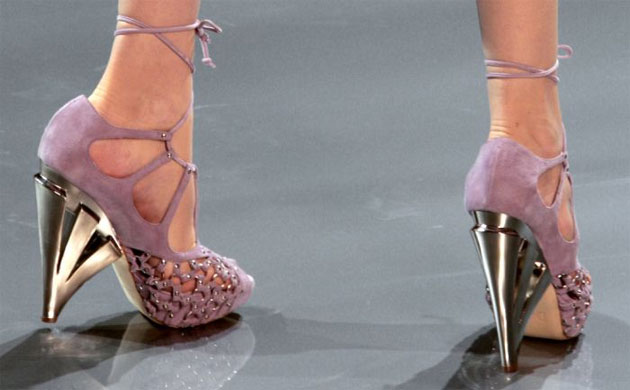
It’s nice to see that “weird shit” is back in style. Above, the latest from last week’s Christian Lacroix haute couture show in Paris (via parlour). Although there were no uniformly mind-blowing collections, there are a few choice pieces here and there, including this 20s-meets-the-future ensemble by Galliano (and from that same collection, these evil-looking shoes!), as well as this sexy number from Chanel. In truth, it’s nothing we haven’t seen before, but that doesn’t make it any less pleasant to behold.

However, the one designer who’s truly been kicking ass this year is handsome devil Gareth Pugh (previously here). What I love most about his Autumn/Winter 2008 collection is the texture. I bet wearing his stuff feels like being a piece of origami. And I have a feeling he’s only getting started. Go, Garteth, go!

pugh01.jpg

Daily Drag Queen Affirmations: 365 Days of Faboo!

Daily Drag Queen Affirmations (DDQA) offers 365 videos of different drag queens who each offer you a fresh, life-affirming nugget of wisdom for every glorious new day – all for just 20 bucks. “Buy it for yourself. Buy it for a friend. Buy it for that bitch you know!” They offer some samples on their YouTube channel, including my favorite one, above.

The all-star cast of this endeavor includes Willam Belli, the mastermind and star of Tranny McGuyver, a show that Belli describes in the following terms: “Basically, it’s In the Heat of the Night meets Tootsie without all the heart-of-gold, positivity bullshit. We’re not trying to out-dyke Cagney & Lacey or anything. Just watch it. It’s fierce.” No, really. Just watch it!

“You want the beef taco or the fish taco?” Priceless.

Daily Drag Queen Affirmations, via bluefirecracker

“Starch Makes the Gentleman…” – Beau Brummell

stefan01.jpg

Deformed ribs, fainting rooms and OMGDRAMAZ – why should ladies have all the fun? Men wear corsets too! Male corsetry was first popularized in Regency England by Beau Brummell, the original dandy – a man who polished his boots with champagneHere he is in his pre-insane-from-syphilis days, sporting abs of whalebone. “Sixpack? Don’t need one.”

There’s been a spectacular revival of dandy style in fashion magazines and on the runway, but it’s not until now that I’ve seen a strong new take with a darker tone. Photographer Peter Ashworth (previously mentioned here) recently collaborated with designer Stefán Orschel-Read (who also models in the shoot) to create Orschel-Read’s A/W fashion lookbook, “Mourning for Orlando” – a series that, at various turns, perfectly marries dandy and deathrock. My favorite images are of the streamlined corset/jacket combo; I imagine Mr. Pearl would approve! The collection includes a wider array of unusual pairings, including geisha, punk, Baroque, and, amazingly, the 70’s leisure suit. How do they all combine? See for yourself.

stefan02.jpg

Fritz Lang’s Metropolis – Lost Footage Discovered

Extraordinary news! Metropolis, Fritz Lang’s astounding silent sci-fi magnum opus, was originally released in 1927 and restored in 2001, with at least 90 minutes of footage lost. Now, through a long chain of distributors, collectors and art funds the missing scenes have been found. These scenes fill gaps in the plot, expand characters that seem minor in current versions and complete the film – this is the Metropolis we were meant to see. The found film will need a lot of work but I have high hopes for a re-release. Private screening at The Edison, anyone?

Last Tuesday Paula Félix-Didier traveled on a secret mission to Berlin in order to meet with three film experts and editors from ZEITmagazin. The museum director from Buenos Aires had something special in her luggage: a copy of a long version of Fritz Lang’s Metropolis, including scenes believed lost for almost 80 years. After examining the film the three experts are certain: The find from Buenos Aires is a real treasure, a worldwide sensation. Metropolis, the most important silent film in German history, can from this day on be considered to have been rediscovered.

You can read the fascinating story in full here on ZEITmagazin. A few new stills are here.

Battle Angel Alita’s Post-Flesh Odyssey

alita01.jpg

The volume was already tattered by the time it made its way to me, passed almost reverently between the awkward 8th graders who usually spent most of their ride on the packed schoolbus (“Cattlecar 47” we named it, after students started sitting on the floor) staring out the window.

The book was Tears of an Angel, the second volume of Battle Angel Alita, Viz graphics’ translation of Yukito Kishiro’s Gunnm.

This was 1996 and in our part of the world, at least, manga was all but unknown. Inside we found a world like nothing we’d seen. An oppressive city hung in the sky over a massive scrapyard where no birds (or anything else) could fly. Bodies were replaced constantly with rugged, mad machinery. Blood flowed like water. In the midst of it all, the characters tried, desperately, to carve out their own peace. We were enraptured.

alita02.jpg

Not all youthful inspirations stand the test of time. But re-reading “Alita” recently, with a James Cameron-directed (urgh) movie on the way, I was pleased to find that it did. Even today, few visions of a mechanistic dystopia are as relentless, ballsy and downright heartbreaking as this.

YouTube’s Takena Says Good Morning

THEY are coming for your FLESH and BLOOD! Now the last hope of the family rests on a sexy faithful MAID! The most brutal clay-animation you’ve ever seen!

So trumpets the blurb for a squishy animation by YouTube’s claymation horror star, Takena. Most likely NSFW, this clip is a hellride through a quiet family evening turned to living nightmare and one maid’s heroic effort to save her home. All she needs is courage and a chainsaw. Avoid anything resembling gummy candy while you watch, below.

Saluting Don S. Davis

stargate_sg1_don_s_davis_int_hammond_9.jpg
Open the iris.

Windom Earle: Garland, what do you fear most… in the world?

Major Garland Briggs (drugged with sodium pentothal): The possibility that love is not enough.

Q. Gauti has just informed me that Don S. Davis, the prolific character actor best known for his role as General Hammond on Stargate SG-1, passed away last weekend following a massive heart attack. Oof.

Stargate’s rad and all, but I’ll always remember Davis as the stern but gentle Major Garland Briggs on Twin Peaks, truly one of the most lovable supporting characters in television history.

Rest in peace, good sir. Safe travels to the White Lodge.

Fantastic Contraption Artist: Stephane Halleux

As promised, a look at one of the Fantastic Contraption artists, Stephane Halleux. Stephane is a Belgian artist specializing in mixed media sculpture. There’s an outstanding amount of labor that goes into each of his almost cognizant creatures, from the beginning stages of acquiring found objects to sketch concepts to actual construction. Here’s more about what Stephane does, in his own words:

I like crazy mixtures, unlikely associations, advanced technology mixed with mechanisms of long ago. I’ve always been fascinated by robotics, its advantages and contradictions. The importance of robotisation and its increasing influence on mankind. Who never dreamt of owning a robot able to do the dirty work. But where are the bounds? How far is a robot useful to men and when does it begin endangering their life ? That’s what I want to make: caricatures of robots that have gone beyond the limits, all that with a fanciful vision of the future. The future we imagined some years ago: big computers full of cables with warning lights everywhere. That’s what I like: an old fashioned universe’s future.

A few more of my favorite images, beyond the jump.