When I experience genuine reverence for a band, it is my solemn duty to immediately share with the people of Coilhouse. Enter The Irrepressibles: a UK 10-piece that has combined all that is grand about glam, baroque, and pop, wrapped it into a beautiful, melodramatic performance package and released it into the world in early 2010 with an album titled Mirror Mirror.
Lead singer and chief saboteur Jaimie McDermott’s countertenor wails and whispers amidst the accompanying orchestral rush in the video below. Recorded at The Queen Elizabeth Hall in London, the “Mirror Mirror Spectacle” presents the group as enchanted music-box ballerinas in origami ruffs, playing in mirrors and flickering lights.
Yes, he is singing his own name in the chorus, what of it?
Mc Dermott’s passion for the theatrical translates into performances so daring, in 2005 they cost him the entire first incarnation of the band. Fortunately, these days he seems to be managing his imagination [and his ego] more successfully. From a report in The GuardianUK:
Recently, they presented an “air spectacle” in Italy, which involved “1,000 balloons, LED lights, 21 fans and costumes made from plastic bags from Leylands”. They have performed in the middle of a lake at the Latitude festival in Southwold, and floated 10 metres off the ground at the Roundhouse in London. It’s reached a point, says McDermott, where “my band have written in their contract that they can say no to me. They’re scared about what I’m going to do to them next.”
Here’s hoping The Irrepressibles tour the world and record at least a few more albums before their leading man accidentally shoots the lot of them into space. Meanwhile, we can buy Mirror Mirror, and keep up with them on Facebook and Twitter.
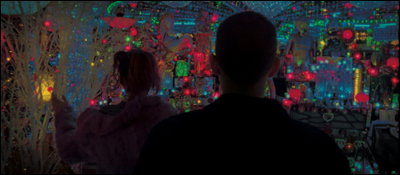
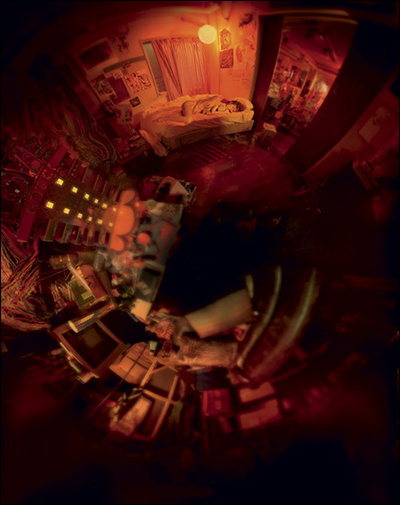
Enter the Void is Gaspar Noé ‘s third feature film. Enter the Void is Tokyo on LSD, DMT and MDMA. Enter the Void will get you high.
It’s also your mom.
All of these things are true. It’s fairly taxing to neatly wrap up and present a film as ambitious, sprawling and simultaneously simple as Enter the Void. At its most basic, the film has us following the adventures and revelations of a freshly-disembodied soul in Shinjuku via a jaw-dropping array of techniques and effects, including first-person POV, woosh-through-walls-and-above-Tokyo overhead shots, 3D imaging and massive amounts of other enhancements. At its most potent, Enter the Void‘s combination of a simple plot & predominantly amateur actors with flawless use of exceptionally difficult techniques creates a viewer experience so unique and powerful, it’s bound to spawn a cinematic movement. It better. Because this bombastic, gorgeous spectacle is also a vehicle that plugs you in and allows you to [almost subconsciously] impart your own meaning over a minimal framework of ideas through the use of repetition and lulls in the narrative.
Of course, this also explains the split reaction of the critics: with a running time of 161 minutes, Enter the Void was often too long for seekers of pure entertainment, and too obnoxious for lovers of traditionally-cerebral cinema. But this was the film Noé set out to create when he first started making movies, and after years of waiting for the freedom and money to do so, he left no stop unpulled:
I tried to get very close to an altered state of consciousness. Or, I tried to, in a cinematic way, reproduce the perception of someone who is on drugs. And there are moments in the movie closer to a dream state, and through that, many people have told that they felt stoned during the movie, and felt they had gone on an acid trip. And there are people who are comfortable with that. But maybe for the people who don’t enjoy losing control of their perceptions, maybe that is where they get annoyed with me. For example, people who have done acid in their youth or whenever, they say they feel like doing acid again after the movie. But people who have never done drugs, or only smoked marijuana, they say to me, “After watching your movie, I know what drugs feel like… but now I will never never never do them.” [laughs]
Through the movie, I wanted to wash myself free of expectations, I was not trying to upset people, but I don’t care if they are. I did the movie for myself and my friends. You work in cinema, you might consider what a director you respect thinks of your film.
80-percent of Enter the Void is a traditional narrative movie. I suppose it’s more similar to Jacob’s Ladder or Videodrome than it is to Inauguration of the Pleasure Dome by Kenneth Anger, which is very experimental. It’s the other 10% of 20% that reminds you of the language and glamour of dreams.
Instead of reading a laundry list of potentially offensive concepts and imagery in Enter the Void, consider this: 1. If you remember that Noé’s previous film featured a 10-minute rape scene, this one is kind of a cakewalk. 2. The only way to Enter the Void is with a mind wide-open and all aversions on Pause. After you’ve watched the film [ideally the original, un-cut version], take a look at this discussion over at Factual Opinion, and thesetwo interviews with Noe. The trailer and the much-talked-about opening title sequence, below.
Yesterday, Wired published an essay by writer/comedian Patton Oswalt titled Wake Up, Geek Culture. Time to Die. It’s about the demise of geekdom, the rise of otaku culture in America, and what it means to be living in a world where Boba Fett’s helmet appears “emblazoned on sleeveless T-shirts worn by gym douches hefting dumbbells.” All this discussion is very near and dear to our hearts, and was eloquently explored by Joshua Ellis in an essay called Children by the Million Wait for Alex Chilton, which appeared in Coilhouse Issue 04.
Both essays make the point that “we’re on the brink of Etewaf: Everything That Ever Was—Available Forever.” But where Joshua Ellis suggests that we’ve won the culture war by essentially remaking the world in our image, Patton Oswalt argues that “with everyone more or less otaku and everything immediately awesome… the old inner longing for more or better that made our present pop culture so amazing is dwindling.” This, he warns, produces “weak otakus” – not a generation of artists, but one of noncommittal pop-culture consumers. “Why create anything new,” he asks, “when there’s a mountain of freshly excavated pop culture to recut, repurpose, and manipulate on your iMovie?” The proposed solution to this problem steers the essay into a weird, fantastical place. In order to rebuild geek culture, Oswalt argues, we must first bring about the “Etewaf Singularity.” He goes on to explain:
It has already started. It’s all around us. VH1 list shows. Freddy vs. Jason. Websites that list the 10 biggest sports meltdowns, the 50 weirdest plastic surgeries, the 200 harshest nut shots. Alien vs. Predator. Lists of fails, lists of boobs, lists of deleted movie scenes. Entire TV seasons on iTunes. An entire studio’s film vault, downloadable with a click. Easter egg scenes of wild sex in Grand Theft Auto. Hell, Grand Theft Auto, period. And yes, I know that a lot of what I’m listing here seems like it’s outside of the “nerd world” and part of the wider pop culture. Well, I’ve got news for you—pop culture is nerd culture. The fans of Real Housewives of Hoboken watch, discuss, and absorb their show the same way a geek watched Dark Shadows or obsessed over his eighth-level half-elf ranger character in Dungeons & Dragons. It’s the method of consumption, not what’s on the plate.
Since there’s no going back—no reverse on the out-of-control locomotive we’ve created—we’ve got to dump nitro into the engines. We need to get serious, and I’m here to outline my own personal fantasy: We start with lists of the best lists of boobs. Every Beatles song, along with every alternate take, along with every cover version of every one of their songs and every alternate take of every cover version, all on your chewing-gum-sized iPod nano. Goonies vs. Saw. Every book on your Kindle. Every book on Kindle on every Kindle. The Human Centipede done with the cast of The Hills and directed by the Coen brothers.
That’s when we’ll reach Etewaf singularity. Pop culture will become self-aware. It will happen in the A.V. Club first: A brilliant Nathan Rabin column about the worst Turkish rip-offs of American comic book characters will suddenly begin writing its own comments, each a single sentence from the sequel to A Confederacy of Dunces. Then a fourth and fifth season of Arrested Development, directed by David Milch of Deadwood, will appear suddenly in the TV Shows section of iTunes. Someone BitTorrenting a Crass bootleg will suddenly find their hard drive crammed with Elvis Presley’s “lost” grunge album from 1994. And everyone’s TiVo will record Ghostbusters III, starring Peter Sellers, Lee Marvin, and John Candy.
This will last only a moment. We’ll have one minute before pop culture swells and blackens like a rotten peach and then explodes, sending every movie, album, book, and TV show flying away into space. Maybe tendrils and fragments of them will attach to asteroids or plop down on ice planets light-years away. A billion years after our sun burns out, a race of intelligent ice crystals will build a culture based on dialog from The Princess Bride. On another planet, intelligent gas clouds will wait for the yearly passing of the “Lebowski” comet. One of the rings of Saturn will be made from blurbs for the softcover release of Infinite Jest, twirled forever into a ribbon of effusive praise.
The essay continues on to describe “year zero for pop culture,” in which we’ll be stuck with nothing but “a VHS copy of Zapped!, the soundtrack to The Road Warrior, and Steve Ditko’s eight-issue run on Shade: The Changing Man” to work with for creating new culture. Oswalt goes on to describe the society that emerges: it includes entire musical genres spawned by Road Warrior (“waste-rock” and its counterpoint, “flute-driven folk”), the creation of the Iranian Beatles, and the ubiquitousness of Shade as “the new Catcher in the Rye.”
A great read, right down to the comment thread. For the full essay, click here. [Via William Gibson, whose name, incidentally, appears in both essays, both times in the passages describing the authors’ personal golden age of otaku/alternative culture].
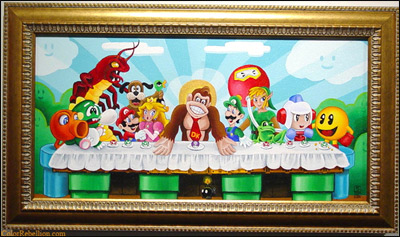
One possible visualization for how Patton Oswalt’s “Etewaf Singularity” may play out – with the world being destroyed by 8-bit characters from old video games. Amazing video by Patrick Jean.
Between 1929 and 1945, Okunoshima Island (located in Takehara, part of the Hiroshima Prefecture) was a chemical warfare production site for the Imperial Japanese Army that produced over six kilotons of mustard gas. Mainichi Daily Newsreports that Okunoshima was even “once erased from the map of Japan for security reasons. […] The poison gas produced at the site took the lives of many people in China and other battlefronts, and former facility workers are continuing to suffer from health ailments caused by the gas.” The moldering husks of the Imperial Army’s power plant and other long-abandoned facility buildings remain standing to this day. In 1988, The Poison Gas Museum was established on the island “in order to alert as many people as possible to the dreadful truths about poison gas.”
Photos of the abandoned Imperial Army poison gas factory on Okunoshima Island via Wiki and JulieInJapan.
But now, Okunoshima Island is becoming better known as “Usagi Shima” (meaning Rabbit Island), a “bunny paradise” where robust leporids numbering in the hundreds roam freely and fearlessly. According to the Mainichi paper’s reportage, it’s believed that the rabbits were first introduced to the island in 1971 when an elementary school in Takehara dumped several of the animals there after being overwhelmed by the responsibilities required to keep rabbits at school. However, many other sources state that the rabbits of Usagi Shima island are direct descendants of lab animals (upon which the Imperial Army’s poisonous gases were tested) set loose by factory workers at the end of WWII.
In either case, the original bunnies of Okunoshima and their successive generations of offspring appear to have thrived in their predator-free environment, grazing on wild greens that grow in abundance all over the island, and accepting food from an ever-increasing stream of enchanted human tourists. The Kyukamura Okunoshima resort hotel located on the island has recently seen a steep increase in visitors to the island thanks to the spread of knowledge of the island via the internet “Many visitors […] are bringing their cameras to take photographs of the rabbits, next year’s zodiac animal, for their New Year’s greeting cards and personal blog sites.”
Blogger Julie in Japan sums up the island’s appeal very well: “Okunoshima has a great message of peace, a chilling history, adorable rabbits, incredible abandoned buildings to take pictures of, and a lot of nature with no crowds. For those reason, I’d recommend going there.” Although, chances are there will be more crowds now, due to the increaseinpress. Hopefully all of this attention won’t upset the bunny balance!
Well, dear reader, here we are on the cusp of Christmas, for some a yearly orgy of food and gifts in honor of the birth of Santa Claus and, for others, a terrible day which brings a visitation by the infernal Krampus. Regardless of whether you are gorging yourself or trembling in fear, we here at the FAM would like to offer you a few minutes of seasonal motion picture entertainment.
Today we present parts one and two of Finnish director Jelmari Helander’s thoroughly entertaining Rare Exports series, the third of which was released on December 3rd as a full length feature. Released in 2003 and 2005 they are presented as promotional/training videos for a company in Finland, Rare Exports, Inc, dealing with the tracking, capturing, training, and handling of Father Christmases for sale abroad.
It is an almost absurdly simple conceit and the entire exercise could have come off as completely banal were it not for the gravelly narration by Jonathan Hutchings and appropriately stoic performances from the main cast of Tommi Korpela, Jorma Tommila, and Tazu Ovaska, their grim visages a counterpoint to Otso Tarkela delightfully feral Kris Kringle. Jean-Noël Mustonen manages to capture both a stark beauty and palpable griminess with his camera, both of which do well to accentuate the moments of surreal humor throughout each film. For all the scenes of waving grass and abattoir-esque training rooms, these are still movies that feature three men chasing down a nude, 300 year-old Father Christmas and taking him down with tranquillizer darts, all in order to domesticate him so that he may have a child on his lap without having to worry about him eating them.
On another note, I must say that I really appreciated Helander using the same cast from film to film. Even the full-length release retains most of the original cast with the exception of Tarkela (for obvious reason) and Ovaska. Were this an American production, this may have not been the case, one need only look at the Finnish and American trailers of the new film to get a sense of how things could have gone horribly awry. It’s a small thing to be sure but I enjoy the continuity across all three films.
And that is going to wrap it up for this year’s Yuletide edition of The Friday Afternoon Movie. From everyone here, we wish you and yours a pleasant and Krampus free holiday.
Having trouble getting in the holiday spirit? Burnt a batch of Christmas cookies for the fourth time in a row? Can’t find that perfect gift for great-aunt Mildred in the throng-flooded mall? Lamenting the tragic lack of traditional French Yuletide songs in your life? Fear not, cialis sale because Siouxsie and her cheerful band of merry-makers are here with a little ditty to remind you of the true meaning of the season: drinking so much that you can’t even manage to clash cymbals properly.
God is dead – that’s nice! Sunglasses worn on head – that’s nice! (Minty, “That’s Nice”)
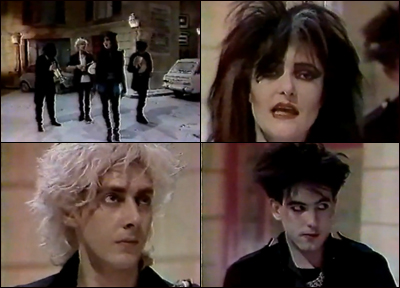
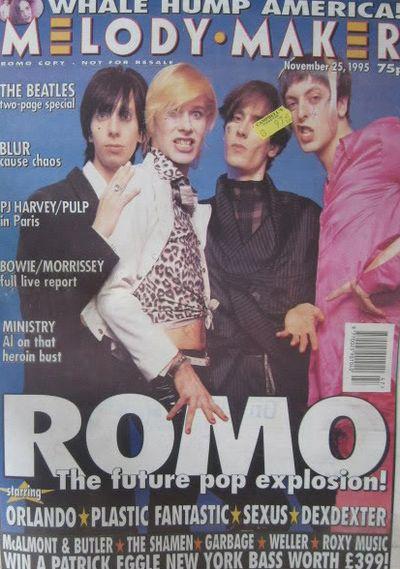
It’s official: the 1990s are back and Rediscovering Completely Forgotten Music phenomena (especially the Next Big Things which never became truly big) is about to become a fad. It’s quite probable that revival mania and pop-archaeology will eventually lead to finding a trace of Romantic Modernism, or Romo in short – one of the most ephemeral music movements of the past decade, which was born (and soon faded) in the UK circa 1995.
Said to be a stylish answer to Britpop’s penchant for sweatshirts, pubs and ‘lad culture’, Romo bands and their fandom tried to revive the glamorous spirit of 70s and 80s and merge it with ultra-modern, pre-millennium decadence. Japan, Roxy Music and Soft Cell were their model idols, but the early, eyeliner-and-leopard-print incarnation of Manic Street Preachers would be an equally appropriate reference.
The term (heavily promoted especially by Melody Maker‘s Simon Price) was an attempt to label a couple of bands which had little in common – except for ruffles, velvet and musical eclecticism pushed forward to the point of awkwardness. Most of these bands failed to release more than a single (those released are probably going to become rare collectibles very soon) and hence remained an obscure curiosity: Sexus,DexDexter, Plastic Fantastic, all of whom found themselves on the cover of Melody Maker before even recording anything. The Suede scenario definitely didn’t work in their case. Maybe because all of the aforementioned bands focused on their (honestly, amazing) looks rather than on writing good songs.
Two of the Romo bands were a bit more lucky – read about them after the jump.
Beijing animation studio 39°N presents a suitably creepy animated version of Neil Gaiman’s poem/short story Nicholas Was for their 2010 Christmas card. I’ll be honest, I’m not the biggest fan of the reading here but the look is fantastic.
The holidays can be a trying time. Maybe you’re feeling frazzled after being bombarded for months by holiday advertising, holiday music, and various wars on holidays. Or maybe you don’t give two shits for these supposedly special days and are just feeling kicked around lately. Maybe you just want to chill out. If you find yourself in such a situation let me suggest sitting down and zoning out for two and a half minutes with the new song from Eskmo, a.k.a. Brendan Angelides, entitled “We Got More” which features a hypnotizing video by one Cyriak who has made a career of hypnotic animation. It may be the most relaxing two and a half minutes you have today.