Respect and Love for Marlon Riggs
A wee bit o’ cheer, courtesy of Marlon Riggs and the Institute of Snap!thology…
… that’s spurring me to write up an overview of something far deeper and more complex. This “Snap Diva” sequence is one of the more lighthearted scenes from Tongues Untied, a powerful independent film by activist/educator/filmmaker/author Marlon Riggs. The clip was sent to me earlier today by an old friend as an offhandedly affectionate “haaaay”, but it ended up triggering intense memories of watching Riggs’ films on PBS over a decade ago. I was bowled over by them at the time; I’m overjoyed to be reminded of them again.
Riggs died of AIDS in 1994 while still struggling to complete his final film, Black Is…Black Ain’t. An intensely personal, well-researched examination of the diversity of African-American identities, Black Is…Black Ain’t was completed by Riggs’ colleagues after his death, and released posthumously in the mid 90s. “His camera traverses the country, bringing us face to face with Black folks young and old, rich and poor, rural and urban, gay and straight, grappling with the paradox of numerous, often contested definitions of Blackness.” [via]
Riggs was a giant of public television during the late 80s and early 90s, and a truly inspiring force for positive change. Via glbtq:
Riggs’ experience of racism began in his segregated childhood schools but continued even at Harvard, where he studied American history, graduating with honors in 1978. He then earned an M. A. in 1981 at the University of California, Berkeley’s Graduate School of Journalism, where he later taught documentary film courses.
Riggs first gained recognition for writing, producing, and directing the Emmy-winning, hour-long documentary Ethnic Notions (1987), which explored black stereotypes and stereotyping. The film helped establish Riggs’ career as a contemporary historical documentary producer.
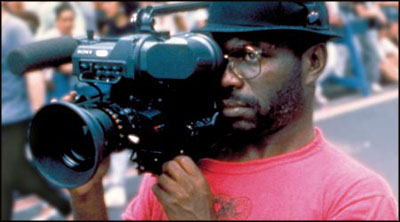
But most of his later films and writings probe the dichotomy Riggs perceived between the strong, “Afrocentric” black man and the black “sissy” gay man. As a “sissy” himself, Riggs felt deeply his status as a pariah within the black community.
Tongues Untied (1989), Riggs’ most famous film, is an extensively reviewed and critically acclaimed documentary that met with controversy in conservative circles when it was aired on public television. Funded by a National Endowment for the Arts grant, it figured in the cultural wars over control of the NEA and the Public Broadcasting System.