The brilliant and exuberantly tenacious Phil Broughton is a health physicist, radiation safety educator, and the proprietor/ranter-in-chief of Funranium Labs. It’s a joy to publish his edifying, hilarious essay concerning Hollywood expository narratives as they pertain to… TEH SCIENCE! Illustrated with LULZ from across the world wide interwubz, arbitrarily selected by yours truly. Haha! Sorry, Phil. (No I’m not.) But seriously, Phil is a tremendously gregarious and charming font of knowledge, so feel free to poke him about coffee, nuclear weapons, beer, history, urban exploring, science “or any of the myriad useless facts bubbling about” in his brainmeats at funranium@gmail.com. Yay, Phil! ~Mer
Hollywood, we need to talk about your dating habits. In particular, how important it is to have a reference to verify ages before you get in trouble. No, I’m not talking about the hypersexualization of 12 year old girls trying to pass for 18. Nor am I talking about the 60-somethings trying to pass for 18 as well. That is a totally separate headshaking situation.
I would like to blame the movie Prometheus for this rant, but it’s hardly the only guilty party, just the one that finally made me snap. Hollywood, you don’t understand how carbon dating works, that there are other dating methods that sometimes work better, and that the true (unattainable) goal is to find the perfect point of reference to scale them all against. But underlying all of that is a body of scientific work and assumptions that you’ve conveniently ignored in the interest of “character driven plot”. But I have news for you: your characters and your plot make less sense when you take these shortcuts. And when you do this, people become confused as to what science and state of the art technology actually are, to the point that we have to deprogram juries and judges of the CSI Effect in capital punishment trials because Reality. Doesn’t. Work. Like. That.
It is All Soul’s Day, when the veil between the living and the dead is said to be at its most diaphanous. And so we present a feature on the eligaically named, NYC-based band O’death, written Katelan Foisy. A multimedia artist, writer, model, and tarologist, Katelan is known as “La Gitana” and the “Mistress of Magic”. She can be found on the internet almost everywhere. ~Mer
Portrait by Katelan Foisy.
O’death is one of those bands you remember falling in love with. I first heard them back in 2007 in the former apartment of William S. Burroughs. I was making cowboy coffee and my boyfriend at the time was queuing up music for our Darwin’s Nightmare Party, a party to “celebrate” the naturalist’s birthday. “You’ve got to listen to this band,” he said as I poured loose coffee grounds into boiling water. He hit play and I stopped, mid-pour, to turn around. “Who is this?” I demanded. He told me it was O’death, a Brooklyn-based band he had seen a few weeks back. I left the coffee as we danced on cigarette strewn, whiskey stained wooden floors. The song was “Down to Rest” and I was entranced. It had the feeling of a small town forgotten and decayed, remembered only by the myth passed down by word of mouth by elders at camp fires.
Spring, 2008. I walked into a coffee shop to deliver a human skull to an artist when a poster caught my eye. It was for an O’death show. I remembered that night again like it was the first time. I immediately went home and tried to befriend the band. They were about to come out with a new album Broken Hymns Limbs and Skin and commissioned me to do a portrait as part of the press packet. I listened to the album. It was more refined than the first but still pulled the listener into a world between waking and dreaming. I remember thinking there was something incredibly special about this band; it wasn’t just that they had taken parts of old time Appalachia and made it contemporary, it was that they could make you feel you were part of the story. This could be explained in the way they’ve recorded each album. Head Home and Broken Hymns, Limbs, and Skins were recorded live. As you listen, you see them on stage. What you hear on the album is as passionate as a live performance.
Outside, their most recent album, was recorded in fragments. David Rogers-Berry, the band’s drummer, had recently battled Osteosarcoma (a form of bone cancer), undergoing chemotherapy and a shoulder replacement. Where many would have given up, O’death embraced this as an opportunity to experiment with sound. The album’s lineup of Gabe Darling- banjo/ukulele, Jesse Newman- bass, Greg Jamie-singer/lyricist, and violinist Bob Pycior lead the music towards a slower, more melodic turn.
Each O’death album has a distinct feel while retaining the band’s singular magic. They transport listeners to new places. Hearing an O’death song is like falling into a small book of short stories told in a cave by a fire, on a ship during a storm, in a pub on the streets of England, or while hidden away in a swampland cabin. Their music transcends time. Upon first listen, a characteristic track might be mistaken for a classic folk song. However, their words are striking in the contemporary dialogue with time and humanity they invoke.
Despite an old time feel to their music, the only song actually based upon a historical event is “Fire on Peshtigo” from Broken Hymns, Limbs, and Skin. It was inspired by the 1871 Peshtigo, Wisconsin firestorm that killed 1,500 and which occurred the same day as the Chicago, Holland and Manistee, Michigan fires.
Gerda Wegener, Cuckoo, 1920. Note the fallen black mask on the floor: it repeats in many of Gerda’s erotic paintings.
This is the true story of turn-of-the-century lesbian romance, erotic Deco illustrations rife with harlequins and crinolines, the world’s first male-to-female sex reassignment surgery, and the 1950s pulp novel that brought it all to light.
The story begins one hundred years ago. In 1912, artist couple Gerda and Einar Wegener arrived in Paris, hoping for greater prosperity and freedom than their conservative hometown of Copengahen would allow. They checked into the Hôtel d’Alsace, where – they were shocked to learn – they had been placed into the very same room where Oscar Wilde had once died twelve years earlier. The couple spent the next few days reading Wilde’s works out loud to each other. The forbidden sexuality, transformation, beauty and tragedy in Wilde’s work was reflected in the couple’s following years together.
Gerda, left. Lili, right.
In Paris, Gerda quickly became well-known for her sensual, free-spirited illustrations. Her work often featured a mysterious beauty with a stylish short bob, full lips, and beguiling brown eyes. In 1913, the public was shocked to learn the identity of the mystery model: Gerda’s husband, Einar. Einar was transitioning to living life openly as woman named Lili Elbe.
In the next room, tucked away in a fireproof lockbox, there’s a handwritten note from 1952, hastily scrawled down on looseleaf paper by a man named John (aka Jack) Whiteside Parsons. (My partner and I are both fascinated by the tales surrounding Parsons and his equally scintillating wife, Marjorie Cameron.) Purchased a few years back from a reputable private collector, it’s a short list of the books from Parsons’ personal library– the ones he planned to take with him when he relocated from Southern California to Mexico. Everything from biochem science to William Blake to Alice in Wonderland. Only… Parsons never made it to Mexico. Within days of writing that note, the man blew himself up amid persistent, weird rumors of ritual workings, sex magick, portals.
Sixty years ago to this day, in fact.
June 17th, 1952: a “brilliant young rocket scientist and occultist was killed in an explosion in Pasadena of origins that remain mysterious [...] Five days later, Pasadena police closed the case and announced that he dropped a vial of fulminate of mercury onto the floor of his home laboratory [...] He was 37 years old and one of the country’s top chemical engineers, a founder of Jet Propulsion Laboratory, and the inventor of the solid fuel that would take man to the moon.” (via)
Such a strange fellow, with such an utterly bizarre life trajectory! And for me, for whatever reason, something about that list of indispensable books feels more eerie and portentous than any of his “Do What Thou Wilt”/”As Above, So Below” writings. But in any case, thoughts of Parsons’ mythic Moonchild loom large in my sky tonight. His biography is one of the most compelling stranger-than-fiction stories of the 20th Century. Here’s some highly recommended reading for the newly intrigued:
The following embed of a notorious 1987 indie film called Superstar: The Karen Carpenter Story comes to us courtesy of New Zealand-based comic book writer and artist Dylan Horrocks, who says “I remember seeing it at the Auckland Film Festival and being disconcerted, impressed, and powerfully moved. [...] The audience laughed a lot at the beginning. But by the end, we watched in stunned silence. I’ve never forgotten it.”
Two years after graduating with an MFA from Bard College, Superstar director Todd Haynes (Velvet Goldmine,Far from Heaven,Safe) shocked and moved unprepared audiences with the now-infamous and nigh-impossible-to-track down 43 minute film. “Seizing upon the inspired gimmick of using Barbie and Ken dolls to sympathetically recount the story of the pop star’s death from anorexia, he spent months making miniature dishes, chairs, costumes, Kleenex and Ex-Lax boxes, and Carpenters’ records to create the film’s intricate, doll-size mise-en-scene. The result was both audacious and accomplished as the dolls seemingly ceased to be dolls leaving the audience weeping for the tragic singer.” (via)
Richard Carpenter, upon viewing the film, was apparently enraged at its depiction of his family– especially by Haynes’ insinuations that Richard was gay. In 1989, after confirming with A&M Records that Haynes had never obtained proper music licensing for numerous Carpenters songs used in the film, Richard Carpenter served Haynes with a cease-and-desist order and sued him for failing to obtain proper clearance. Haynes offered “to only show the film in clinics and schools, with all money going to the Karen Carpenter Memorial Fund for anorexia research”, but Carpenter was unrelenting, and eventually won his lawsuit against Haynes. All copies of Superstar were recalled and destroyed. (According to Wiki, the Museum of Modern Art retains a print of the film, but has consented to never screen or exhibit it at the Carpenter estate’s request.)
More than two full decades after it was made, copies of Superstar still remain very difficult to track down. Except, of course (somewhat dubiously), on YouTube.
O frabjous day! (Callooh! Callay!) It is March 20th, 2012– the official US release date of UK-based author Nick Harkaway‘s second novel, Angelmaker.
Comrades, if you appreciate joyful and highly original storytelling, you need to pick up this book. Immediately. Trust me when I tell you that Angelmaker is easily one of the most endearing works of fiction that will be published this year… or next, for that matter.
Better yet, trust William Gibson: “You are in for a treat, sort of like Dickens meets Mervyn Peake in a modern Mother London. The very best sort of odd.” Or Tim Martin: “this is as far as it could be from the wearied tropes that dominate so much of fantasy and SF.” Or Glen Weldon: “A big, gleefully absurd, huggable bear of a novel.” Or Charles Yu: “Nick Harkaway’s novel is like a fractal: when examined at any scale, it reveals itself to be complex, fine-structured and ornately beautiful. And just like a fractal, all of this complexity and beauty derives from a powerful and elegant underlying idea.”
(Yes. YES! THIS. What they said. All of it, plus tax, and with great interest.)
Who among you has read Harkaway’s debut novel, The Gone-Away World? Those who have know what a big-hearted and ferociously intelligent storyteller he is– how he crafts narratives that defy categorization (and sometimes gravity), shunting his intricate, multi-pronged prose along at breakneck speeds. TGAW is a sprawling, surprisingly poignant hero’s epic that unfurls like a Lichtenberg figure against an unlikely backdrop of pirates, mimes, ninjas, horrific super-weapons and devastating post-apocalypse. It’s equal parts meticulous, silly, sincere, impassioned, hilarious.
The yarn of Angelmaker is made of similarly electric stuff, only spun even more finely, and woven so intricately that many passages play out like a kind of multi-layered literary sleight-of-hand: How did he do that? Within his wordplay, Harkaway ensconces acts of commensurately deft swordplay, espionage, gangbuster hijinks, and even higher fantasy. Intricate family bonds are explored and philosophical quagmires grappled with. There are trains, planes, automobiles, and submersibles. Sex! Monks! Murder! Mechanical bees! We are introduced to tragic elephants and a heroic pug. Harkaway dares us not to fall in hopelessly in love with each and every character and object and exotic locale he braids into the microcirculatory tapestry. (Bear in mind, there are thousands of distinct and lavishly described elements.)
At the golden hammering heart of the story we find Joe Spork, a lonely/adorable identity-crisis-having horologist, and Edie Banister, a ninety-year-old former superspy whose badassery transcends time and easy pigeonholing. Together –with the help of their magnificent friends/lovers/family, and thwarted by an assortment of deliciously loathsome villains– Joe and Edie must rescue the world from an antiquated doomsday device unlike anything anyone ever imagined… save for the tormented genius Frenchwoman who haplessly invented it.
It all sounds utterly absurd, doesn’t it? Well, it is. Ravishingly so.
Now. That being said, I’m delighted to present the following Coilhouse interview with Nick Harkaway, author of Angelmaker and The Gone-Away World. Huge thanks to Qais Fulton for supplying several of these questions, and downright humongous thanks to Mister Harkaway for taking the time to answer them all so thoughtfully.
Nick Harkaway. Photo by Rory Lindsay.
COILHOUSE: You were a professional screenwriter before becoming a novelist. Both The Gone Away World and Angelmaker –while infinitely more complex, dense, and multi-layered than the medium of film could ever allow for– have decidedly cinematic qualities: panoramic descriptions of places and scenes, well-paced bursts of action, crackling dialogue. Do you often find yourself pushing or pulling against that previous construct, or have you compartmentalized the two mediums? What (if any) are some of the most important tools you’ve brought with you from your screenwriting career? NICK HARKAWAY: Mostly for me the sense of the story leads the writing, so I know where I’m going and I come up with how to say it as I go. (I don’t mean that character doesn’t drive, rather than I have an overarching sense of what character and plot will do in combination, and I then have to write a line through that using the right scenes and the right language to express it. There’s a constant battle to find words and events which properly capture the concept in my head. And sometimes it turns out that the concept has conveniently ignored some logical realities and I have to bridge a gap…)
But screenwriting is a terrific base to work from. There are two gifts it gives which are obvious: if you’ve written a movie script, you know that you can finish a story. (I swear, more people get hung up on sheer terror of the long form than anything else.) And you know about concision. Every good writer I know has at one time or another worked in a field which required them to be able to express a lot in a short space, with minimal linguistic flourish. Whether that’s journalism, the civil service, the law, or something else, it’s a great discipline. I, obviously, have sort of abandoned that kind of sparse writing, at least for the moment, but that doesn’t mean I don’t benefit from it.
What pushed you to write your first novel? Was there a specific catalyst?
Yes. I was heartily sick of pitch meetings. I couldn’t stand taking another great story to someone who was fried on Starbucks’ coffee and not really paying attention and have them object to everything which was interesting about it and then complain that what was left wasn’t original enough. Or some variation on that theme. The final straw was a musketeer-ish story I wanted to write which was about a women who had, in her youth, dressed as a kind of D’Artagnan figure. She’s in middle age, her kid gets kidnapped, and she has to go back to being an adventurer – but she’s no longer a waif. She’s a farmer. She’s strong, heavy, and very obviously female. So she puts on a fake beard and decides essentially to be Porthos instead. There was all kinds of fun stuff in that story – just talking about it I want to get it out of the drawer again. Anyway, my panel of (female) execs sit through this, and at the end they say “well, it’s kinda hard to place stories with a middle-aged female lead”. And that is their entire critique apart from a nice extra kiss-off about transvestitism being hard to sell, too. And I just thought “screw this”.
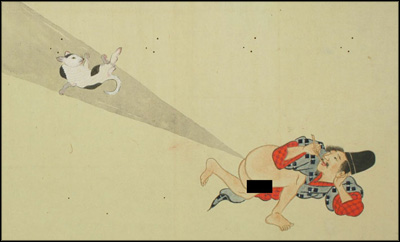
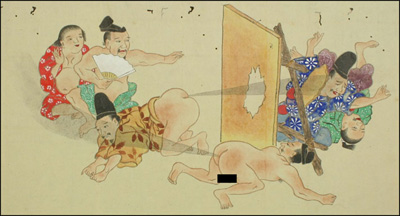
I was doing research for another post a while back, and found something a bit…unusual. It was an old Japanese scroll about farting. No, you didn’t misread that last sentence. The whole scroll, which is called He-Gassen (“The Fart Battle”) is just about people farting. Farting at other people, farting at cats, farting off of horses, farting into bags; just farting everywhere. [...] I kept expecting to find some deep cultural explanation as to why these guys made whole scrolls about farting. But I think it really just boils down to one universal truth: farts are funny. We can pretend that our senses of humor are more sophisticated than that, but let’s face it: when somebody lets one rip, you’re going to chuckle.
Couldn’t have put it better myself!
Click this link to read and see more. Click it now. Trust me. You may not know it yet, but you need more 19th Century Japanese fart scroll in your life. Delve deep into this dubious cleft of cryptohistory.
“Fuck You” Opening Party is tomorrow (Thursday, February 16th) from 6pm-9pm. Exhibition closes Thursday, March 8th. Boo-Hooray is open every day from 11am-6pm.
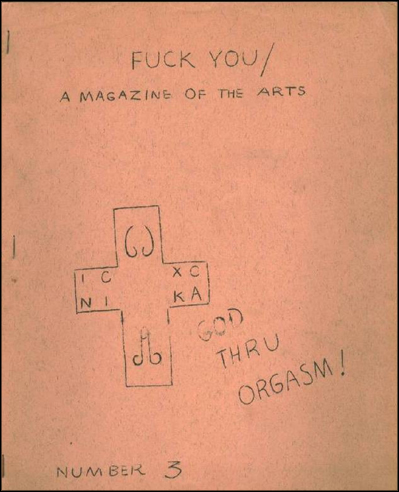
There’s a gallery space down on Canal St. in NYC called Boo-Hooray; it’s a splendid place dedicated to 20th/21st century counterculture ephemera, photography, and book arts. Tomorrow evening (Thursday, Feb 16th) is the opening night for their most recent exhibition: a comprehensive collection of publications from Ed Sanders’ legendary Fuck You Press, including a complete run of Fuck You, A Magazine of the Arts.
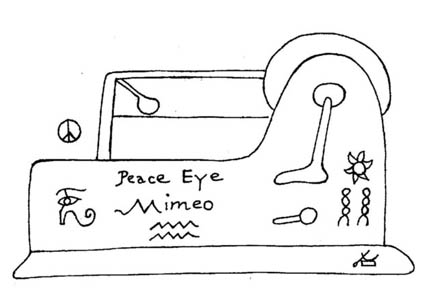
Ed Sanders‘ an unofficial patron saint of the 20th century underground who has often been referred to as “the bridge between the Beat and Hippie Generations”. More specifically, he’s a poet, singer, activist, author, and publisher. Any way you cut ‘n’ paste it, this man broke the mold and the mimeograph!
Sanders shares a bit of history about his publication:
“In February of 1962 I was sitting in Stanley’s Bar at 12th and B with some friends from the Catholic Worker. We’d just seen Jonas Mekas’s movie Guns of the Trees, and I announced I was going to publish a poetry journal called Fuck You, A Magazine of the Arts. There was a certain tone of skepticism among my rather inebriated friends, but the next day I began typing stencils, and had an issue out within a week. I bought a small mimeograph machine, and installed it in my pad on East 11th, hand-cranking and collating 500 copies, which I gave away free wherever I wandered. (…)
Fuck You was part of what they called the Mimeograph Revolution, and my vision was to reach out to the “Best Minds” of my generation with a message of Gandhian pacifism, great sharing, social change, the expansion of personal freedom (including the legalization of marijuana), and the then-stirring messages of sexual liberation.
I published Fuck You, A Magazine of the Arts from 1962 through 1965, for a total of thirteen issues. In addition, I formed a mimeograph press which issued a flood of broadsides and manifestoes during those years, including Burroughs’s Roosevelt After Inauguration, Carol Bergé’s Vancouver Report, Auden’s Platonic Blow, The Marijuana Review, and a bootleg collection of the final Cantos of Ezra Pound.
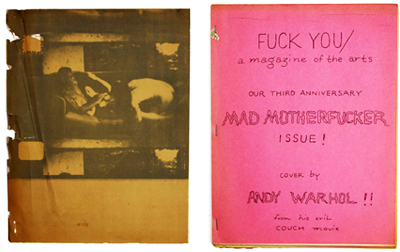
Other contributors to Fuck You included Allen Ginsberg, Andy Warhol, Julian Beck, Ray Bremser, Lenore Kandel, Charles Olson, Tuli Kupferberg, Joel Oppenheimer, Peter Orlovsky, Philip Whalen, Herbert Huncke, Frank O’Hara, Leroi Jones, Diane DiPrima, Gary Snyder, Robert Kelly, Judith Malina, Carl Solomon, Gregory Corso, Robert Duncan, Robert Creeley, Michael McClure, Ted Berrigan, Joe Brainard, Gilbert Sorrentino, and countless others.
It was a ‘zine “dedicated to free expression, defying taboo subjects, celebrating sexual liberation and the use of psychedelics years before the Summer of Love. Sanders and his collaborators bridged the Beats of the Fifties and the counterculture of the late Sixties, and helped define many of the differences between the two—the latter building on the breakthroughs initiated by the former.”
The Fuck You opening party is happening Thursday, February 16th – 6pm-9pm. Sanders will be reading from/signing copies of his book. Exhibition closes Thursday, March 8th. Boo-Hooray is open every day from 11am-6pm.
New Yorkers! Don’t miss this! (And by all means, report back in comments.)