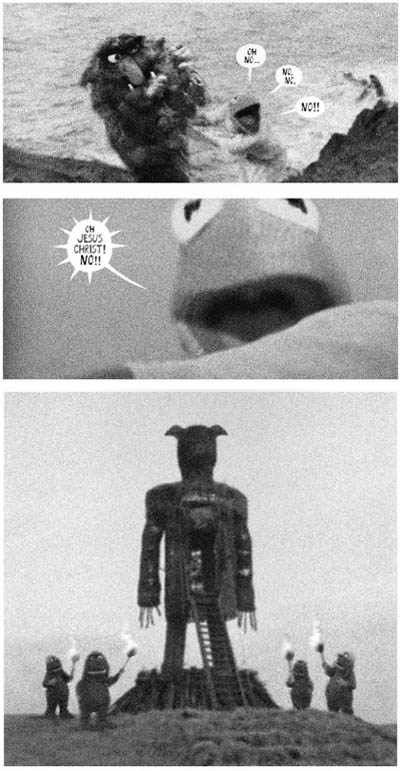
Welcome to the best worst thing you will see all week. Icelandic comedy troupe Midland, in a fit of horrible genius, has done what, no doubt, only a few severely stoned first year film students have thought of. That is, they have created the above trailer for a movie entitled Den Lille Grimme Aelling (The Ugly Duckling), a movie that interprets the world of Walt Disney’s barely comprehensible Donald Duck through the harsh, unforgiving lens of the Dogme 95 school of film making. What follows is nearly three minutes of childhood memories funneled through the unyielding, sadomasochistic vision of von Trier and Vinterberg (though, like von Trier and Vinterberg Midland winds up cheating a bit here and there.) So come along and follow Donald as he deals with his three children, a sizable drug debt, and the rich uncle who abused him as a child. Then maybe weep a little.
You would probably want to be careful when making a movie that involves Afghanistan. You could, perhaps, be more cavalier in dealing with Osama bin Laden (in the U.S. at least), but I’d think you would want to exhibit some sort of sensitivity when making a film about a country we’ve been involved with on, let’s just say, unpleasant terms for a while now. It seems like a bad idea to make a film about a group of white people (like, super white people) running around a poor, war-torn country (our war, no less) doing sick karate kicks and slaughtering the local populace in droves, even if they’re “zombies”, and then have them partake in hot, white people make-out sessions in between said slaughter. I don’t know, maybe it’s just me.
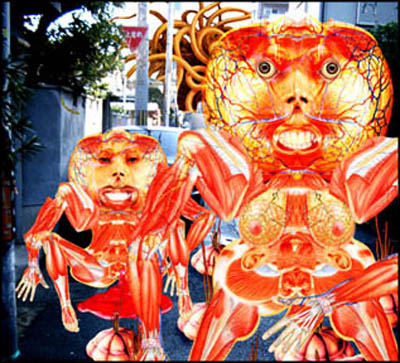
This perfect, gleaming sliver of transcendent “whaaaa thaaaa faaaaaa??!” comes to us care of a tweet from Keith Jenson of Brainwomb, who claims to be sharing it to polarize the effect of the “‘spirit bomb’ of Harajuku” video that Nadya just posted. (Athough it seems just as likely that he’s trying to insidiously destroy us with subliminal mind control.)
Laughing Squid says that Japanese artist Sekitani Norihiro –be sure to check out that website, but be warned, it is rife with CAN’T UNSEE imagery– made this succinctly fucked-up-beyond-all-reckoning-ness for the digital grindcore demigod Maruosa.
It would seem, at first glance, that this is not a thing that should exist in this reality. This is something that should be glimpsed only when gazing into some dark mirror of this world; something seen on the other side of a portal opening into the formless Void. Here, in the emptiness of this Other Place, one might find this scene, a Fellini-esque performance in which a sweaty, rotund gentleman sings an off-key, off-tempo version of “Jesus Loves Me”, to the decidedly mechanical beat of a cat named Midnight on organ and a mouse named Squeaky on the drum, mallets taped to its paws. No, this is something that should not be a part of our world. Alas, however, it is. Specifically, it is an excerpt from the late 50s children’s television program Andy’s Gang, filmed in front of an audience of what I can only assume were budding sociopaths who did not find this horrible in the least and, indeed, seem quite entertained. For the curious, context does little to make this clip any less dismal.
I’ll admit, I know very little about the Swiss, stop-motion cartoon Pingu other than that it is a Swiss, stop-motion cartoon about penguins. That does little to dampen my enthusiasm for this, a remake of John Carpenter’s sci-fi/horror classic The Thing by Lee Hardcastle, starring the adorable cast of the aforementioned cartoon and animated in the same style. It is just as good as it sounds.
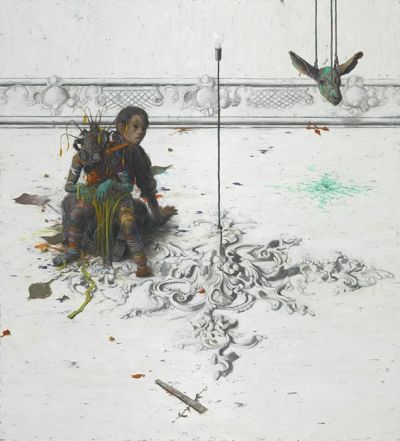
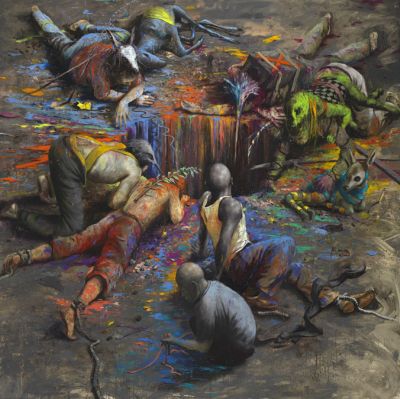
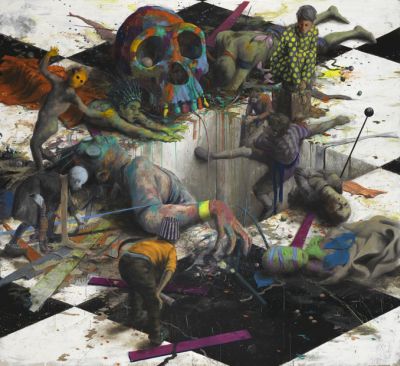
Take one part Hieronymous Bosch and sprinkle liberally with bright, rainbow colors and you’re about halfway to describing the work of Jonas Burgert. Here is a world in which people inhabit barren wastelands and nameless nowheres, outfitted in the vivid hues of their particular tribes. I really like the interplay of these two elements; the color trying, and failing, to act as a camouflage for the decidedly bleak subject matter. The colors splattered and scribbled all over, it’s like some child’s coloring book of Hell — both unsettling and beautiful.
Switched to a YouTube playlist because the VICE video would auto-play. You can see the full-length version at the link at the end of the article.
Perhaps not the best thing for the week of Christmas, but history cares not about holidays. Last Saturday, as I’m sure you all know, Kim Jong Il, the iron handed dictator of the Democratic People’s Republic of Korea, died from an apparent heart attack at the age of 69. The past week has seen a continuous outpouring of grief (some real, some staged) from within the Hermit Kingdom, while the rest of the world seems to look on with trepidation, waiting to see what his heir apparent, Kim Jung-un, will do.
Less than a week before Jong Il’s death, VICE News ran another of their fascinating looks into North Korea. Shane Smith, accompanied by freelance journalist Simon Ostrovosky, traveled to Siberia to investigate North Korean logging camps located deep in the forests. Here, North Korean citizens are contracted as laborers for up to 10 years, during which time they are housed, fed, and paid a pittance for their work. The North Korean government, meanwhile, was paid handsomely for what basically amounts to slave labor.
Smith’s interest seems to be twofold: to expose these camps, and to try to talk to North Korean citizens, a feat nearly impossible in his visits to the country itself. If you’ve seen Smith’s past work, then you’ll know what you’re in for. The reporting is solid, but there is a Gonzo aspect to it as well. A decent chunk of the forty minute documentary is spent on a crowded, sweltering train where the only thing to do to numb the boredom is drink. Unsurprisingly, it turns out to be rather difficult to get near these camps, but he and his crew manage to at least talk for a bit with some of the laborers.
Regardless of your feelings on the style, VICE has done a stupendous job exposing yet another facet of the horror that was Kim Jong Il’s regime. In the closing minutes of the piece Shane reveals that much of the scrutiny they found themselves under was no doubt due to the fact that the Dear Leader was visiting the same area of Russia at the time to meet with President Dmitry Medvedev and broker another labor deal, to sell more of his people. If that isn’t evil, I’m not sure what is.
I’ve been dreading this, the moment when one of my overseers decreed a theme week. Finding items of interest on the internet is one thing, but I never do well when sent to find a specific thing. It could be some sort of blogging performance anxiety. Set with a specific task I am so preoccupied with getting a superlative result that in the end the whole experience arrives limp and unsatisfying to all involved. It’s terrible. It is with that in mind, then, that I submit to you this search result, extracted from YouTube in a fit of panicked desperation; a video clip of Harry Potter making out with a female centaur while, I believe, Hitler looks on from a hiding place behind a dresser, done in The Sims. Believe me when I say that I am just as disappointed in me as you are.
Good morning, good morning, good moooorrrrrrniiiing! Have some warm (creeping) fuzzies:
Yes! It’s ye olde “Donkey Rhubarb” video! One of musician Richard D. James’, director David Slade’s, and Canary Wharf’s finest moments.
James called these charming creatures his “Rhubears”, and toted them along to several live Aphex Twin shows in the mid nineties. Via wiki: “James has also admitted to having his friends dress up as them to terrorise line-ups outside of clubs.”