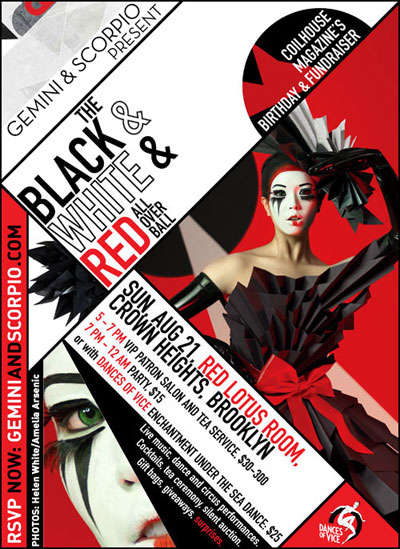
GEMINI & SCORPIO Present: The Black & White & Red All Over Ball. (Flyer by Nadya & Nicole, inspired by Courtney Riot. Imagery courtesy of Helen White & Amelia Arsenic.)
For years and years and years, we’ve been talking about throwing an epic Coilhouse party in New York City. There’s a lot to celebrate: our vibrant family of East Coast-based Coilhouse contributors and compatriots, the four-year anniversary of the Coilhouse site, and, of course, the imminent release of Coilhouse Issue 06… which is gorgeous, by the way! (It’s visually unlike anything else we’ve attempted thus far. So much hard and occasionally heartrending work has been poured into this issue over the past year, by a big team of devoted staffers, contributors, interns and editors.)
In keeping with the distinct color scheme of Issue 06, and with a cheery nod to the slapdash, seat-o-the-pants times Coilhouse currently finds itself in, we’re calling our Coilbash The Black & White & Red All Over Ball. We are striving to make it the fanciest, most weird and wonderful costume ball of our career thus far. And, quite frankly, we’re not only hoping for, but counting on a healthy turnout, in spite of the short notice-ness. We really hope to see you there. It’s not just about the Benjamins. Honestly, we’re aching for a proper Big Apple shindig. We dearly want to meet and greet and hug the stuffing out of all our East Coast lovelies, and then maybe dance the night away, if that’s all right with you? We feel like it’s way past due.
With a little (actually a LOT) of help from our friends, we’ve been getting the word out, and lining up an incredible array of art and performance. Two dozen fabulous silent auction items have been donated by Coihouse featured artists, friends and contributors. We’ve locked down a lavish venue, and we’re ready to rock your socks off. HOLY SHIT. GUYS. LET’S DO THIS.
Please do read further for more details.
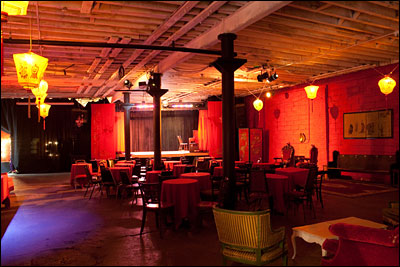
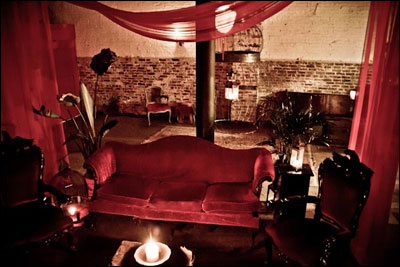
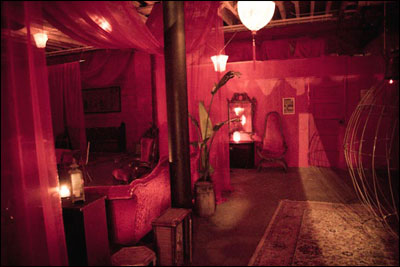
Our beautiful venue, the Red Lotus Room.
First of all, check out the space! We shall be getting our boogie on in Crown Heights, Brooklyn, at the sumptuous, sprawling, velvety Red Lotus Room, home of the legendary Shanghai Mermaid speakeasy. When Mer first sent out a big “CALLING ALL CARS” email to her NYC crew, several people recommended we get in touch with the lovely Juliette, who runs both the space and the speakeasy. Juliette is a kindred spirit for sure, deeply committed to DIY community and the arts. Asian lanterns and chandeliers, exposed wood beam ceilings, red velvet-draped walls… oh my!
Upon arrival at the Red Lotus Room, revelers will enter a secret, lush cabaret universe to an extravaganza of live music, dance and circus performances. Aerialists… fire… projections… Dadaist spectacle… surprises galore. Dance to rollicking sets from DJ luminaries. Bid on silent auction items donated by longtime supporters and featured Coilhouse artists: a splendid array of autographed prints and books, and one-of-a-kind art objects. (PS: we’re working to see if we can’t arrange for this to be an international auction, to make things more interesting!) Mix and mingle with Coilhouse staff and family of longtime East Coast contributors, including Molly Crabapple, Clayton James Cubitt, and Jeff Wengrofsky. Angeliska Polacheck is even flying in from Austin for this! Plus, partygoers will get the first glimpse of Coilhouse Issue Six, and an opportunity to pre-order it at a discount. There will be tea ceremony, there will be booze, there will be belly dancers and cabaret, flaming poi and flying trapeze. Most of all, there will be a whole lotta love in the dang room, because the night of August 21st is all about Coilhouse celebrating its birthday, and most importantly, its community.
So, yes. As you can see, the space is amazing. Then there’s the phenomenal party production team, Gemini & Scorpio, who are presenting the evening’s festivities. G&S have stepped up in the most gobsmackingly incredible way to help us to list, promote, organize, cat-herd and co-curate this shindig. Run by “two artsy New York City gals and creators of G&S’ Fabulous Guide to Online Dating (old, but useful!)” our cherished and generous G&S team are: “Smart, creative, funky and different, just like the people we are here to meet. Our email list spreads the word on underground happenings in NYC you’d otherwise never hear about, and our own–sometimes unbelievable–parties bring our thousands-strong creatives’ community offline.” Holy macaroni, they’re badass.
With their help, combined with the counsel and kindness of our dear friend Shien Lee of Dances of Vice (be sure to scroll down and take note of the DoV/Coilbash two-event deal!), and the wisdom of the aforementioned Juliette and Shanghai Mermaid, we have been able to reach further and deeper into the NYC underground than we ever could on our own from way over here in sunny Cali. Our lionhearted comrade and champion, Molly Crabapple, has also been helping out tremendously with backline support. In the midst of all of this last-minute chaos, whenever we take a brief moment to catch our breath, we feel like we’re swooning in the outpouring of love, support and advice we’ve received from all of these women, their extended networks, and beyond. (Thank you, lovely ladies. THANK you, thank you, thank you. We can never say it enough. We are so darn grateful to all of you.)
With their help, and in cahoots with countless other members of da ‘Haus’s own extensive tribe in NYC (who will undoubtedly be getting a ton of blog shout-outs and love over the next few weeks), we’ve been able to confirm a lot of fantastic talent over the past couple of days, with more acts to be added over the next week. Here’s the current roster:
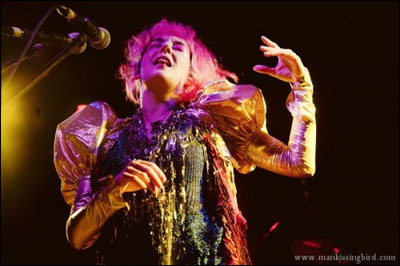
Kim Boekbinder. Photo by Marianne Bijou.
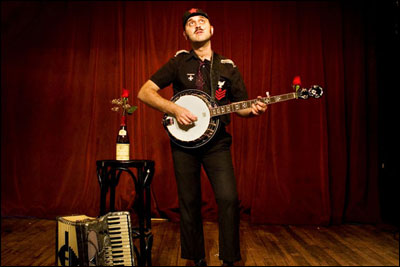
Franz Nicolay. Photo by Konstantin Sergeyev.

Brian Viglione. Photo by Ethan Miller.
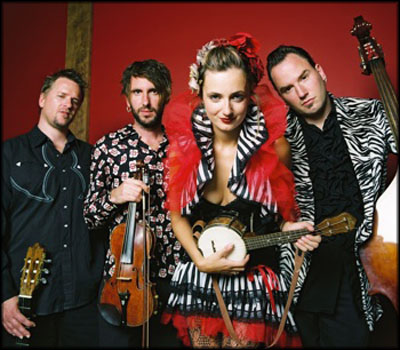
The Fishtank Ensemble (Promo photo.)
MUSIC: Kim Boekbinder (Vermillion Lies) Our beloved genre-defying songstress of murderous waltzes and epic pop ballads will woo us with voice, guitar, looping pedal and a bag full of mystery. In Coilhouse’s review of her album The Impossible Girl, Mer described her as “a bravely vulnerable, electrifying lightning rod of a woman.” She is all that and more. The wondrous Fishtank Ensemble (fellow Californians who just happen to be in NYC this week) will give us a blissful, heartmelting, booty-shakin’ dose of their signature blend of Roma, Serbian, flamenco, manouche, Turkish and Greek music, plus original compositions! Franz Nicolay (World Inferno, Hold Steady, Guignol) is a dashing moutsachioed multi-instrumentalist, composer, and the hardest working boho-accordionist in NYC. Brian Viglione (Dresden Dolls, World Inferno, Gentlemen & Assassins), who will be providing us with an assortment of unfettered, theatrical DRUM SOLOS throughout the evening, is an energetic, expressive, percussive powerhouse. Thomas Negovan, bless his beautiful heart, is flying all the way from Chicago to give us a delicious taste of occult-tinged, erotic, 1920s cabaret songcraft. Kelvin Daly, builder of unique musical instruments, will favor us with mysterious and elegant performances. Theremina (yes, that’s Mer’s stage name, shhh!) will humbly provide a wee bit of wistful, theremin-drenched ambient music to sway and swoon to. Ooo, and then there are the DJs! Wengrofsky – Scrappy and eclectic vinyl wizardry. PUREVILE! – Sets of new wave, dark glam, new romantic from the co-founder of DISKO NOUVEAUX.
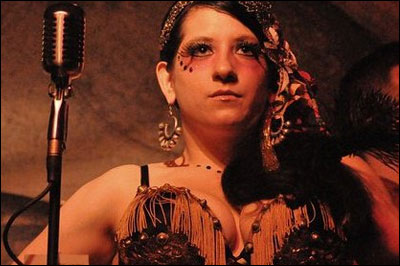
Sarah Hassan
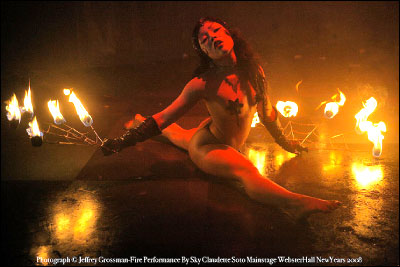
Sky Claudette. Photo by Jeffrey Grossman.
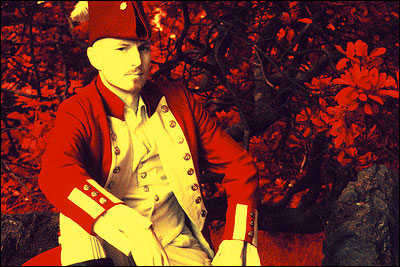
Our ringmaster, SF SLIM. Photo by Jacob Appelbaum.
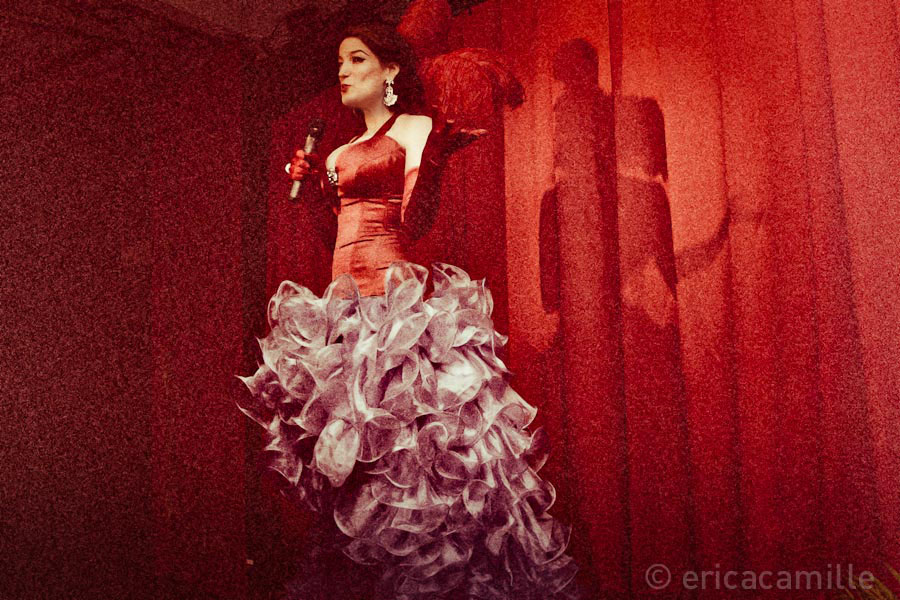
DANCE/CABARET: Our darling, delicious blog contributor, Sarah Hassan, will be taking the stage as a Bellow Dancer & Bedouin Showgirl. Paige & Ahnika (recently ‘Haused here) will provide a set of electrifying, emotive, empowering belly dance. LeRoi Prince is bringing us a bit of Weimar drag/burlesque genderfuckery with swagger and class. Liron & Daly, a bewitching husband and wife team, will give us aerials performed to live musical accompaniment. Eros Fyre – Sky & Vlad will perform feats of fire magick. Ian Baker of Interpretive Arson will be bringing out the fire rope dart. Our Master of Ceremonies is the one and only SF SLIM. Slim’s been a friend of ours for years; he’s a charming collaborative culture evangelist and a nattily-dressed Joy-Facilitator who “eats concepts and makes things”. We’re overjoyed that he’s agreed to be our ringmaster, in addition to helping out behind the scenes.
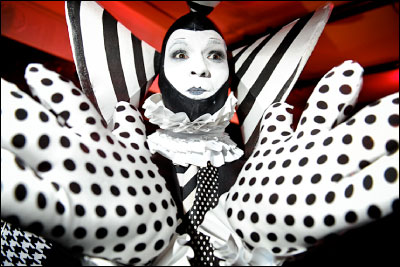
Muffinhead! Photo by Gabi Porter.
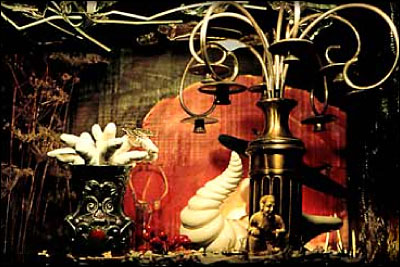
Some of Empire S.N.A.F.U.’s unsettling art.
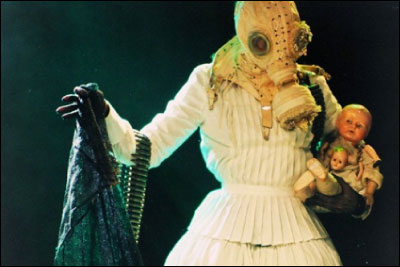
PUREVILE!
MISCELLANEOUS SPECTACLE & ODDITY: Some sort of gorgeously unsettling, as-of-yet-determined “art incident” courtesy of EMPIRE S.N.A.F.U will occur. S.N.A.F.U. is “a feverish visual and theatrical mélange of dystopian technology, sexual obsolescence, and implied religion,” painstakingly assembled from a vast and unsettling assortment of found materials. Muffinhead – Lavishly costumed, colorful performance absurdist; a spectacular cartoon imaginary made real. The PUREVILE! girls – Exquisite living dolls unearthed from some great-great-auntie’s steamer trunk, bedecked in bespoke post-apocalyptic Victorian finery. Three-minute theremin lessons from Mer, if you’re game to make some woo-woo noises. AND! Last but not least, a Black & White & Red All Over Photo Booth.
SILENT AUCTION. Items will include art donated by Diamanda Galas, Molly Crabapple, Jessica Joslin, Paul Komoda, Jason Levesque & Xeni Jardin, Century Guild, Disinfo, PUREVILE!, Kate O’Brien, Nicole Aptekar, and Asha Beta. There will also be a full set of the out-of-print, highly collectible back-issues of Coilhouse (Issues 1-5).
COSTUME SUGGESTIONS: Sharp curves in black and white and red, in keeping with the German Expressionist/Bauhaus/Constructivist color palette of the upcoming Coilhouse print issue. Think decadent Weimar, 1920s Soviet Union, Klaus Nomi, origami-inspired, architectural, Metropolis, or De Stijl fashion. Polar Bear & Penguin? Nun in red fishnets! Valentine’s Day Zebra. Vampire and Midnight Snack. Anything in the color scheme goes, as long as you GO FOR IT.
VIP TICKETS: Donations over $30 will grant patrons 5 pm admission for an East-meets-West tea service, and first access to the silent auction. The tea service will be from 5-7. Enjoy live acoustic music and crackling wax-cylinder ambiance, private salon performances, and cozy conversation with Coilhouse co-founding editors Nadya Lev and Meredith Yayanos. Depending on donation level, there are many goodies to be had! VIP pricing structure is as follows:
- $30 Coilhouse buttons + stickers + baubles
- $50 Coilhouse buttons + stickers + Coilhouse I/I/I coffee mug
- $75 Coilhouse buttons + stickers + plus codes for DRM-free, high res PDF downloads of Coilhouse out-of-print back issues 1-5 + Coilhouse laptop vinyl.
- $100 All of the above + limited edition “Interstellar Vanguard” print by Zoetica Ebb. (Print exclusive to this tier.)
- $150 Everything in $75 gift bag + free pre-order of upcoming Issue Six print mag + a signed one-of-a-kind magazine proof from a past issue of Coilhouse.
- $200 All of the above + second printer’s proof + a trip to the COILBOX to pick out a final “mystery merch” item worth $30 – $50
- $300 All of the above + acknowledgment in print Issue 07 as a Coilhouse Print Patron + personalized thank-you card from Nadya Lev and Meredith Yayanos.
GENERAL ADMISSION. The main event starts at 7:00 and goes until midnight. Entrance is $15.
Admission to the main party event is included with all VIP tea service and salon tickets.
SPECIAL DEAL FOR DANCES OF VICE ATTENDEES! The DoV Enchantment Under the Sea Dance is happening on Saturday, August 20th. Why not make a cross-pollinating, bohemian art and culture blow-out of the whole weekend? We’ve teamed up with Shien and Co. to offer a special ticket to those who attend both events. For $25, you can be a guest at both parties. This will gain you general admission entrance to both events.
LOCATION. Red Lotus Room. 893 Bergen (between Classon and Franklin). It’s a wee bit off the beaten path, but hey, aren’t we all?! There is a subway stop close by, and we’re arranging to have some clear (and possibly quite entertaining) signposts up for all folks coming by public transit from the train station to the venue.
WHAT NOW? All that’s left is for you to buy tickets and RSVP! See you there, loves.