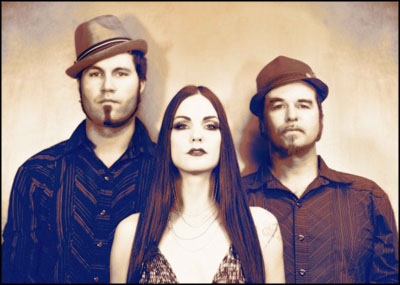
R.I.P. Earl Scruggs (Bluegrass Badass) January 6, 1924 – March 28, 2012
The hard-picking, war-protesting American folk music legend Earl Scruggs has died, aged 88.

The hard-picking, war-protesting American folk music legend Earl Scruggs has died, aged 88.

Good afternoon! Is anybody else having trouble staying awake today? You’re not alone…
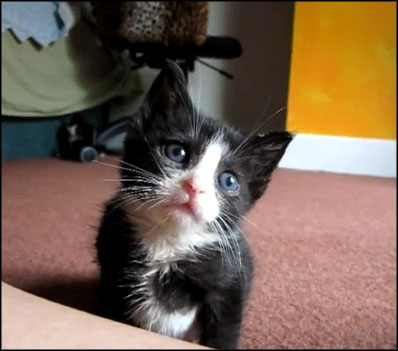
This is Lady Peanut. She is a very good listener:
(Guh. Is it any wonder this video’s going spectacularly viral?)
The soporific object of this wee kitteh’s affection is Sarah Donner, a self-proclaimed singer/songwriter/creative type/cat lady with a bright, sweet voice. She says “Lady Peanut […] likes to sit by me when I get out the ukulele.” The catchy tune Sarah’s singing is called “Treeline”, and she is kindly offering it as a free download through her ReverbNation account.
Sarah and a cameraman also made this charming Trap/Neuter/Return video documenting their personal TNR experience, which feels like an interesting/informative thing to share on a sleepy Monday afternoon:
To learn more about TNR and feral cat colonies, check out this ASCPA webpage. (In the interest of fair and complete reportage, while the ASPCA, the Humane Society of the Unites States, and other animal rights groups are pro-TNR, it is a controversial procedure which many wildlife and bird advocacy organizations have argued against. But either way, something to think/talk about.)
Visit Sarah’s website to find out lots of cute and funny details about her, and to hear more strummy folky yumminess.
In conclusion, here’s a screenshot of Lady Peanut’s sweet little face. Because, well, just LOOK at her. Squeeee…
I had never heard of Swedish duo Niki & The Dove before this, illness but their new single, capsule “The Fox”, ask has won me over with its loping, electronic beat and lovely vocals. The video, created by Seattle-based WINTR is, perhaps, more technically impressive than thematically. The constantly shifting mask and geometric shapes are beautiful (the night time scenes near the end being especially impressive) and work well with the song, but there is not much more to it than that. Regardless of your feelings on the visuals, however, the song itself is well worth a listen.
Via The Fox Is Black
Who knew that the Nyan Cat song could lend itself so well to space rock and shoegaze genres? Turn up the volume, close your eyes, and drift away in a tiny poptart rocket to the farthest reaches of the galaxy, leaving behind a rainbow of tiny bells and transcendental distortion.
Today, we celebrate what would have been Anaïs Nin’s 109th birthday by posting Bells of Atlantis, an experimental film from 1952.
The film stars Nin as the mythical queen of Atlantis and conveys, as Wonders in the Dark puts it, “the experience of trying to remember and re-experience a dream.” Over cascading experimental footage, Nin reads aloud from her novella House of Incest. We catch glimpses of her nude form swinging in a hammock, and we see her shadow undulating over sheer fabric blowing in the wind, but for the most part, the imagery, captured by Nin’s husband Ian Hugo, remains very abstract, creating a “sense of swimming through a hallucination, trying to get closer to a world clouded not only by its own hazy nature, but the veils of memory and reality cast over it – given form by the watery ambiance that washes over the images.”
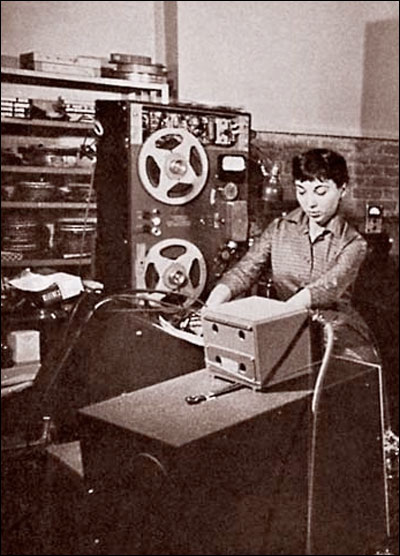
Bebe Barron, an early pioneer of electronic music.
The soundscape was crafted by Louis and Bebe Barron, two pioneers of electronic music who are best known for composing the world’s first entirely electronic music score for The Forbidden Planet, which the Barrons filled with “bleeps, blurps, whirs, whines, throbs, hums, and screeches.” They built their own circuits, which they viewed as “cybernetic organisms,” and spliced together the sounds they made into collages. Louis did the work of creating the circuits, while Bebe did most of the composing. Their sound, wrote Nin, was akin to “a molecule that has stubbed its toes.” Bebe Barron was one of the first women in the field of electronic music, and in her last interview, she fondly recalls memories of her friend Anaïs.
[via wobbly]
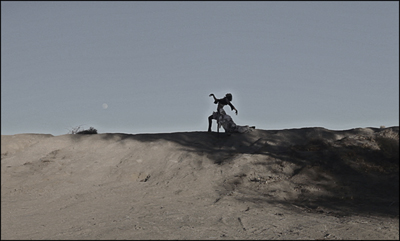
LA-based imagemaker/mover/shaker Sequoia Emmanuelle has just premiered this video of dancer Auberon Shull (definitely watch it full screen):
Filmed, edited and directed by Sequoia Emmanuelle
Dance by Auberon Shull
Hair and makeup by Ashley Joy Beck
Costumes by Tiffa Novoa and Auberon Shull
Music by Distance and Adventure Club
Auberon is a powerhouse. Sequoia, too, is a force of nature who has shot countless portrait series and fashion editorials with all manner of West Coast lovelies: Skingraft, Eskmo, Zoe Jakes and Rachel Brice (for Tawapa/Wild Card/Five and Diamond), Galareh, Kucoon, Beats Antique, Lucent Dossier Vaudeville Circus, El Circo… the list’s about a mile long. In addition to her photography portfolio and video work, Sequoia’s also got a well-established background in fashion design (check out her S&G Clothing line), wardrobe styling, painting, and graphic design.
Recently, she took the time to answer a few questions about her collaboration with Auberon, and to let us know what’s coming next. (Thank you, Sequoia! Always a pleasure.)
Much of the Coilhouse readership is already familiar with your photography, but this may be the first time many of us have (knowingly) watched a video by you. Can you tell us a bit about the differences and parallels between your creative process shooting/editing film and your photography methods?
Sequoia Emmanuelle: I grew up watching music videos, [they’re] a huge inspiration to me, and I have always planned on getting more involved with film/video as well as photography. In the last year I have been working on several videos for fashion, music and dance. It feels very natural to the way I see things for photography, but of course it is very different, too. For one thing, everything you shoot needs to be horizontal, so it changes the composition of how you set things up. Your lenses change, and lighting changes. You can’t use strobe lights for video, so you have to set things up quite differently. When it comes to editing, it’s quite involved, because you have to pay attention to all the moving details and make your cuts flow in an interesting and creative way, not to mention syncing up the music. Right now I am focusing on simple ways of creating artistic videos… using less is more for the time being, and I’ll surely get more experimental as I keep working at it.

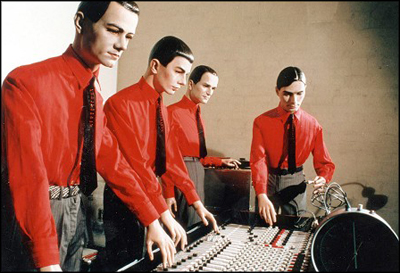
Holy shitballs. New Yorkers, you lucky ducks, you get to have ALL the retro-badass fun! Via East Village Radio:
Kraftwerk –one of the most important groups in electronic music’s relatively short history– will be the focus of a retrospective taking place in April at the Museum of Modern Art in NYC, the New York Times reports. The band, featuring lone founding member Ralf Hütter, will be present and performing as part of the celebration named Kraftwerk-Retrospective 1 2 3 4 5 6 7 8. Starting April 10th […] Kraftwerk will perform over eight consecutive nights, with each evening dedicated to one of the pioneering group’s albums in chronological order, starting with 1974’s Autobahn.
The concerts will be held MoMA’s (appropriately retrofuturetastic) Donald B. and Catherine C. Marron Atrium. Tickets go on sale at noon, February 22nd, $25 a pop. (Zounds, they’re gonna go fast!)
Randy Halverson’s gorgeously ethereal “Dakotalapse”. Comprised of thousands of 20-30 second exposures stitched together, it was shot mostly near the White River in South Dakota, with additional footage shot in Utah and Colorado.
In the opening “Dakotalapse” title shot, you see bands of red and green moving across the sky. After asking several Astronomers, they are possible noctilucent clouds, airglow or faint Aurora. I never got a definite answer to what it is. You can also see the red and green bands in other shots.
At :53 and 2:17 seconds into the video you see a Meteor with a Persistent Train. Which is ionizing gases, which lasted over a half hour in the cameras frame. Phil Plait wrote an article about the phenomena [for Discover Magazine] here.
There is a second Meteor with a much shorter persistent train at 2:51 in the video. This one wasn’t backlit by the moon like the first, and moves out of the frame quickly.
The soundtrack was done by Bear McCreary, who some of you may know from his work on Battlestar Galactica If you like this there is a 23 minute(!) extended cut available for download.
Via lens culture
Kiss – A Love Story is a stunning short film directed by Joseph Hodgson & Franck Aubry set to a beautiful song entitled “Stille” by Bendik. It’s not a complex piece, and fairly abstract, but it’s almost a perfect combination of sound and imagery. ( As John Martz at Drawn notes, you may want to set it to full screen when you watch it, as the aspect ratio makes the video tiny when scaled down to fit our template.)
Via Drawn