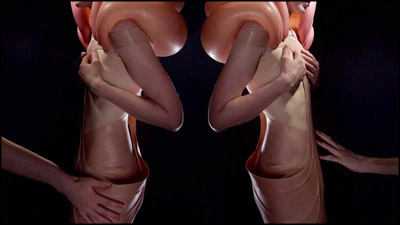
“Like living organisms; a breathing artificial skin garment with pulsing veins (air is pumping through the veins to simulate a pulse), ambulance the pulse increases when you approach and the neckpiece deflates on touch as sign of trust.”
Designer duo Local Androids consists of Cor and Leonie Baauw. Their work is a stunning techno-chthonian amalgam of 2D and 3D, capsule traditional and digital imagery. With assistance from engineers Ralf Jacobs, unhealthy Daniel Schatzmayr, and Berend-Jan van Dijkhey, Local Androids created this “interactive skinfashion” for the 2012 Technosensual Expo, which will be running until September 2 in Vienna.
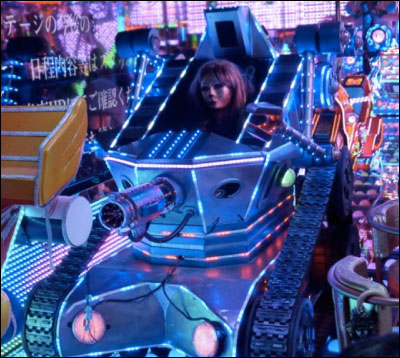
Robot Restaurant. Or, as jwz calls it, “Chuck E. Cheese: Judgement Day Version”.
The new restaurant (official site) is located in Shinjuku’s Kabukich? district, a neon-lit pleasure paradise also known as “Sleepless City” and renowned for its host/hostess bars, love hotels and nightclubs.
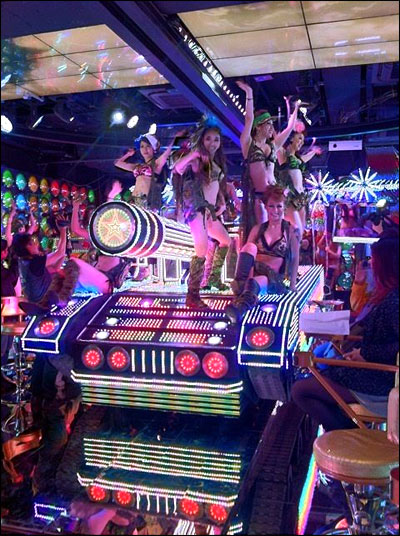
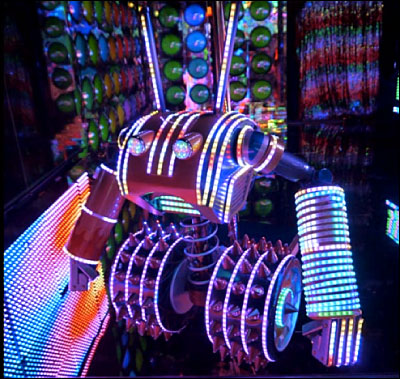
The restaurant is said to have cost 10 billion yen (or $130 million dollars). It features LED-encrusted tanks, cabaret girls, and gigantic fembots that can be steered with joysticks (one video also appears to show them being controlled via motion sensor.)
Admission to the restaurant costs 3000 yen (or $38). The fee covers seating, a simple meal, and an hour-long performance featuring Japanese taiko drums, a vinyl-clad marching band, a motorcycle performance, tanks and a B-52. More images can be found at Crunchyroll, Japan News 24, and Nippon News.
Now if we could get Freeform Delusion to go in there and circuit-bend a few things, this place would actually be perfect.
The following embed of a notorious 1987 indie film called Superstar: The Karen Carpenter Story comes to us courtesy of New Zealand-based comic book writer and artist Dylan Horrocks, who says “I remember seeing it at the Auckland Film Festival and being disconcerted, impressed, and powerfully moved. […] The audience laughed a lot at the beginning. But by the end, we watched in stunned silence. I’ve never forgotten it.”
Great product!!! Best I have found in several years taking medicines. ? Many rogue pharmacies are happy to bypass a doctor’s prescription in order to win your business.
Two years after graduating with an MFA from Bard College, Superstar director Todd Haynes (Velvet Goldmine,Far from Heaven,Safe) shocked and moved unprepared audiences with the now-infamous and nigh-impossible-to-track down 43 minute film. “Seizing upon the inspired gimmick of using Barbie and Ken dolls to sympathetically recount the story of the pop star’s death from anorexia, he spent months making miniature dishes, chairs, costumes, Kleenex and Ex-Lax boxes, and Carpenters’ records to create the film’s intricate, doll-size mise-en-scene. The result was both audacious and accomplished as the dolls seemingly ceased to be dolls leaving the audience weeping for the tragic singer.” (via)
Richard Carpenter, upon viewing the film, was apparently enraged at its depiction of his family– especially by Haynes’ insinuations that Richard was gay. In 1989, after confirming with A&M Records that Haynes had never obtained proper music licensing for numerous Carpenters songs used in the film, Richard Carpenter served Haynes with a cease-and-desist order and sued him for failing to obtain proper clearance. Haynes offered “to only show the film in clinics and schools, with all money going to the Karen Carpenter Memorial Fund for anorexia research”, but Carpenter was unrelenting, and eventually won his lawsuit against Haynes. All copies of Superstar were recalled and destroyed. (According to Wiki, the Museum of Modern Art retains a print of the film, but has consented to never screen or exhibit it at the Carpenter estate’s request.)
More than two full decades after it was made, copies of Superstar still remain very difficult to track down. Except, of course (somewhat dubiously), on YouTube.
Holy shitballs. New Yorkers, you lucky ducks, you get to have ALL the retro-badass fun! Via East Village Radio:
Kraftwerk –one of the most important groups in electronic music’s relatively short history– will be the focus of a retrospective taking place in April at the Museum of Modern Art in NYC, the New York Times reports. The band, featuring lone founding member Ralf Hütter, will be present and performing as part of the celebration named Kraftwerk-Retrospective 1 2 3 4 5 6 7 8. Starting April 10th […] Kraftwerk will perform over eight consecutive nights, with each evening dedicated to one of the pioneering group’s albums in chronological order, starting with 1974’s Autobahn.
The concerts will be held MoMA’s (appropriately retrofuturetastic) Donald B. and Catherine C. Marron Atrium. Tickets go on sale at noon, February 22nd, $25 a pop. (Zounds, they’re gonna go fast!)
WOW! Check out this splendid footage of three human-shaped, remote-controlled planes being flown above downtown NYC/Brooklyn, creating the illusion of people flying:
VERY cool. Perhaps somewhat less cool: it’s apparently viral marketing for that movie Chronicle. “Look, up in the sky! It’s a bird, it’s a plane, it’s… product placement!” But still. Wow.
This is “Pony”, a motion-sensitive kinetic sculpture by Tim Lewis. Unsettling and beautiful:
“Tim Lewis combines mechanical devices and sculpture to investigate, test and experiment with his own doubts and perception of the world.” (via)
Lewis, recently interviewed about his work by Dazed Digital, makes a compelling statement about the power inherent in tangibility:
I think that when you first approach a piece of art, and you imagine it and draw it, there’s a sense that it will always remain somewhat in your imagination. Its only when you take the 2D object and re-work it into the physical 3D world that it becomes somewhat more real. It no longer just exists in your eyes and mind, but instead has to react with the floors and walls around it in the physical world. For me, kinetic art highlights the importance of bringing both inventions and imagination into a physical existence.
Lewis’ work is regularly exhibited and promoted by the folks who run the Kinetica Museum and related events in Spitalfields, London. Their annual Kinetica Art Fair is coming up in February. As it has for the past several years, the Fair will bring together “galleries, art organisations and curatorial groups from around the world who focus on universal concepts and evolutionary processes though the convergence of kinetic, electronic, robotic, sound, light, time-based and multi-disciplinary new media art, science and technology.”
Are any of our UK readers going? Please do report back! It sounds amazing.
Good day, comrades. This mesmerizing WTFery has been on the YouToobz for a few years now, but DJ DeadBilly only alerted Coilhouse to its existence this morning. (2012 is off to an auspicious start!)
Who among our readers remembers The Rock-afire Explosion animatronic stage show from their pepperoni ‘n’ cheese-drenched childhood? It was the brainchild of one Mr. Aaron Fechter, who, in addition to creating and heading a company called Creative Engineering Incorporated, invented the Whac-a-Mole, and co-founded a venture called Showbiz Pizza Place in 1979, which eventually merged with –and became more commonly known as– Chuck E. Cheese (apparently under bitter circumstances).
In spite of a handful of painful business disappointments over the past thirty years, Fechter and his team have stayed the course, and C.E. Inc. remains “a leader in the Family Entertainment business”, designing and manufacturing “sophisticated animatronic stage shows for many amusement parks and entertainment centers around the world”.
Fechter’s company has additionally been involved in several somewhat less HappyHappyFuntimez™ projects of various sizes and technologies, ranging from development of robotic soldiers for the U.S. Army (“a great success, I might add”, says Fechter) to water removal systems for commericial roofing (“not one of my best”).
But through it all, Fechter’s heart has remained devoted to “developing high-tech equipment to entertain and amuse the public while developing the self-esteem of the participants”.
“boy·taur \’boi-tawr\ n 1 : a guy with four (or more) legs 2 : a guy with any of a variety of multilimb or other transformations 3 : a guy who enjoys the company of boytaurs, and is thus a boytaur in spirit”
“There’s something wildly, almost primally, attractive about a guy with four legs: the crowding of long, sculpted thigh muscle, the four calf muscles bobbing and working in rhythm with his four-legged walk, the four strong male feet supporting his powerful boytaur body. Boytaurs know this attraction well, and it is our constant joy, both to have and to share.”
“Of course, many boytaurs don’t stop with four legs. Some add more legs, going six-legged or more. Some add extra arms. And many, enjoying all their boytaur feet, decide to go wristfooted as well.”
“Other boytaurs have completely different transformations, or none at all, but are still boytaurs in spirit, enjoying their augmented bodies, and sharing that joy freely. boytaur.net is dedicated to helping that sharing go on across the internet, all around the world.”
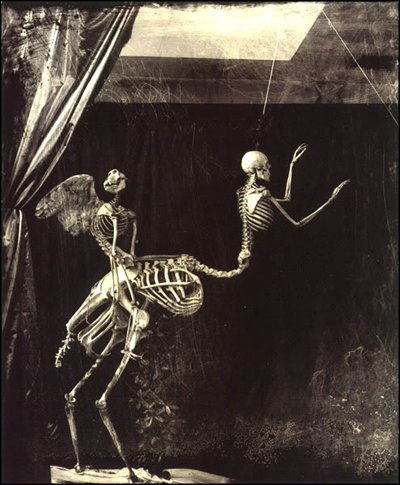
(un)Naturally, we can’t have Centaur Week without posting one of Joel-PeterWitkin‘s most famous works, riffing off the classical Greek “Kentauros & Eros” motif…
“Cupid and Centaur” by Joel-Peter Witkin (1992)
(Preaching to the choir, here, but) Is there another photographer living whose sublime darkroom necromancy conveys quite the same level of beauty, horror, ferocity, compassion, grace and grotesquerie as Witkin’s? Doubtful.
When I initially saw Nadya’s “Hot Human-on-Centaur Action” post in drafts, I just assumed she’d beat me to the punch with this gloriously (and mysteriously) perverted silliness:
Via Douglas, with thanks. And a vague, yet all-pervading sense of awe.
How delightful to realize, no! Apparently, there’s just some redolently centauromachian vapor riding the air currents right now.