Just in time to put you off your lunch, the Friday Afternoon arrives with 2009’s Food Inc, the scathing documentary/critique of America’s food industry. Directed by Robert Kenner and co-produced by Fast Food Nation author Eric Schlosser, Food Inc is of the variety that both infuriates and terrifies in equal measure. It must be pointed out, however, that if you are already up on the subject matter, or have already read Fast Food Nation, there isn’t a whole lot that is new here. Still, for those uninitiated in the horrific practices of companies like Monsanto and Tyson it can be an eye-opening experience.
Recently, it was shown on PBS for their POV segment — it can be viewed on their website until this coming Thursday, should the YouTube version get pulled — and was followed with the delightfully Lynchian Notes on Milk (Click that link to watch. Do it!) a short film looking at the rise of milk in America.
So get to watching, dear readers, and get a better picture of the horrible stuff we put into our bodies everyday. In the meantime I’ll get back to my Big Mac, because nothing tastes quite like Creutzfeldt–Jakob.
Update: Reader rbk points out that PBS is not viewable in America’s hat, Canadia. Therefore, filthy Canucks should go here.
Born in 1897, Lucille Bogan first began recording in 1923, singing vaudeville songs. By the 1930s she had established herself as a blues singer and her oeuvre was slanted decidedly toward the raunchy. In songs like “Sloppy Drunk Blues”, “Tricks Ain’t Walkin’ No More”, and “B.D. Woman’s Blues” (the B.D. stands for bull dyke) she focused on themes like gambling, drinking, lesbianism, and prostitution; themes that featured prominently in the juke joints she had worked in early in her career.
One of her last recordings, “Shave ‘Em Dry” in March 1935, had two versions, one that kept to the tamer innuendo of most blues songs and an unexpurgated version, featured above, which does away with subtlety altogether. An interesting little piece of historical titillation, if only for a retort to the “music today is morally bankrupt” argument often favored by the familial old-guard.
Kim Beaton and her digitigrade leg extensions. Photo by Dionwrbear.
The booming film industry here in Wellington, New Zealand (a.k.a “Wellywood“) has attracted phenomenal talent from all over the world. Creatives come from as far away as Los Angeles, London, Johannesburg, Vancouver and Tokyo to work on films like District 9, Avatar, and the LotR series. One such transplant is Kim Beaton, a multi-talented artist/inventor from Seattle who was recently hired by Weta Workshop to do conceptual design work on the upcoming Hobbit films.
Kim is a vibrant, intensely focused person who always seems happiest when she has multiple projects in development: large scale sculptures, community arts outreach programs, armor design and production, you name it! She’s also an accomplished inventor. In fact, many of you may already be familiar with one of her patents– last summer, two YouTube videos were posted of Kim striding through downtown Seattle in a pair of startling, stilt-like “reverse leg” extensions. The clips quickly went viral.
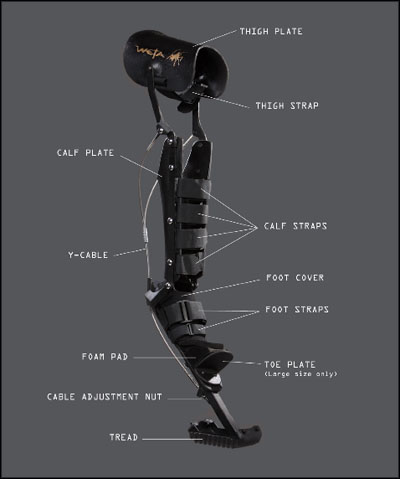
Upon arriving here, Kim was encouraged by Richard Taylor (5-time Academy Award winner and co-owner/co-director of the Weta Companies) to continue honing the digilegs’ design in the workshop. After several months of development and fine-tuning, the company is selling Kim’s professional design, now christened Weta Legs, for $945 U.S. dollars a pair. From the official site: “Weta has made many pairs of digitigrade leg extensions in the past for stunt men and creature performers in the movies and on the stage, but this is the first time we can offer [this] leg to anyone.” In fact, it’s the first time any company has put a line of digilegs into mainstream production.
A heads up to performers, costumers, burners, party monsters, cosplayers, designers and filmmakers– this is big. I’ve had the opportunity to test Kim’s prototype myself. They’re incredible. They’re comfortable. They’re FUN. I mean, really, really fun. Watch this instructional video (featuring Kim and a woman who has never been in stilts or extensions of any kind before in her life) to hear and see a bit about why her particular adaptation of the digitigrade concept is so unique and easy to acclimate to wearing.
As far as I know, there’s nothing else remotely like them available on the market. It’s very exciting news for Kim, for her company, and best of all, for all of the non film industry folks out there who can finally own a pair of these. Recently, Kim spoke with me at length about the history of digilegs, as well as her past community collaborations and several other upcoming personal projects. I hope you’ll enjoy getting to know this incredible woman and her work as much as I have.
Please describe the Weta Legs. What sets your invention apart from other kinds of stilts or leg extensions?
They have been called the Holy Grail of costuming. How do you build a device that will give a person the backward leg of a dog or horse? They are referred to by all sorts of names: digilegs, digitigrades, faun legs…
What does digitigrade mean?
A digitigrade is an animal that stands or walks on its digits, or toes. But this is not easy to say unless you like tongue twisters, so it was shortened to “digileg”. They’ve also been called “dog legs” or “reverse stilts”. Originally, we called them leg extensions, because they’re not really stilts, but we want to give them one name that is pretty easy to say. Hence, Weta Legs.
One mustn’t get too put out by who one’s friends choose to play with.
So goes the story of Ian Worrel’s short animated film, Second Wind featuring an old man and his giant feline traveling companion. It’s a beautiful six minutes, rife with expressive animation and a haunting score. Just the thing to perk up a boring Wednesday afternoon.
A gripping masterpiece of neo-noir psychological suspense. A mesmerizing meditation on the mysterious nature of identity. An inscrutable, profoundly unsettling fever dream, issued from deep within the director’s anguished psyche. A phantasmagorical family saga that ends in murder and betrayal.
It’s been nearly a month since Portland-based, multi-disciplinary artist John C. Worsley released Stars Lost Your Name, and it’s still my daily work accompaniment. The twelve-track album begins as a beautiful, dreamy blend of minimal electronic grooves and sedate guitar riffs, then slowly escalates, fluctuating between waves of intricate, restless layers, and muted ambiance. At times measured and brooding, at times brimming with anticipation, this is easily one of my favorite albums of 2010 so far. Bonus? Every song is named after a star, the album thus forming a constellation.
I’m a sucker for a concept album, and Stars Lost Your Name happens to be one of those. The official story goes like this:
On the 24th of February, 2010, a moving truck was picked up in Portland. Over the course of the following 6 days, 12 states, and 3096 miles, while helping a friend move from Portland, Oregon to Cambridge, Massachusetts, these 12 songs were initially composed; in motels, in living rooms, and in the passenger seat.
After returning to Portland by air, 6 more days were spent recording and arranging before the album was deemed finished at 66:48 in length on the 12th of March, and released the following 24th; a roadmap, memoir, and secret constellation.
You can download Stars Lost Your Name in its entirety, for free, here. Thank you, John. However, if you like what you hear, the album is also on iTunes. Love it with money!
When we started putting together Coilhouse issue 04, a haunted theme emerged. As issue 05 design got underway a couple of weeks back, a pattern appeared again, and this time it’s TETRIS. Yes, the clever game of geometry and speed hasbeen oneveryone‘s minds throughout the virtual Coilhouse HQ. To celebrate this bizarre synchronicity, here is a..curious tribute to the addictive and wonderful pastime, paid in full as only Europop can do. [via Kris Ether]
It’s time to re-examine the way we think about hats.
Via Jo Weldon‘s fascinating Formspring page comes this lo-fi snippet of Dada neo-burlesque, courtesy of the cheekily brilliant “reigning Cheese Queen of Coney Island” a.k.a. “The Girl With The 44DD Brain”, Miz Nasty Canasta:
(NSFW, and if hysterical cackling and/or car alarms set your teeth on edge, better skip it.)
The Brooklyn-based Canasta, who’s an inveterate pop culture geek, first came to my attention when io9 covered one of her gigs as a co-producer and performer in the whip-smart Pinchbottom Burlesque, which regularly features theatrical nudie shows based on sci fi to Biblical to classical literary references from Doctor Who to Dickens to Star Trek. Whenever she takes the stage, Canasta strives to “create a dazzling spectacle of perplexing proportions.”
Perplexing to say the least! And irreverent, and sexy, and hilarious. If you think the car alarm steez is outre, wait until you get a load of her signature Groucho routine! (For the sake of our darling worker bee readers, it’s after the jump.)
A treat for this, the 16th of April, in the year of our Lord Two Thousand and Ten. Today the FAM presents the 2004 BBC documentary Tetris: From Russia With Love at the risk of offending the beautiful yet cruel Nadya by forcing her to relive the traumatic events that led to the loss of her family and her subsequent immigration to the States. Even now as I sit here writing this, I strain my ears, listening for the tell-tale tapping of her limping gate, the staccato rhythm of cane and wooden leg working in lurching concert upon the stone floors and metal walkways of The Catacombs.
My editor’s sordid past aside, the BBC did a terrific job of examining the story of quite possibly the most addictive videogame ever made. A model of simplicity there are probably few of my generation that don’t remember their experience with Tetris; and I’m willing to bet that more than a few can relate stories of falling asleep and dreaming of falling tetrominoes or of being unable to expunge the home console version’s music from their brains.
The life of Tetris — created deep within Soviet Russia and leaked through the iron curtain, leaving a trail of in-fighting, threats, and questionable copyright law in its wake — is one of the great, epic tales in videogames. It encapsulates a time in the industry when games were just beginning to implant themselves as a cultural force and, in a broader sense, was a portent of things to come, arriving at the same time that the Soviet Union was beginning to dissolve.
In fact it’s easy to take Tetris as metaphor entirely too far. In it’s plainness and restraint it opens itself up to any number of meanings. It is perhaps best then to acknowledge it as a great game and leave it at that, lest one be tempted to sum up the end of the 20th century in terms of falling blocks.
After weeks of streamlining, updating, researching and grooming, our media kit is finally done. We’re so proud of it, comrades! It might seem a little strange to get the warm fuzzies over something intended for cold, hard commerce, but we feel that this is a respectful and elegant representation of Coilhouse and its readers. We’re excited. Especially when we think back to 2007 and realize just how far this good ship has traveled. For those interested in learning more about advertising in Issue 05, as well as in future issues, the 2010 Coilhouse Media Kit is available for download here. In addition to that reveal, we have three more bits of very interesting information to share:
Our biggest news is that we’re dropping the magazine’s price to $12.99 in stores. We’re doing this to give back to all the readers who’ve supported us through the years, and for everyone who wishes the magazine was slightly more affordable. The quality of the magazine (number of pages, paper stock) will remain the same. In fact, the overall quality of Issue #05 is going up, as we’ll be trying out a dazzling special effect on the cover, and including a large fold-out poster inside. For the time being, the mag will remain at $15 in our online shop and will include a special surprise (to be divulged at a later date), for those readers who buy directly from us. We’re committed to making the magazine more affordable both in stores and on the web, but we need to take it one step at a time. This is the first step.
We’re more than tripling our distribution in Barnes & Noble stores across the country. It will be in more stores than ever before! A list of locations will be posted. In addition, Issue 05 has been accepted into the Barnes & Noble Endcap Display Case – you know, the one that you see when you first walk into the magazine aisle, under the heading “Featured Titles” or “Just Arrived.” Issue 05 will be there for four whole weeks. This is a huge win for us, as we hope that we’ll be able to introduce more readers to Coilhouse than ever. Especially with such an intense cover, which we can’t wait to reveal to you. Eeee! We’re sitting on our hands to keep from spilling the beans. Soon. SOON.
Issue 05 will be appear in more independently-owned shops than ever before. We just got picked for distribution by Last Gasp, a respected distributor of all things alt, who recently celebrated their 40th birthday. They’re amazing. In addition to its history of publishing underground comix, Last Gasp is known for distributing items such as the RE/Search books, the Gothic & Lolita Bible, Hi-Fructose, Fantagraphics titles, and a lot of other more obscure counter-culture stuff. They can get us into a lot of cool mom and pop shops that other distributors don’t have access to.
Issue 05 will have more reach than any issue we’ve ever done, and it’s our most ambitious, colorful output to date. It’s so hard to keep the content of this issue under our hats! We’re sitting on our hands again. But there’s some beautiful stuff. You already know about the Neil Gaiman & Amanda Palmer piece, and some of you may have heard online whispers of Chet Zar and Zoë Keating and Gibbous Fashions and Crabapple illustrations… babies, that’s barely the tip of the iceberg. Just you wait.
For small businesses looking to advertise in Coilhouse, this is the issue. We considered putting that sentence in flashing, grunting, neon porno marquee lights for emphasis, but we are classy ladies. (Besides, we couldn’t figure out the HTML coding.) If you’ve been on the fence about taking out an ad, please note that this is probably the best issue to start. With the lower cover price, more people who haven’t heard of the magazine will be inclined to buy it. Combine that with special display promotion at Barnes & Noble, and it’s a guarantee that more folks will be picking up and leafing though it than our previous issues, which were often relegated to the back shelves of periodical purgatory.
We’d much, much, muchly much rather survive with the help of small independent businesses than large corporate sponsors. We cannot overstate that. Which is why we’ve kept the Small-Business Ad Format rates the same as they were before. It’s still possible to advertise in Coilhouse for as low as $99 per issue. We’ve hired a kick-ass Ad Manager, longtime Coilhouse reader Samantha Chin-Wolner, to help small businesses get their ads squared away. Sam will assist you with every step of the process, and she’s a total sweetheart.