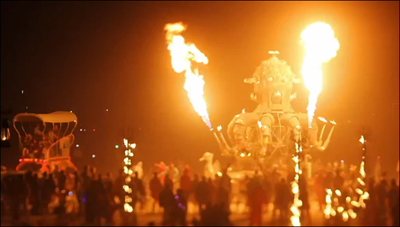
“Canon 60d, Canon digital rebel, Canon 5dII, shot as slow as 1 shot every 15 seconds and as fast as 6.5fps frames per second. Canon 90mm Tilt shift lens and a 17-35mm lens. Mumford Stepper Table and Time-machine for motion control.” (Via Ariana Osborne, thanks!)
This epic twenty-minute tilt shift video was shot at the gargantuan Burning Man festival earlier this year by James Cole, with additional motion-controlled time-lapse by Jason Phipps and Byron Mason. It’s a particularly vibrant window through which to observe the surreal bustle of Black Rock City. Whether you’re pro or anti-dubstep/techno, the accompanying music, provided by Elite Force and the DISTRIKT , feels wompingly apt. Fantastic editing.
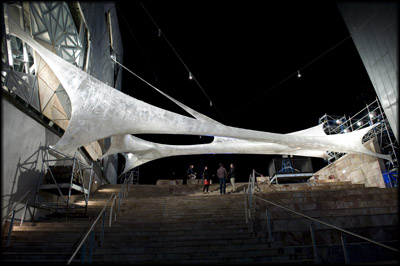
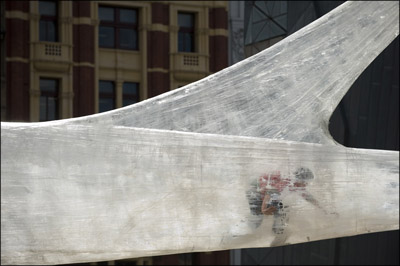
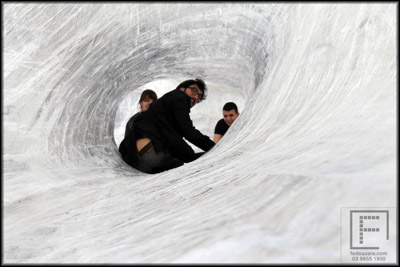
Numen / For Use are an art and design collective who create organic, web-like structures from adhesive tape. Their temporary installations are large and stable enough for several adults to crawl through, and the effect is not unlike being trapped in a giant spider’s web.
After climbing up a step ladder, you find yourself suspended in a series of glistening caverns, the frosted plastic obscuring your view of the outside world.
Photo by Fred Kroh.
Their latest project, Tape Melbourne, took eight days to complete, with three artists and fifteen volunteers working nine hours every day. The exhibit used thirty kilometers of tape to build, with more tape to repair and fix the structure on a nightly basis.
The Numen / For Use website contains more examples of their work, including images and videos of the construction process. You can explore their newest installation at Federation Square, Melbourne, Australia for a few more days; from now through September 24th, 2011.
Photo courtesy of Federation Square
More photos of the installation after the jump. (Editor’s note: This is our cherished intern Connie Chen’s first blog post for Coilhouse. Thank you, Connie!)
Some stunning images by photographer Catherine Hyland from her China Series and Wonderland. Located outside Bejing, Wonderland was designed to be the largest theme park in Asia. Construction began in 1998, but was halted because its developers and the local farmers could not come to an agreement on the proposed 120 acres of land required to fulfill such a grandiose vision. What’s left is one of those seemingly post apocalyptic landscapes that photograph so well.
Her other photographs from China are equally as impressive, featuring stark, urban lanscapes. The images of giant, towering apartment blocks and crowded alleys, cast in the perpetual daylight of a vast metropolis, have an otherworldly quality to them. You can see more from both series after the jump.
When I was a child, I had an ongoing and masochistic addiction to scale models. That is to say, that while I enjoyed miniatures, mostly of the military variety, I mainly enjoyed them in the idealized, finished versions in my head. I did not, however, take much joy in the harsh, time intensive reality of constructing a 1/48th scale German Tiger tank — a reality fraught with frustration and toxic substances. It was a truly volatile combination, I assure you, and usually resulted in my shaking with impotent rage over a pile of badly painted plastic, it’s surfaces ravaged by the effects of Testors Model Cement.
Despite a complete lack of ability (which I have learned to accept) I still find myself fascinated with diminutive, scale reproductions of places and objects. Randy Hage does not work in the area of war that so preoccupied the violent imagination of my youth, but his work is astounding. Focusing on New York City storefronts he recreates everything from the signage and shutters to the graffiti that adorns their facades and various bits of detritus inside and out. The level of detail here requires a patience that I never possessed or, no doubt, ever will.
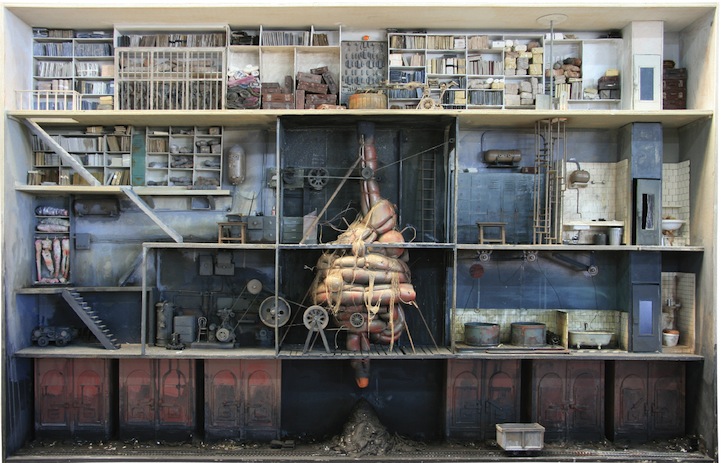
Le grand digérant (Digesting the great) No. 4, 102 x 162 x 15
“Giai-Miniet is what’d you get if Kafka had designed Barbie dreamhouses.” (via)
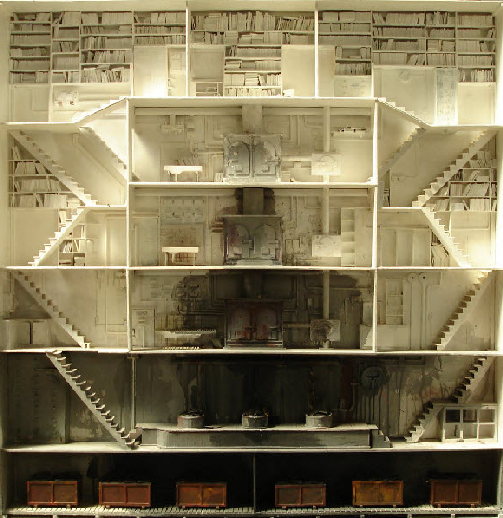
Dreamhouses? Perhaps more like maisons de cauchemars. Marc Giai-Miniet‘s painstakingly detailed, mixed-media shadow-box installations are reminiscent of a vaguely ominous, fading nightmare; a slumbering visitation to a childhood home, dilapidated and abandoned, darkened corridors permeated with a surreal atmosphere of dusty déjà-vu.
Ominous, fantastical, and yet on some level that barely registers – these ‘boxes’ are familiar and comforting in a way unique to those corners in which we have previously peeked and will explore once more when we are slumbering and our subconscious holds sway. Again and again we will wind through our own personal, chaotic and connected dreamhouses – and M. Giai-Miniet appears to know this full well.
Born in 1946 in Trappes, France, Marc Giai-Miniet studied at the l’Ecole Nationale Superieure des Beaux-Arts, a distinguished national school of Fine Arts in Paris, France. He is currently the Secretary of the Salon de Mai, a gallery founded in Paris with the purpose of encouraging and exhibiting younger abstract artists.
Marc Giai-Miniet, photo by Sylvie Giai-Miniet
According to Giai-Miniet (though run through Google translator) :
“The ‘boxes’ have appeared relatively late in my work as a painter, as a natural and necessary, and have become an inseparable part, a double play. Reminiscent of my teenage desire to do theater, and perhaps even the deepest yet my memories of childhood games pitched battles between miniature electric trains and installed under the table in the family dining room. These “boxes”, from their manufacture in the years 92 – 93, repeated the themes of my paintings: the brainwashing scene, visit the mummies, stirring transfusions and various larvae. Small characters were cardboard cut out of the ballet and existential irony of my painting. Over work, buildings are becoming increasingly large, the characters have disappeared and books, whole libraries have taken place in conjunction with laboratories, storage rooms, waiting or interrogation cells, stairs, corridors, furnaces, sewers or outbound docks … I understand that the books burned, and figured, were painful metaphor of human life, both mind and matter and inexorably doomed to their fate. . For not only the books can be burned but sometimes transmitted through knowledge, they we “burn”, we transform, we accompany or lead us astray … in a vision became ‘existential.’ ”
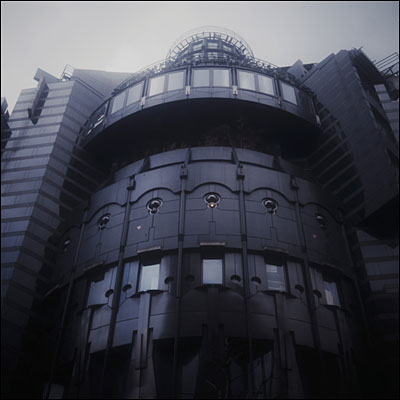
Flickr user turezure recently snapped this menacing picture of the Humax Pavilion in Shibuya. Doesn’t it look like it’s just sitting there, biding its time, waiting to bust a move, Megatron-style?
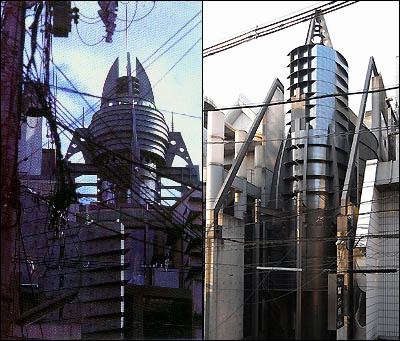
The Pavilion was designed in 1991 by Hiroyuki Wakabayashi, who also designed the Nankai 50000 train series, seen above. The design theme for the train was Outdated Future, and indeed, there is a suspicious resemblance to the 1978 Cylon Centurian model.Wakabayashi’s other works include the breathtaking Uji Station and Maruto Bldg. No.17 in Kyoto. [via Battling Pink Robots]
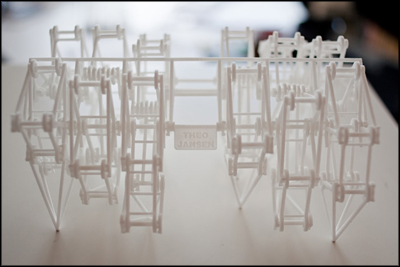
Jansen’s kinetic creatures have evolved quite a bit since then, and as of this month, the wonderful 3D printing company Shapeways has made a small version of Animaris Geneticus Parvus, available for purchase through their site.
These wee baby Beests, born from one of Jansen’s original behemoth windwalker designs, are “printed already assembled and [work] right after birth from the machine! No other production method can do this!” (Is 3D printing technology trippy, or what?) Apparently there are more Beests in development as well.
“Arthur Fellig, better known as Weegee, was a New York city freelance news photographer from the 1930s to the 1950s. Here he talks about his career and gives advice to those wanting to become news photographers.”
Weegee’s a phonetic version of Ouija. The cigar-gnawing Fellig earned his nickname “because of his frequent, seemingly prescient arrivals at scenes only minutes after crimes, fires or other emergencies were reported to authorities.”
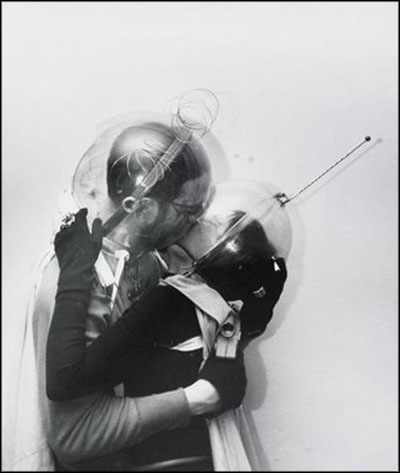
Crassly manipulative at times, and an unapologetic opportunist, Fellig also claimed (as heard in the interview above) to be a humanist at heart. As questionable as some of the paparazzo’s methods might have been, the human pathos of his imagery, whether it features tenement fire survivors, public drunks, murdered gangsters or smooching space cadets (seen below) is unquestionably powerful indeed.
EDITOR’S NOTE: Yet another wonderful post from our longtime contributor, Jeffrey Wengrofsky! This past year, he’s been keeping busy with all manner of projects, and this Sunday, April 3, his Syndicate of Human Image Traffickers will be screening “The Gospel According to Reverend Billy” as part of the Prison is an Angry Father fundraiser at Goodbye Blue Monday (1087 Broadway, Bushwick, New York). It’s a benefit for a prisoner’s rights project created by the Sanctuary of Hope. The event will include live performances of an almost musical variety, as well as the screening of several more short films in addition the Syndicate’s. Doors open at 8pm. Showtime for “The Gospel According to Reverend Billy” is 10pm. This event is free of charge.
Last year I spent my summer vacation working on a feature film in Detroit. While creeping around the city, I could not help but notice its mountainous Masonic Temple – the largest in the world – whose muscular shoulders rise above its environs as if Charlton Heston’s urban fortress in Omega Man were carved into Yosemite’s El Capitan. I was even able to arrange a private tour of the windowless monolith by its hospitable and wily Grand Master, including many meeting rooms and a majestic 4,004 seat auditorium (numerologists take note), all of it a visual feast for anyone with a taste for dramatic architecture, grotesque beauty, or even cryptography for that matter. While in the lobby, our guide offhandedly revealed three levels of meaning behind a seemingly random painting, and the stately oddities awaiting us in floors above and below nearly exploded with symbolic resonance. Unfortunately, the photographer I brought with me was so spooked by the whole experience that he ran screaming into the long night, ever since unreachable by phone or email.
And who can blame him? The uninitiated public can never comfortably claim to understand the true raison d’etre and inner machinations of secret societies because any scholar or spokesperson or self-declared defector may actually be a shill for the organization, planting seeds of misinformation and spreading misleading rumors. Even joining such a society does not entitle one to understanding the ways of its upper circles. Circles within circles, dear reader. Are you getting sleepy? The cinematic accoutrements – vaulted iron doors, masks, handshakes and cloaks – provide the perfect canvas for our fears of the unknown and desires for hidden order beneath evident chaos, conjuring a veil behind which we may never knowingly trespass. Consequently, it can never be definitely settled as to whether any or all such societies are actually: cults of mystical inquiry; wholesome gatherings of those serving laudable Enlightenment values of science and public service; the core of a dastardly “power elite”; congresses of people who enjoy rituals involving aprons (not that there’s anything wrong with that); or some combination thereof.
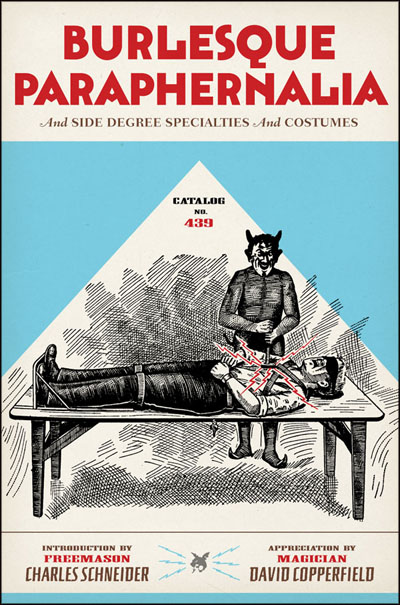
Last year, Fantagraphics reproduced Catalog No. 439 of the DeMoulin Brothers– the most extensive depiction of initiation contraptions and ritual outfits used by Freemasons and other fraternal orders, like the Odd Fellows, the Knights of Pythias, and E. Clampus Vitus. Bearing the title Burlesque Paraphernalia and Side Degree Specialties and Costumes, this wacky book may shed a shred of light into the outer sanctum of these associations – unless, of course, it is actually a hoax disseminated to lead us astray. Bracketing but never disregarding this notion, the readership of Coilhouse may discover certain Truths regarding these quasi-mystical clubs from perusing its glossy pages. Even if Enlightenment should, as always, prove ever elusive, the illustrated designs of Edmund DeMoulin and the handiwork of his brothers Ulysses and Erastus, as reproduced in Burlesque Paraphernalia, will still deliver amusing, if sadistic, anthropology.