Compared to others on the market, best price and quality. . Placing an order at our online pharmacy is simple.
Via Mike Estee, who writes: “the overt culture co-opting is perhaps the most realistic aspect of this futuristic Burning Man ad.”
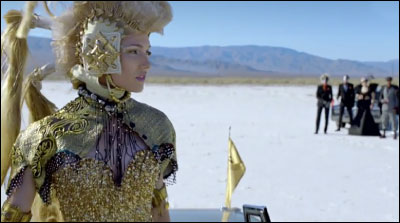
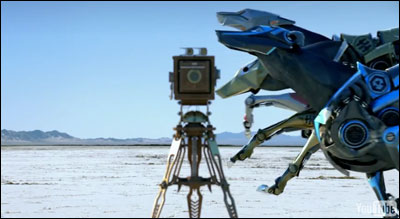
In this Absolut Vodka commercial, bougie leather-and-feathers trustafarians congregate for a day at the dog races in the desert. Except that the dogs are mechanical, controlled through a Tron-like interface in which three DJs play bad house music. Still, the fashion is breathtaking, the expensive props are beautifully-crafted, and the robotic greyhounds are strikingly feral and majestic. So mute the video, put on a song by Birdy Nam Nam, and enjoy.
Ultimately, the video’s douchy atmosphere (and weird racial tension) ruins what could have been a timeless commercial on par with Campari’s artful, transgressive spot for Red Passion.
It’s interesting to compare this video to images that clearly served as reference. The the groundbreaking influence of Tiffa Novoa, which manifests itself in many of the opulent fashions featured on the Twisted Lamb blog, likely inspired the ad’s costume design. A recent video crafted by Sequoia Emmanuelle that features Auberon Shull dancing in the desert is on par, in terms of quality, with this expensive ad. Except that instead of selling a beverage, Emmanuelle’s video promotes a powerful performer, independent musicians and alt designers.
We’re getting so close to the point where we have the tools to outstrip the industries that co-opt us. For example, with the advent of the RED, the Mark II, and the upcoming Blackmagic Cinema Camera, producing high-quality film footage is becoming more and more affordable. Kickstarter is providing a way for people to fund independent productions on a larger scale than ever before. So even as this Absolut ad tries to be futuristic, in many ways, it’s racing towards becoming a relic of the past – a time in which production quality belonged squarely to large advertisers with vapid aims. The future can’t come fast enough.
Holy shitballs. New Yorkers, you lucky ducks, you get to have ALL the retro-badass fun! Via East Village Radio:
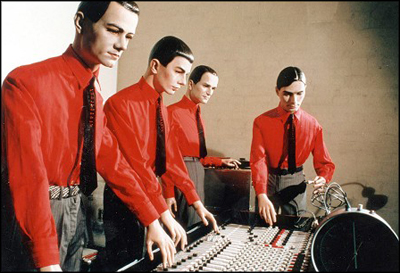
Kraftwerk –one of the most important groups in electronic music’s relatively short history– will be the focus of a retrospective taking place in April at the Museum of Modern Art in NYC, the New York Times reports. The band, featuring lone founding member Ralf Hütter, will be present and performing as part of the celebration named Kraftwerk-Retrospective 1 2 3 4 5 6 7 8. Starting April 10th […] Kraftwerk will perform over eight consecutive nights, with each evening dedicated to one of the pioneering group’s albums in chronological order, starting with 1974’s Autobahn.
The concerts will be held MoMA’s (appropriately retrofuturetastic) Donald B. and Catherine C. Marron Atrium. Tickets go on sale at noon, February 22nd, $25 a pop. (Zounds, they’re gonna go fast!)
This is “Pony”, a motion-sensitive kinetic sculpture by Tim Lewis. Unsettling and beautiful:
“Tim Lewis combines mechanical devices and sculpture to investigate, test and experiment with his own doubts and perception of the world.” (via)
Lewis, recently interviewed about his work by Dazed Digital, makes a compelling statement about the power inherent in tangibility:
I think that when you first approach a piece of art, and you imagine it and draw it, there’s a sense that it will always remain somewhat in your imagination. Its only when you take the 2D object and re-work it into the physical 3D world that it becomes somewhat more real. It no longer just exists in your eyes and mind, but instead has to react with the floors and walls around it in the physical world. For me, kinetic art highlights the importance of bringing both inventions and imagination into a physical existence.
Lewis’ work is regularly exhibited and promoted by the folks who run the Kinetica Museum and related events in Spitalfields, London. Their annual Kinetica Art Fair is coming up in February. As it has for the past several years, the Fair will bring together “galleries, art organisations and curatorial groups from around the world who focus on universal concepts and evolutionary processes though the convergence of kinetic, electronic, robotic, sound, light, time-based and multi-disciplinary new media art, science and technology.”
Are any of our UK readers going? Please do report back! It sounds amazing.
A short film by Jim Henson from 1963 created for an AT&T seminar on data communication:
The organizers of the seminar, Inpro, actually set the tone for the film in a three-page memo from one of Inpro’s principals, Ted Mills to Henson. Mills outlined the nascent, but growing relationship between man and machine: a relationship not without tension and resentment: “He [the robot] is sure that All Men Basically Want to Play Golf, and not run businesses — if he can do it better.” (Mills also later designed the ride for the Bell System at the 1964 World’s Fair.) Henson’s execution is not only true to Mills’ vision, but he also puts his own unique, irreverent spin on the material.
Sure beats a PowerPoint presentation. This wasn’t the first gig for the smoke-belching, metal host either, it had already made a previous, corporate appearance in 1961, at the US Food Fair in Hamburg, Germany:
I seem to have completely missed this upon its release (and it may have been better posted around Christmas), but Cool Hunting has a short profile of Lou Nasti, whose studio, Mechanical Displays, who has done animatronic installations all over the world. His most famous might be various Christmas displays for storefronts on Manhattan’s 5th Avenue. Nasti (whose resembles Disney’s version of Mister Geppetto to such a degree that one would be forgiven for thinking it intentional) is the perfect type for this sort of piece: earnest and in love with his work. He oversees a shop stacked high with tools and parts, and toys. Admittedly, I have a penchant for these sorts of spaces, with their towering, organized clutter. They have a character all their own, often as interesting as the people who work in them.
Good day, comrades. This mesmerizing WTFery has been on the YouToobz for a few years now, but DJ DeadBilly only alerted Coilhouse to its existence this morning. (2012 is off to an auspicious start!)
Who among our readers remembers The Rock-afire Explosion animatronic stage show from their pepperoni ‘n’ cheese-drenched childhood? It was the brainchild of one Mr. Aaron Fechter, who, in addition to creating and heading a company called Creative Engineering Incorporated, invented the Whac-a-Mole, and co-founded a venture called Showbiz Pizza Place in 1979, which eventually merged with –and became more commonly known as– Chuck E. Cheese (apparently under bitter circumstances).
In spite of a handful of painful business disappointments over the past thirty years, Fechter and his team have stayed the course, and C.E. Inc. remains “a leader in the Family Entertainment business”, designing and manufacturing “sophisticated animatronic stage shows for many amusement parks and entertainment centers around the world”.
Fechter’s company has additionally been involved in several somewhat less HappyHappyFuntimez™ projects of various sizes and technologies, ranging from development of robotic soldiers for the U.S. Army (“a great success, I might add”, says Fechter) to water removal systems for commericial roofing (“not one of my best”).
But through it all, Fechter’s heart has remained devoted to “developing high-tech equipment to entertain and amuse the public while developing the self-esteem of the participants”.
ROSA is, perhaps, not the most original short film ever and, in fact, it does feature a healthy dose of post-Matrix kung-fuery, but that makes it no less impressive. Made by one man, Spanish comic artist Jesús Orellana, for $100 and a year of his life, ROSA tells the story of a cyborg who, as part of a project to restart Earth’s ecosystem, awakens in a post-apocalyptic with no natural life, only other cyborgs who seem intent on destroying Rosa. Again, there’s a lot of slow motion jumping and martial arts pat-a-cake, and the characters themselves are a bit stiff at times, but the fact that one person was able to produce something of this scale is impressive. Orellana has, apparently, already been approached by some studio types so it’s quite possible that we may be seeing much more of Rosa in the future.
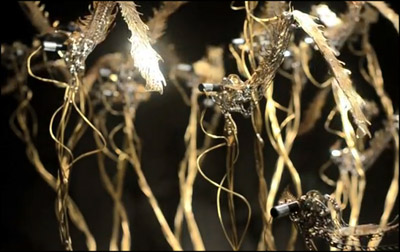
This beautiful video footage was recently shot by the Asia Society Museum in New York City, where Korean artist U-Ram Choe‘s most recent triumph, a shimmering, golden, “breathing” sculpture, is being premiered.
Most of Choe’s elaborate kinetic sculptures are assembled from stainless steel and acrylic, and motorized with robotics that he himself develops and programs. The above work, called Custos Cavum (“Guardian of the Hole” in Latin) is a particularly delicate and elaborate piece created as a response to this tenth-century Shiva Nataraja sculpture. (Custos Cavum is part of the Asia Society’s “In Focus” series, which invites contemporary artists to craft new works inspired by pieces from the museum’s permanent collection. Choe’s new work is being shown with the Shiva sculpture.)
Choe has stated that his creation is “a creature [that] protects the flow of communication between the two realms that assures mutual respect. In this fable, the guardian is a symbol of coexistence just as the Hindu god, Shiva, is a symbol of balance and harmony.” (via)
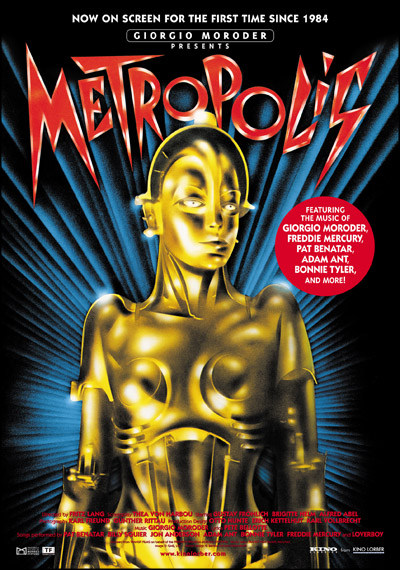
“In 1981, here three-time Academy Award-winning composer Giorgio Moroder began a three-year endeavor to restore the science fiction classic, Metropolis. During this process, Moroder made the controversial decision to give the film a new, contemporary score, and added a pop music soundtrack featuring songs from some of the biggest stars of the early MTV era, including Pat Benatar, Billy Squier, Freddie Mercury, Bonnie Tyler, Adam Ant, Jon Anderson and more. In addition to the new score, missing footage was re-edited into the film, intertitles were removed and replaced with subtitles and sound effects and color tinting were added, creating an all new experience…and an all-new film! But for more than a quarter century, this version of Metropolis has remained out of print – until now. A new HD transfer was created from one of the few remaining prints available, and Kino Lorber is presenting the film in the best possible quality – just as it was seen in its original release in August 1984.”
Seen it? Love it? Hate it?
No matter what, these current screenings are sure to be lively, campy, fun gatherings. (If any of our good readers up going, please report back!)
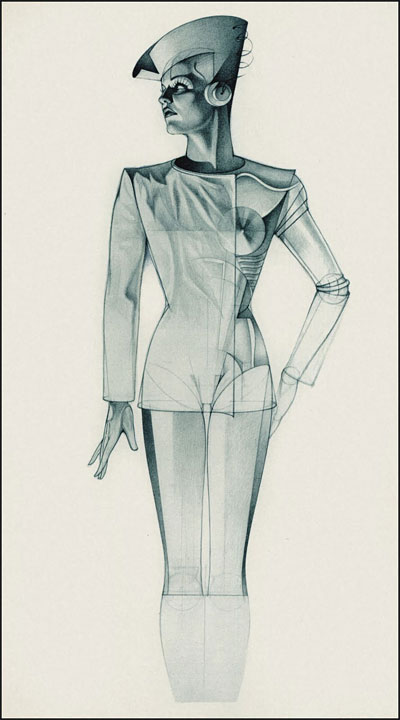
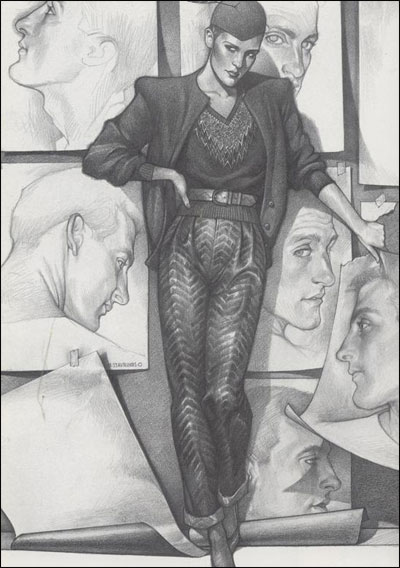
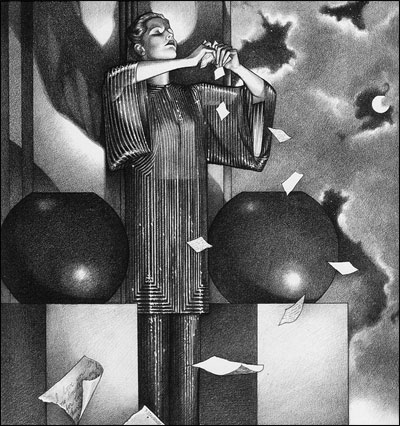
George Stavrinos was a fashion illustrator who lived from 1948-1990. Not much is written about him on Wikipedia at the moment, but according to illustrator Thomas Heller Buchanan, “his softly modeled pencil drawings were a mainstay of Bergdorf Goodman and Barney’s fashion ads, though Stavrinos did not consider himself a fashion illustrator. He was an artist, photographer, commercial illustrator, and filmmaker.”
A graduate of RISD, Stravinos was known for his representational style and strong draftsmanship that “created an arresting new look that set the pace for his contemporaries and still continues to be an influence,” according to his bio in the Society of Illustrators Hall of Fame. A huge fan of J. C. Leyendecker, Stavrinos crafted striking illustrations that mixed time periods and transcended the world of fashion. He died from pneumonia complications at the young age of 42.
Despite the bizarre scarcity of information available about Stavrinos on the web, one unlikely source turned up to give a glimse into his life: this auction website. In describing a rare book of Stavrinos illustrations printed in Japan, a person who may have known Stavrinos writes:
When my dear friend George Stavrinos arrived in New York in November 1973, he had but five hundred dollars in his pocket and a portfolio of dreams tucked under his arm. At that time Fashion was the almost exclusive province of the photographic image. Fashion Illustration, which had once flourished under the magical touch of Lepape and Benito, or much later, under Gruau, had devolved into bland, linear sketches of half hearted ads. … Into this vacuum enters Mr. Stavrinos whose illustrations for Bergdorf Goodman and Barneys New York, brought back a lushly representational style of Fine Art Illustration not seen since the days of Charles Dana Gibson, Howard Chandler Christy, J.C. Leyendecker and Antonio Lopez. The Stavrinos style was characterized by a great attention to detail, an exactness and a symmetry normally associated with classical works. His work revolutionized fashion illustration in much the same way that Bruce Weber, Herb Ritts & Scavullo revolutionized fashion photography. For while his work is highly representational, it’s imagery evokes those tender, tingling feelings of Romance & Longing. Memories of a time that never may have never existed, except in our imaginations.
In addition to his contributions to the fashion world, Stavrinos also has a place in the history of LGBT art. He created a smoldering cover for first edition of The Deformity Lover, a book of queer poems by Felice Picano, his illustrations ran in Christopher Street and Blueboy, two seminal gay magazines of the 1970s, and he may have contributed an uncredited cover for Paul Monette’s “Taking Care of Mrs. Carroll.” His most overtly homoerotic works, The Bather and Lifeguard, appear in the Leslie Lohman Museum of Gay and Lesbian Art.