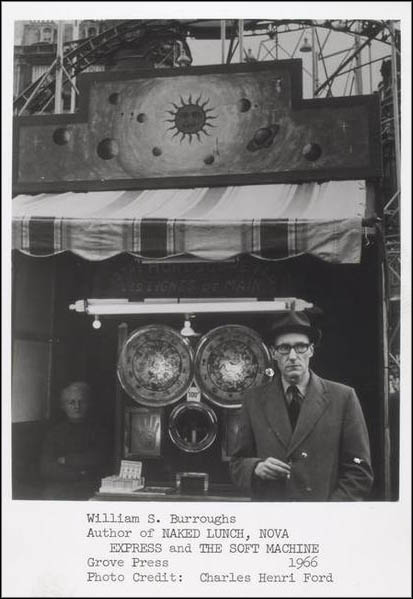
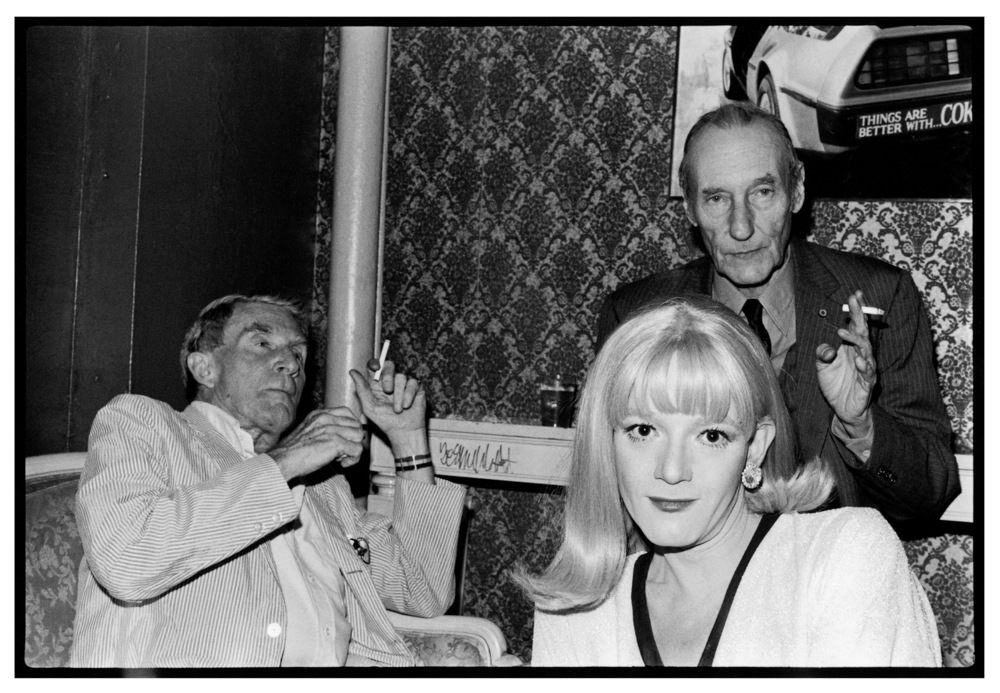
Yes. Hello. Feb 5th is the date of novelist William S. Burroughs’ birth. Coilhouse should really show the man some love. W.S.B. double feature, anyone?
First, The Cut-Ups, a mesmeric and disorienting experimental piece Burroughs put together with filmmaker Antony Balch (aided by multi-disciplinary art firebrand Brion Gysin and others) in 1966. Over the course of twenty minutes, it plays out in very much the same vein as Burroughs’ literary cut-ups, only with multiple sensory layers of headfuckery. (Read more about the film here / the generalized concept of cut-ups here.)
Second, a clip from the 1983 documentary Burroughs, wherein the birthday Billy reads aloud and acts out the horrifically funny Dr. Benway passage from Naked Lunch. Co-starring Jackie Curtis as the nurse! (And check out this amazing photo of Gysin, Curtis, and Burroughs together. Dawww.)
“Your mind will answer most questions if you learn to relax and wait for the answer.”
(W.S.B.)
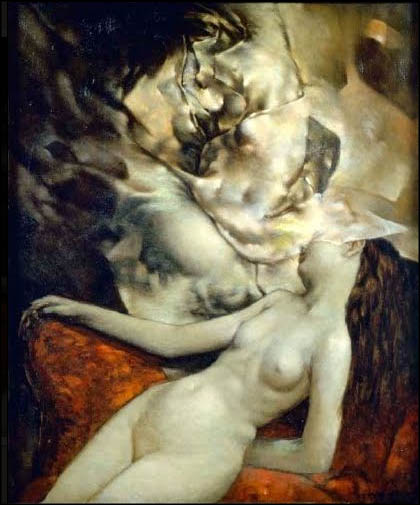
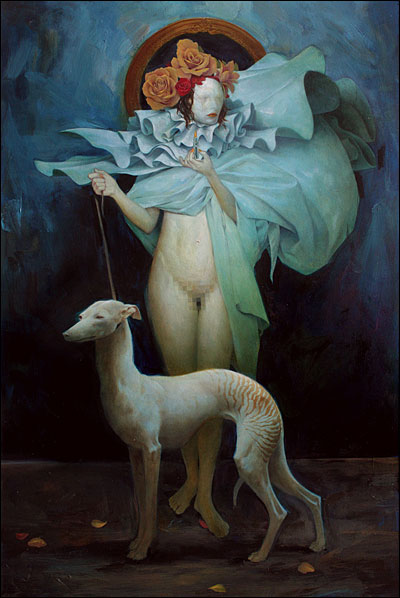
Sleeping Nude (1954) by Dorothea Tanning. Oil on canvas.
And she did. Countless others have walked through that door behind Dorothea Tanning– fellow iconoclasts and creative powerhouses (many women, but surely, many not) who might never have pursued their work otherwise.
Her independence, her intelligence, and her centenarian resolve to lead an extraordinary life no matter what, should be as central to her legacy as her art and writings. Tanning died in her sleep last night at the age of 101…
“…and pieces of history die with her. Artist, poet, wife of Max Ernst from 1946 until he died in 1976, and (along with Frida Kahlo, Leonora Carrington, Kay Sage, Lee Miller, Maya Deren, Remedios Varo, and Leonor Fini) one of a group of great women Surrealists, she was at the center of a movement that was a vicious mill for women. Among the surrealists, females — while ‘allowed’ to be artists — were often also relegated to the sidelines of neglected or beset mistresses, muses, and madwomen.” ~Jerry Saltz (for New York Magazine)
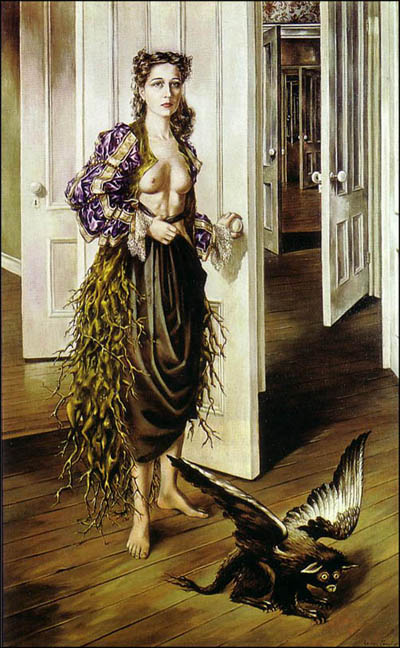
Birthday (1942) by Dorothea Tanning. Oil on canvas.
Her advice to younger generations: “Keep your eye on your inner world and keep away from ads, idiots and movie stars.”
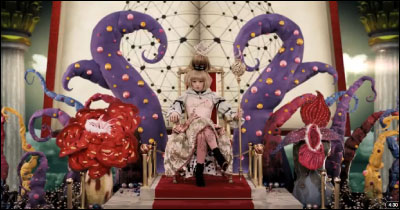
Featured previously on Coilhouse for her debut music video Pon Pon Pon, 19-year-old blogger-turned-singer Caroline Charonplop Kyary Pamyu Pamyu (also known is Kyary, or Carrie Pam) is back with a new music video for her single Tsukema Tsukeru.
According to Super Happy Awesome, the song is all about the application, appreciation, and effects of false eyelashes. Kicking off the video with a sparkly-lashed wink to Kanye’s Power (which was also parodied to great effect by Freddie Wong), Kyary celebrates the art of eyelash extension through lyrics (“It’s the magic in a type of eyelash / My confidence changes, the way I see the world changes”), choreography (plenty of jazz hands emulating the batting of full lashes), set design (with some terrifying CGI depictions of the (lash-bedecked) Hamsa Hand floating in the background), and, perhaps most potently, costume design (featuring an extra head on top of her wig wearing lashes, a rather anatomical-looking corset decorated with an eye pendant, and two giant false eyelashes on her boobs).
The same team that created Pon Pon Pon was responsible for Tsukema Tsukeru. The song was produced by Yasutaka Nakata, one half of the electronic duo capsule. The video was art-directed by Sebastian Masuda, a pioneer of “kawaii culture” who also founded Harajuku fashion label %6DOKIDOKI. Masuda and Kyary also recently collaborated on an exhibition titled Table of Dreams.
In describing his first meeting and subsequent collaboration with Kyary, Nakata calls her “the ‘spirit bomb’ of Harajuku culture.” (The spirit bomb, the translator explains, “refers to an attack in the classic anime ‘Dragon Ball’, which channels the energy of surrounding life forms into a powerful sphere.”) Kyary’s success, writes Nakata, lies in her ability to infect people with enthusiasm for her projects. “I think it’s because everyone who gathers around Kyary feels like, ‘if I were with Kyary, I’d be able to express things that are new to me.’ That is, of course, how I feel too. So it’s different from a collaboration, and – to tell the truth – even saying that I produce her has a different meaning. The closest I can get is saying, ‘I’m doing it just for the fun of it.’ I feel like Kyary has this power in her to involve people that way.”
WOW! Check out this splendid footage of three human-shaped, remote-controlled planes being flown above downtown NYC/Brooklyn, creating the illusion of people flying:
VERY cool. Perhaps somewhat less cool: it’s apparently viral marketing for that movie Chronicle. “Look, up in the sky! It’s a bird, it’s a plane, it’s… product placement!” But still. Wow.
This is “Pony”, a motion-sensitive kinetic sculpture by Tim Lewis. Unsettling and beautiful:
“Tim Lewis combines mechanical devices and sculpture to investigate, test and experiment with his own doubts and perception of the world.” (via)
Lewis, recently interviewed about his work by Dazed Digital, makes a compelling statement about the power inherent in tangibility:
I think that when you first approach a piece of art, and you imagine it and draw it, there’s a sense that it will always remain somewhat in your imagination. Its only when you take the 2D object and re-work it into the physical 3D world that it becomes somewhat more real. It no longer just exists in your eyes and mind, but instead has to react with the floors and walls around it in the physical world. For me, kinetic art highlights the importance of bringing both inventions and imagination into a physical existence.
Lewis’ work is regularly exhibited and promoted by the folks who run the Kinetica Museum and related events in Spitalfields, London. Their annual Kinetica Art Fair is coming up in February. As it has for the past several years, the Fair will bring together “galleries, art organisations and curatorial groups from around the world who focus on universal concepts and evolutionary processes though the convergence of kinetic, electronic, robotic, sound, light, time-based and multi-disciplinary new media art, science and technology.”
Are any of our UK readers going? Please do report back! It sounds amazing.
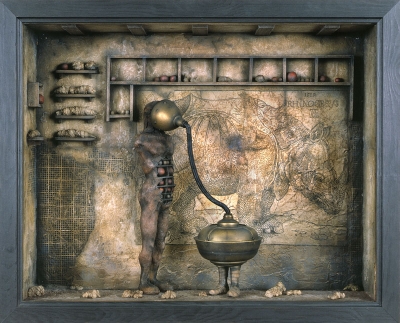
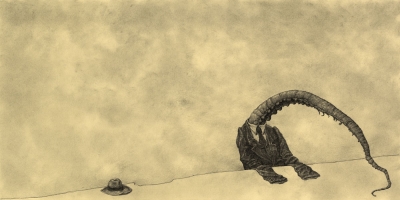
Spanish artist Oscar Sanmartin Vargas has a staggering portfolio of mixed media work, and ranging from dioramas, pharm to surreal architectural etchings, to detailed studies of alien biological specimens. The drawings are especially haunting; all their subjects depicted under a perpetually overcast sky. In regards to those strange animals: he released a book in 2007, entitled Leyendario: Criaturas de Agua (Legendary Creatures of the Water), a video preview of which can be found below. I am completely smitten with these — the line work, the use of empty space, the mystery of them. They are simply wonderful.
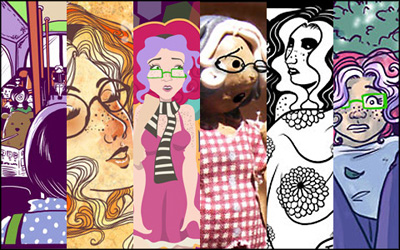
Megan Rose Gedris’ comic Yu + Me is billed as a surreal lesbian romance- and it’s hard to say more than that with out spoiling it. In fact, this is one of those situations where, for some people, even mentioning the spoilers may spoil it. If you prefer stories in which things are what they seem, Yu + Me may not be your cuppa. But if you enjoy adventure, love, and a decadent proliferation of visual styles, then dive in. It’s a complete story, just short of 850 pages. Take a weekend and indulge.
Societal Beauty | acrylic and oil on board | 20 x 30. “Part of a body of work focusing on human embodiments.”
Jeremy Enecio‘s work explores sexual and mythological themes. Enecio is one of those generous artists who shares the steps of his technique; his Vimeo channel feature a timelapse video of him creating a painting in painting of a tentacled girl (this is back from 2007, so his technique may have changed since then).
Enecio’s blog features many beautiful images that are not on his website, including Doll (a painting about a sexual the sexual tension between a couple), a work-in-progress that would eventually a painting titled Technology, an aging satyr, and a beautiful eyeless serpentine dragon. Enecio has a shop of very affordable prints as well.
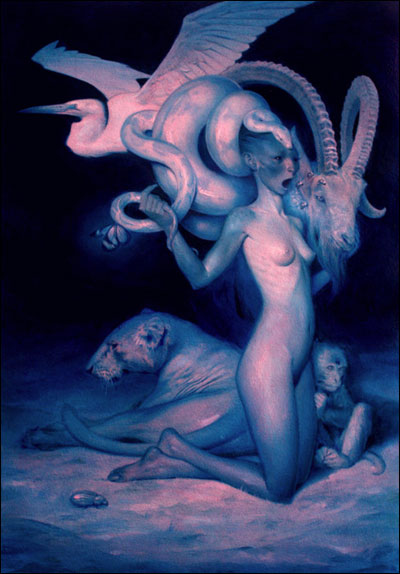
Fauna | acrylic and oil on paper | 13.5 x 20 “Part of a body of work focusing on human embodiments.” Here is a look at the painting in its drawing stage.
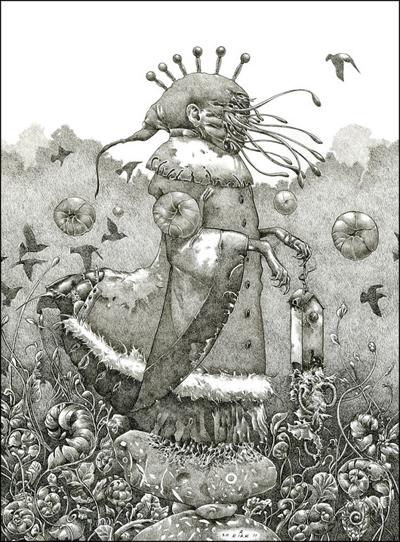
“The Sinister Game of Paperface” by Richard A. Kirk
Artist and author Richard A. Kirk (who we’ve mentionedtwice before on the blog) has just put a bunch of very reasonably priced prints of his recent work into his Etsy store. If you’re shopping for darkly whimsical holiday gifts for your more fae or macabre friends (or just for yourself!) you’ll definitely want to take a look at these intricate, elegant pieces.
Kirk’s phenomenal illustrated novella, The Lost Machine, is also worth checking out– a bleakly beautiful weird fiction story that features ghosts, witches, crows, and enchanted automata. Kirk’s prose is as delicate, finessed and strange as his drawings. Highly recommended.
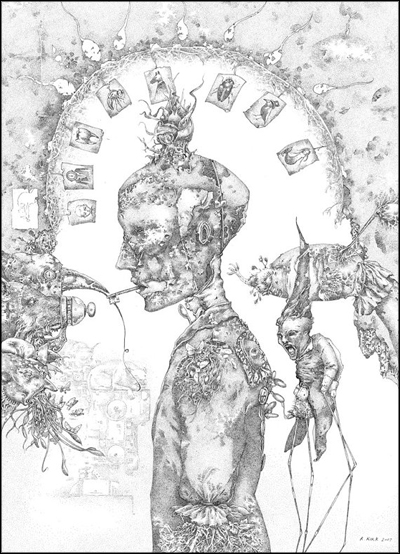
“The Unaccountable Absence of the Wastrel” by Richard A. Kirk
“I had some kind of epiphany about not chasing something in the above-ground world. Something happened in me that I no longer wanted to be in a band that wanted to be famous and go on tour. I just wanted to do something that was ours. I guess it was firmly planting myself in the underground, not after some kind of success that my parents would like.
…In the olden days of New York they had bands and dancing. Dancing and performers of every kind — spoken word, circus, whatever — in the same venue. Places like the Mud Club or Danceteria had a lot of different spaces and a lot of different installations and all kinds of different people went.
And then this weird thing happened when it suddenly became all giant discos and little rock bars. And those people never went to the same place anymore. It seemed like when we started doing Rubulad that people really wanted to be in the same space. They wanted to watch a band and go dance. And be happy.”
~Sari Rubinstein, co-founder of Rubulad, interviewed by Nonsense NYC
Oh, loves. We cover a lot of micropatronage drives on da ‘Haus, but the Rubulad Kickstarter project is especially near and dear. They have been an indescribably huge inspiration to many, many people involved with Coilhouse.
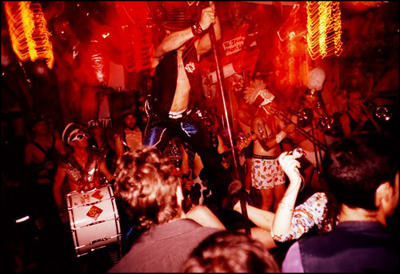
What is Rubulad? Back in 1993, two lovely souls named Sari Rubinstein and Chris Thomas took out a lease on a 5,000 square foot basement in south Williamsburg. Maybe a dozen other people got in on that initial deal, mostly artists and musicians in need of a cheap communal space where they could spread out and work. They all started building up and decorating the space communally. Soon, it became a fun, subterranean hang-out location that drew all sorts of kindred spirits together for dinners, readings, rehearsals, etc.
After a while, Sari, Chris, and their cohorts started throwing parties to cover each month’s rent. Over the course of the next few years, Rubulad (cleverly named with touch-tone letters that corresponded to the space’s phone number)’s space began to evolve, to literally bloom (with vibrant paper flowers, glittering murals, rope vines, colored glass, paper mache sculptures), and the parties developed into these elaborately themed bohemian blow-outs. They. Are. Fucking. AMAZING. For seventeen years now…
(Hang on, let’s take a moment. Seventeen. YEARS.
Yeah.)
…Rubulad has been instrumental in planning and throwing all kinds of events. They’ve already had to move their main warehouse space twice, but their warm, inviting DIY ethic has never faltered or changed; it’s only grown stronger.