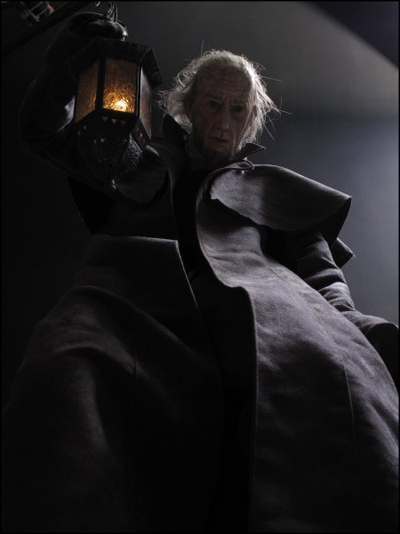
For the past two years, Kevin McTurk –a world-renowned cinematic effects artist– has been hard at work on a breathtaking personal project called The Narrative of Victor Karloch. McTurk describes it as a ”Victorian ghost story puppet film”.
Featuring the voices of Christopher Lloyd, Elijah Wood, and Maurice LaMarche, Karloch combines bunraku style rod puppets, shadow puppetry, and an array of traditional in-camera effects to present a tale from from the journal pages of one Victor Karloch: weatherbeaten alchemist, scholar, and ghost hunter. This film, very much a labor of love for McTurk and his crew, was made possible by grants from Heather Henson’s Handmade Puppet Dreams Film Series and from The Jim Henson Foundation.
Photo provided by Kevin KcTurk.
As you can see from the above preview, it’s a stunning piece of work. And did I mention that the film’s score was provided by Zoe Keating, Lustmord, and… our very own Meredith Yayanos? Yes!
This Thursday, April 19, at Meltdown Comics/NerdMelt Theater in Los Angeles, McTurk will be holding a sneak peek/wrap party reception. There will be a live marionette performance by Eli Presser (one of the film’s key puppeteers) and limited edition Narrative of Victor Karloch t-shirts (designed by comics legend Mike Mignola!) available for sale.
Congrats to all involved! Attendees of the wrap party are enthusiastically encouraged to report back in comments.
Should they choose to delve deep into the dreckish pools of distant memory, some Coilhouse readers may recall this cheeky wee embloggening from 2009, written about the Dictionnaire Infernal, with illustrations by Louis Breton.
She wants to design and print a deck of 69 large (3.5″x5.75″), full-color heavy-stock art cards, each one featuring a Breton illustration from the Dictionnaire Infernal. She’s also planning to create “a supplementary PDF for the deck, with all 69 card images and extended information about each.” She’s given the project room to expand and evolve, depending on how much she raises beyond her minimum goal.
Ariana is all about fastidious documentation, immaculate restoration, and TEH LULZ (see below). EVIL GOOD TIMES. Click on MISTER SCARY ANTEATER OV DOOOO0M to learn more:
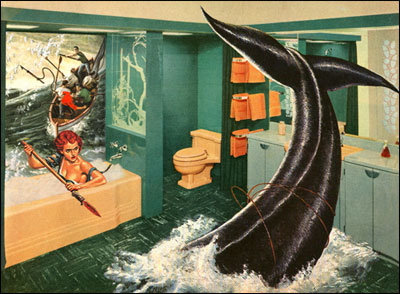
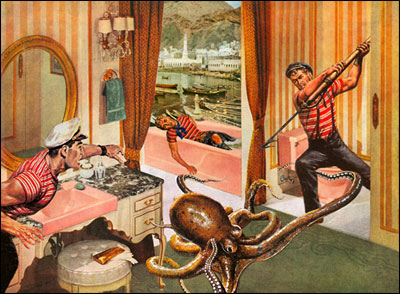
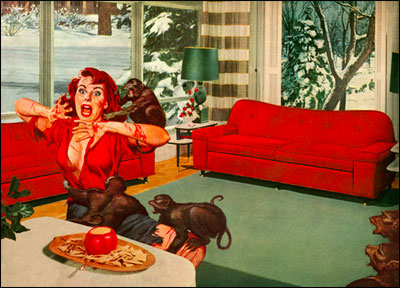
This collage series by Nadine Boughton combines men’s adventure magazines from the 50s and early 60s with the pristine rooms of Better Homes and Gardens. Bedrooms, living rooms and bathrooms are attacked by squids and rabid baboons, overrun by bats, submerged underwater, and besieged by helicopters.
“The collages are set against the backdrop of the McCarthy era, advertising, sexual repression, WWII and the Korean War. The cool, insular world of mid-century modern living glossed over all danger and darkness, which the heroic male fought off in every corner,” writes Boughton.
Today, we celebrate what would have been Anaïs Nin’s 109th birthday by posting Bells of Atlantis, an experimental film from 1952.
The film stars Nin as the mythical queen of Atlantis and conveys, as Wonders in the Dark puts it, ”the experience of trying to remember and re-experience a dream.” Over cascading experimental footage, Nin reads aloud from her novella House of Incest. We catch glimpses of her nude form swinging in a hammock, and we see her shadow undulating over sheer fabric blowing in the wind, but for the most part, the imagery, captured by Nin’s husband Ian Hugo, remains very abstract, creating a “sense of swimming through a hallucination, trying to get closer to a world clouded not only by its own hazy nature, but the veils of memory and reality cast over it – given form by the watery ambiance that washes over the images.”
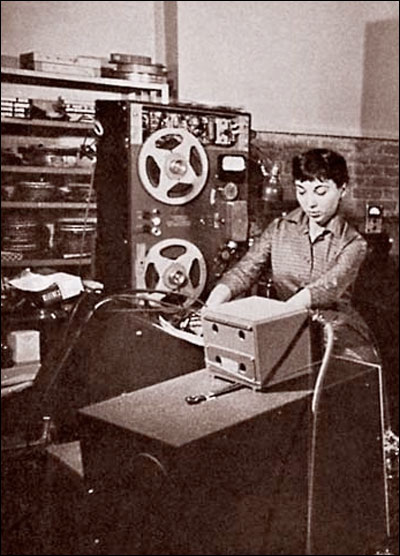
Bebe Barron, an early pioneer of electronic music.
The soundscape was crafted by Louis and Bebe Barron, two pioneers of electronic music who are best known for composing the world’s first entirely electronic music score for The Forbidden Planet, which the Barrons filled with ”bleeps, blurps, whirs, whines, throbs, hums, and screeches.” They built their own circuits, which they viewed as “cybernetic organisms,” and spliced together the sounds they made into collages. Louis did the work of creating the circuits, while Bebe did most of the composing. Their sound, wrote Nin, was akin to “a molecule that has stubbed its toes.” Bebe Barron was one of the first women in the field of electronic music, and in her last interview, she fondly recalls memories of her friend Anaïs.
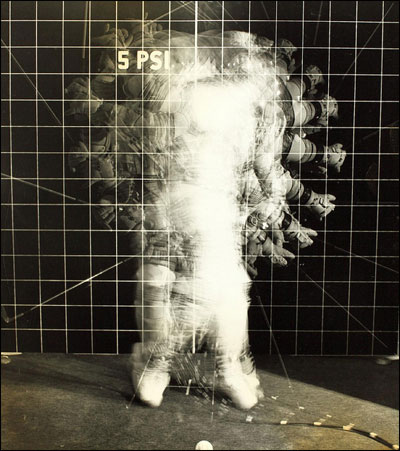
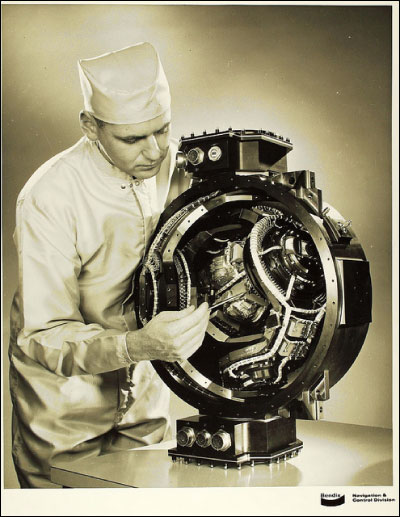
The San Diego Air & Space Museum Archives Flickr Photostream has a lot of beautiful vintage photographs related to flight. You’ll fighter jets, airships, factories, control centers, aviation posters, lushly-illustrated training manuals, and lots of neat historical tidbits.
Of particular interest is the set titled Space Related Images. After the jump, a selection of photos from this set. Space food, astronaut training and retro machinery galore.
If you were a Parisian gentleman in 1923 looking for the newest thing in personal mobility, you may have had a keen interest in the above: cycle-skating. Essentially small bicycle wheels strapped to your legs, they could be used with or without poles, “ski style”. Perfect for the hip, urban man on the go. Just make sure to hike those trousers up over your knee-highs.
One of the most acclaimed films of all time, and certainly one of the artfully made/broadly influential propaganda pieces created to this day, Sergei Eisentstein‘s 1926 feature film The Battleship Potemkin presents an exhilarating (not to mention highly dramatized, sometimes outright fictionalized) depiction of the 1905 mutiny of a Russian battleship’s crew agains their Tsarist commanding officers. Eisenstein made cinematic history with his development of the montage concept, and his unflinching use of realistic violence.
Via Jess Nevins comes word that we can watch the entire thing, uninterrupted, on teh YooToobz. It’s the version with the Shostakovich score, too. Pretty awesome (in the traditional sense of the word, even)!
Editor’s Note: This gem of a submission from writer/proto-ambient scholar/fervent NIN-lover Matt Keefer was discovered several tiers deep during a recent trawl of the Coilhouse slush account. It’s an offbeat and spirited piece, simultaneously comparing and cross-referencing the musical and philosophical kinship inherent between Erik Satie and Trent Reznor, and issuing several preemptive strikes against any and all Would-Be Jaded Hipster Remonstrators. (Also, somehow, on a profound level, it feels like the perfect blog follow-up to that horrifying “Keyboard Cat In Hell” clip Ross just posted). Thank you, Matt. Keep on angstin’ on, comrades.
Trent Reznor is the rightful successor to the great Erik Satie. Don’t let yourself ignore this plain and obvious fact because you are embarrassed of your youth. And no, Trent isn’t disqualified from this lofty inheritance by his perpetual unhappiness. Satie had it just as bad.
In the Spring of 1893, the ever-eccentric Monsieur Erik began a torrid affair with the artist and model Suzanne Valadon. An odd duck in her own right, Madame Valadon kept a goat at her studio to gobble up any of her work that she was unhappy with. After only a single night with Valadon, Erik proposed; the marriage never happened (or if it did, the records of such were later eaten by said goat), but Valadon did move to the room next to Satie’s at the Rue Cortot in Paris. Satie became increasingly obsessed with Valadon, often referring to her as his nanny-goat and filling notebooks with worshipful scrawlings about “her whole being, lovely eyes, gentle hands, and tiny feet.” Indeed, Satie composed his Danses Gothiques as a calmative to restore his composure in the face of the amorous frenzies that Valadon inspired in him. In turn, Valadon painted a portrait of Satie and gifted it to him:
Portrait of Erik Satie by Suzanne Valadon. Who can resist the Pince-Nez? WHO?
Sadly, six months later, the affair ended. One chilly winter evening Valadon vanished, leaving Satie with only his portrait and a broken heart to remember her by. Satie snapped, scrawling in the latter pages of his journals that nothing remained for him “but an icy loneliness that fills the head with emptiness and the heart with sadness.” This is the only intimate relationship that Satie ever had. He would later move to a room in Arcueil and in the 27 years before he drank himself to death, there is no record of anyone visiting his room.
Sometimes, when creative and inspired people get together to collaborate on making imagery in a specific vein that no one’s attempted before, a special kind of magic happens. Case in point, this elaborate photo series independently produced by Jessica Rowell of J-Chan Designs and photographer Nina Pak in cahoots with model Elizabeth Maiden:
Κατάρα της Αθηνάς, η μοίρα της Μέδουσας Αθηνάς: Elizabeth Maiden Μέδουσας: Jessica Rowell of J-Chan’s Designs Photography: Nina Pak Costume Design & Styling: J-Chan’s Designs Location: Vancouver, British Columbia, Canada
Ancient Greek lore and steampunk culture clash, titan style, in a sumptuous mythos-meets-modernity photo series depicting the Goddess Athena (Elizabeth Maiden) and the Gorgon Medusa (Jessica Rowell).
According to legend, the once ravishing Medusa was cursed with a monstrous appearance after “seducing” Poseidon, Lord of the Sea, under the roof of Athena’s sacred temple. Hence, this series title (which, translated into English, means) “Athena’s curse, Medusa’s fate.”
Rowell pulled “inspiration from Desmond Davis’ 1981 film Clash of the Titans, then put an atemporal spin on things by incorporating several contemporary ingredients that “also felt industrial and familiar to alternative culture.”
Darling Madame Darla Teagarden recently shared this image, saying “Early Parisian Goths, 1910. How amazing were they? Very.”
Oh, indeed! VERYvery. That is some unparalleled late fin de siècle bohemia-infused fierceness, for sure. A bit of Google-fu has helped me trace this scrumptious photo as far back as one Mrs. Inman on Flickr. Inman’s photostream is full of all kinds of wonderful vintage postcard scans… she’s a seriously devoted collector and curator. Her tags indicate that this is a century-old French photo postcard from her vast personal archive.