I am certain there are those who would follow Mer’s amazing Cenobite accessory post with something a bit more weighty with content, a bit more elegant than this. Those people are, I am almost as certain, more talented than I. It seems that I am, in fact, just a sucker for a really excellent pun. And thus my private shame is now made public.
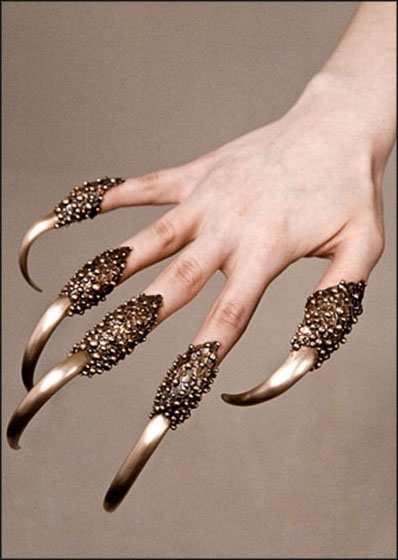
Danielle Nicole Hills is a metalsmith based in Brooklyn, NYC. This week, photos of her wicked “Predator Rings” (for sale in her Etsy shop at $900 per five-fingered pair, or $200 per digit) have been making the rounds on the interwebs.
Predator Rings by Danielle Nicole. (All photos via her Etsy store or personal site.
Dig a little deeper, and it quickly becomes evident that there’s much more going on in this woman’s creative life than these gorgeous claws. Check out the artist statement posted on her personal website:
The impulse to adorn and improve the body in some way is an instinctual commonality throughout the world. The cultural motivations for personal adornment are innumerable, but the way in which people do this is fundamentally the same. I focus on creating a codependent relationship between adornment and the human form in which they both redefine the other. Each piece, when worn, removes the body from the context of modern society, emphasizing instinctual decorative practices.
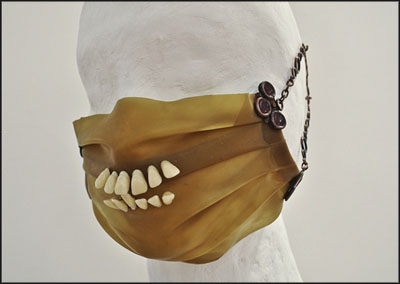
Surgical Mask
By creating an aggressive dichotomy between subtle, elegant forms and vicious primal instinct I am able to transform the frame of reference the wearer is displayed in. The extravagant theatrical nature of each piece makes the concept of ritual and ritual adornment fundamental to the work.
Dang! Talk about heavy metal. Several more fierce pieces by Hills after the jump.
G’morning, loves. Forgive me, for my eyes are bleeding and my brain is fried, and all you’re getting for breakfast is N2O:
This image just mysteriously showed up on my portable hard drive. No idea where it came from. It appears to be vintage packaging for nitrous cannisters, ostensibly used for whipping cream. But judging by the blonde’s glassy-eyed, idiotic stare, the gas may have been used for more, um, unsavory recreational purposes.
Just in time to put you off your lunch, the Friday Afternoon arrives with 2009’s Food Inc, the scathing documentary/critique of America’s food industry. Directed by Robert Kenner and co-produced by Fast Food Nation author Eric Schlosser, Food Inc is of the variety that both infuriates and terrifies in equal measure. It must be pointed out, however, that if you are already up on the subject matter, or have already read Fast Food Nation, there isn’t a whole lot that is new here. Still, for those uninitiated in the horrific practices of companies like Monsanto and Tyson it can be an eye-opening experience.
Recently, it was shown on PBS for their POV segment — it can be viewed on their website until this coming Thursday, should the YouTube version get pulled — and was followed with the delightfully Lynchian Notes on Milk (Click that link to watch. Do it!) a short film looking at the rise of milk in America.
So get to watching, dear readers, and get a better picture of the horrible stuff we put into our bodies everyday. In the meantime I’ll get back to my Big Mac, because nothing tastes quite like Creutzfeldt–Jakob.
Update: Reader rbk points out that PBS is not viewable in America’s hat, Canadia. Therefore, filthy Canucks should go here.
Born in 1897, Lucille Bogan first began recording in 1923, singing vaudeville songs. By the 1930s she had established herself as a blues singer and her oeuvre was slanted decidedly toward the raunchy. In songs like “Sloppy Drunk Blues”, “Tricks Ain’t Walkin’ No More”, and “B.D. Woman’s Blues” (the B.D. stands for bull dyke) she focused on themes like gambling, drinking, lesbianism, and prostitution; themes that featured prominently in the juke joints she had worked in early in her career.
One of her last recordings, “Shave ‘Em Dry” in March 1935, had two versions, one that kept to the tamer innuendo of most blues songs and an unexpurgated version, featured above, which does away with subtlety altogether. An interesting little piece of historical titillation, if only for a retort to the “music today is morally bankrupt” argument often favored by the familial old-guard.
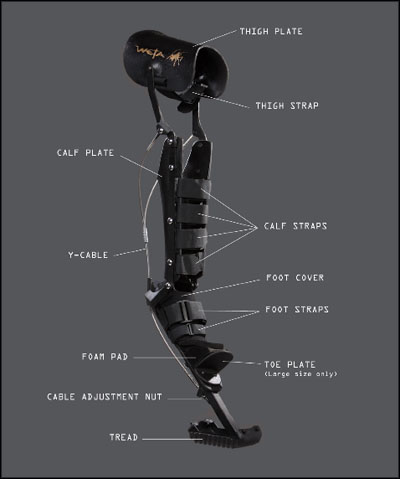
Kim Beaton and her digitigrade leg extensions. Photo by Dionwrbear.
The booming film industry here in Wellington, New Zealand (a.k.a “Wellywood“) has attracted phenomenal talent from all over the world. Creatives come from as far away as Los Angeles, London, Johannesburg, Vancouver and Tokyo to work on films like District 9, Avatar, and the LotR series. One such transplant is Kim Beaton, a multi-talented artist/inventor from Seattle who was recently hired by Weta Workshop to do conceptual design work on the upcoming Hobbit films.
Kim is a vibrant, intensely focused person who always seems happiest when she has multiple projects in development: large scale sculptures, community arts outreach programs, armor design and production, you name it! She’s also an accomplished inventor. In fact, many of you may already be familiar with one of her patents– last summer, two YouTube videos were posted of Kim striding through downtown Seattle in a pair of startling, stilt-like “reverse leg” extensions. The clips quickly went viral.
Upon arriving here, Kim was encouraged by Richard Taylor (5-time Academy Award winner and co-owner/co-director of the Weta Companies) to continue honing the digilegs’ design in the workshop. After several months of development and fine-tuning, the company is selling Kim’s professional design, now christened Weta Legs, for $945 U.S. dollars a pair. From the official site: “Weta has made many pairs of digitigrade leg extensions in the past for stunt men and creature performers in the movies and on the stage, but this is the first time we can offer [this] leg to anyone.” In fact, it’s the first time any company has put a line of digilegs into mainstream production.
A heads up to performers, costumers, burners, party monsters, cosplayers, designers and filmmakers– this is big. I’ve had the opportunity to test Kim’s prototype myself. They’re incredible. They’re comfortable. They’re FUN. I mean, really, really fun. Watch this instructional video (featuring Kim and a woman who has never been in stilts or extensions of any kind before in her life) to hear and see a bit about why her particular adaptation of the digitigrade concept is so unique and easy to acclimate to wearing.
As far as I know, there’s nothing else remotely like them available on the market. It’s very exciting news for Kim, for her company, and best of all, for all of the non film industry folks out there who can finally own a pair of these. Recently, Kim spoke with me at length about the history of digilegs, as well as her past community collaborations and several other upcoming personal projects. I hope you’ll enjoy getting to know this incredible woman and her work as much as I have.
Please describe the Weta Legs. What sets your invention apart from other kinds of stilts or leg extensions?
They have been called the Holy Grail of costuming. How do you build a device that will give a person the backward leg of a dog or horse? They are referred to by all sorts of names: digilegs, digitigrades, faun legs…
What does digitigrade mean?
A digitigrade is an animal that stands or walks on its digits, or toes. But this is not easy to say unless you like tongue twisters, so it was shortened to “digileg”. They’ve also been called “dog legs” or “reverse stilts”. Originally, we called them leg extensions, because they’re not really stilts, but we want to give them one name that is pretty easy to say. Hence, Weta Legs.
One mustn’t get too put out by who one’s friends choose to play with.
So goes the story of Ian Worrel’s short animated film, Second Wind featuring an old man and his giant feline traveling companion. It’s a beautiful six minutes, rife with expressive animation and a haunting score. Just the thing to perk up a boring Wednesday afternoon.
A gripping masterpiece of neo-noir psychological suspense. A mesmerizing meditation on the mysterious nature of identity. An inscrutable, profoundly unsettling fever dream, issued from deep within the director’s anguished psyche. A phantasmagorical family saga that ends in murder and betrayal.
It’s been nearly a month since Portland-based, multi-disciplinary artist John C. Worsley released Stars Lost Your Name, and it’s still my daily work accompaniment. The twelve-track album begins as a beautiful, dreamy blend of minimal electronic grooves and sedate guitar riffs, then slowly escalates, fluctuating between waves of intricate, restless layers, and muted ambiance. At times measured and brooding, at times brimming with anticipation, this is easily one of my favorite albums of 2010 so far. Bonus? Every song is named after a star, the album thus forming a constellation.
I’m a sucker for a concept album, and Stars Lost Your Name happens to be one of those. The official story goes like this:
On the 24th of February, 2010, a moving truck was picked up in Portland. Over the course of the following 6 days, 12 states, and 3096 miles, while helping a friend move from Portland, Oregon to Cambridge, Massachusetts, these 12 songs were initially composed; in motels, in living rooms, and in the passenger seat.
After returning to Portland by air, 6 more days were spent recording and arranging before the album was deemed finished at 66:48 in length on the 12th of March, and released the following 24th; a roadmap, memoir, and secret constellation.
You can download Stars Lost Your Name in its entirety, for free, here. Thank you, John. However, if you like what you hear, the album is also on iTunes. Love it with money!
When we started putting together Coilhouse issue 04, a haunted theme emerged. As issue 05 design got underway a couple of weeks back, a pattern appeared again, and this time it’s TETRIS. Yes, the clever game of geometry and speed hasbeen oneveryone‘s minds throughout the virtual Coilhouse HQ. To celebrate this bizarre synchronicity, here is a..curious tribute to the addictive and wonderful pastime, paid in full as only Europop can do. [via Kris Ether]
It’s time to re-examine the way we think about hats.