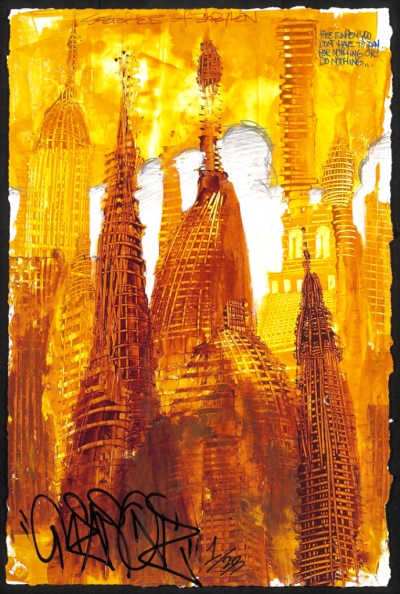
A frantic time-lapse of artist Meer One creating images for his mono-distortion series Sketches of Babylon. A set of 33 individual paintings sharing a common style, Sketches of Babylon depicts the rising, skeletal spires of a totalitarian society on an alien world, rendered in fiery oranges and yellows. They make me think of 60s-era science fiction paperback covers. Baurmann Gallery is going to begin selling them today at 1pm PST for $500.00 apiece. If you’re interested and have the cash you can email them.
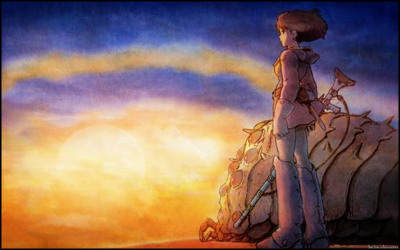
Close on the heels of the announcement that filmmaker Hayao Miyazaki may be preparing a sequel to his 1992 animated film Porco Rosso, Roger Ebert posts some well-deserved, effusive praise of Miyazaki and his first masterpiece, Nausicaa of the Valley of the Wind:
Much of anime in the past 20 years has concentrated on a utopian future, filled with technological wizardry and innovation, which is abundant in Japanese culture. But Miyazaki tends to look back instead of looking forward, inward instead of outward, looking at treasures of futures past that might have been. Like most of his films, his timeline here isn’t technological, but pastoral, with people relying more on each other and the Earth. He favors gorgeous green panoramas usually near blue bodies of water. He is in love with flight with his heroes soaring through the sky, representing our dreams of breaking through our limitations. We sense his hope in women more than men, believing them to be the key to humanity’s progress as opposed to man’s history of violence. These creeds and themes are held dearly and instinctively by the young and hopeful, and its Miyazaki’s ability to convey these naturalistic ideas through his visual imagination, which makes him unique.
Only Pixar has been able to rival Miyazaki’s creative energies in forming entirely new sights, sounds, and stories with each subsequent film. But Pixar is a collection of talent (all of whom pretty much worship him), while Miyazaki is a singular force. While even the greatest of directors have to rely on cast and crew to carry out their visions, Miyazaki pretty much IS the film. He might be the closest thing to the idea of an “auteur” which filmdom has.
Ebert has pointed his readership in the direction of Google Video to watch Nausicaa for free –and apparently guilt free– online. Hooray!
This week’s edition of BTC goes out to Comrade Lev. She’s currently packing up and preparing to roll out to Burning Man 2010 with the Syzygryd crew. I have no doubt whatsoever she’ll hear this classic house anthem by Opus III (as well as its Orbital offspring) out on the playa at some point. Wish I was going with you, hon. Bust some of those signature swirly stompy hottie-in-black moves for me, won’t ya? Unitard optional.
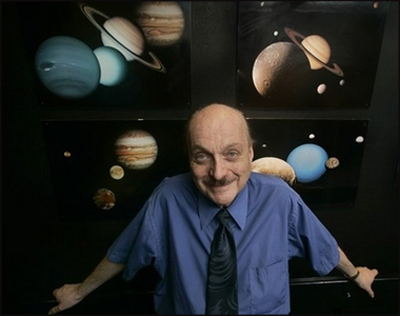
Jack Horkheimer, beloved TV personality and executive director of the Miami Space Transit Planetarium, has died, age 72. Countless legions of us grew up watching the gruff-voiced, wide-eyed astronomer hosting Star Gazer and Star Hustler on public television. Week after week, decade after decade, he’d walk in front of that green screen and excitedly tell us what we could expect to see in the evening sky. His enthusiasm was deeply infectious. He taught us all sorts of things about the universe, and he made us smile.
Farewell, farewell fellow star gazer. We’ll keep looking up.
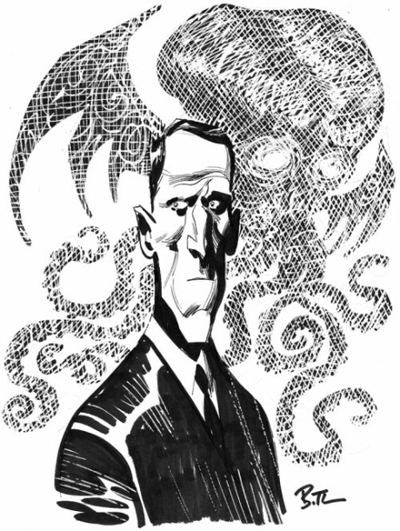
Howard Phillips Lovecraft. Born on this baleful day back in 1890. Portrait by Bruce Timm
“There are not many persons who know what wonders are opened to them in the stories and visions of their youth; for when as children we listen and dream, we think but half-formed thoughts, and when as men we try to remember, we are dulled and prosaic with the poison of life. But some of us awake in the night with strange phantasms of enchanted hills and gardens, of fountains that sing in the sun, of golden cliffs overhanging murmuring seas, of plains that stretch down to sleeping cities of bronze and stone, and of shadowy companies of heroes that ride caparisoned white horses along the edges of thick forests; and then we know that we have looked back through the ivory gates into that world of wonder which was ours before we were wise and unhappy.”
A ride through the dusty landscape of Australia’s Outback as the FAM presents 2005’s brutal Western The Proposition; directed by John Hillcoat, written by Coil Beat heartthrob Nick Cave, and starring Guy Pierce, Ray Winstone, Emily Watson, Danny Huston, and John Hurt to name a few.
The world of Hillcoat’s Australia, circa 1880, is a harsh, desolate, and unforgiving wasteland; an Abadon devoid of compassion or solace. It is this land that Ray Winstone’s Captain Stanley, having moved there with his proper, English wife Martha, attempts to tame. His immediate aim is to hunt down the Burns gang, who are wanted for the rape and murder of the Hopkins family. Having captured two of the brothers, Mikey and Charlie (Guy Pierce), he makes Charlie an offer: he and his brother will be released and excused of all crimes if Charlie kills his brother Arthur (Danny Huston), an eloquent psychopath so vicious that he is known to the Aboriginal inhabitants as “The Dog Man”.
Cave is an accomplished writer and The Proposition calls to mind many of the same themes as his first novel And the Ass Saw the Angel, a book I’ve read twice and still not decided whether I actually enjoyed. As with his novel, The Proposition comes close to merely becoming gruesome pornography of the soul. Cave constructs stories devoid of the concept of innocence — in the end all are guilty and shall be punished.
Still, the images of sun-baked emptiness and blood red skies evoke enough strange beauty to transcend, if only momentarily, the unyielding parade of violence. Winstone plays Stanley as a land-locked Ahab whose intentions, while principled, are not exactly pure in contrast to Arthur, a man with no illusions as to his place in world. The penultimate scene, taking place during an absurd staging of a traditional English Christmas dinner, is superb in its tension making for a dénouement in which no one wins.
It would, perhaps, be easy to dismiss The Proposition as a simple tale of violence begetting violence and indeed that might be a true assessment; but it is so raw in its telling, so unapologetic in its delivery that in the end such an observation is moot. It’s a film that refuses the viewer any consolation and expects no quarter in return. You may either watch or, like the Stanley’s Aboriginal servant Tobey — removing his shoes and abandoning them in the meticulously cultivated garden — you may quietly take your leave.
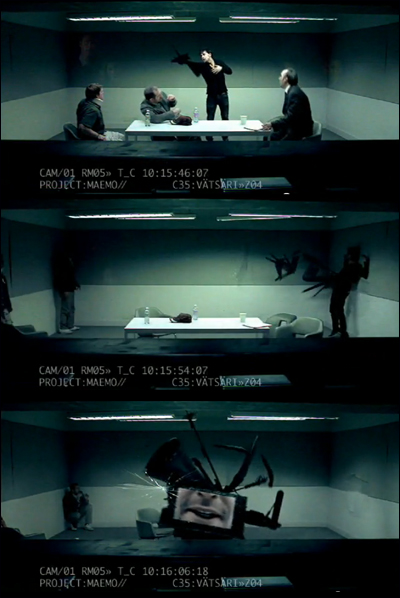
Here’s another Cronenbergian nightmare for you! Been meaning to roll this one out for a while now, but Ross’ Yeasayer post and last week’s focus group scene on Mad Men reminded me to finally get on it.
This Nokia N900 commercial came out late last year, and leaves me a little puzzled even after third and fourth and fifth viewing. The scene opens with a view of a focus group, as seen through glass by the observing parties. A few guys brainstorm desirable phone features, while one – a black-clad, scruffy type – doesn’t seem to be interested in participating. When asked to speak up, he begins to twitching and screaming at his collaborators. Panic ensues. Then, after a series of incredibly cool-looking and terrifying man-becomes-machine contortions, he transforms into a phone. Yep. It’s an insane, abusive man-phone. Enjoy!
Few announcements could be as exciting for the devoted Metal connoisseur as the one made by Manowar, letting their loyal fans know that high quality, Giclée prints of Ken Kelly’s album artwork are now available for purchase. The video shows the the great attention to detail put into these prints, how they are able to reproduce the exquisite sheen on a slave-girl’s naked bosom, as well as showing you what they would look like hanging in your grandmother’s condo. Truly a once-in-a-lifetime opportunity.
Witness the nerdy buffoonery of the trailer for Frank Miller’s commercial for the new scent from Gucci, Gucci Guilty. Certainly, this is not the first director-driven television spot we have featured on Coilhouse, Nadya having previously spotlighted David Lynch’s sixteen minute ad (Film? Vignette?) for Christian Dior. Gucci, however, is playing this one up as an event. The actual commercial hits a little under a month from now at the MTV Music Awards, no doubt preceding the long awaited Lady Gaga/M.I.A. Fish Slapping Dance Battle to the Death.
Entitled “Friendly Fires” “Frank Miller’s Gucci Guilty”, it stars Evan Rachel Wood and Chris Evans in a wire-frame world of imposing, CG skyscrapers and a distinct lack of color. Wood plays a femme fatale in a slinky outfit piloting a futuristic Jaguar XK120on fire while Evans plays a gentleman involved with the aforementioned seductress. It is all very tried and true ground for Miller, a man whose greatest crime has been to take his credit as a director on Sin City seriously enough to convince people with money that he actually is a director. No doubt I will be accused of various degrees of hipster posturing due to this bit of nerd rage but Miller’s green screen chicanery is truly a film-making nadir — managing to take a style that produced some excellent comic books and turning it into a tired, vapid cliche. On the other hand, those same qualities might work well for pimping an over-priced, designer fragrance and indeed “Guilty” seems to share many of the same qualities that made Calvin KleinObsession ads from the 1980s so absurd (and, some would argue, effective). It may be that Miller has finally found his niche.
Update: As BaggerMcGuirk notes in the comments, the ad’s title is not “Friendly Fires” as originally written in this post. Friendly Fires is responsible for the music in the ad.