I must admit, I’m afraid I might be doing a great disservice with this week’s FAM. Not in the sense that the film chosen is of inferior quality or offensive; indeed I have plenty of those which I will no doubt post in the future, without any feelings of guilt. No, my unease comes with the inferior method of delivery. It arises from the fact that I may be exposing people to a film that should only be viewed in the highest possible fidelity which the above offering on YouTube is decidedly not.
Today’s FAM is Alexander Sokurov’s Russian Ark from 2002, a film that I might describe as “decadent” and “luscious” were I a man given to pithy, vague descriptors, which I assure you I am not [Editor’s Note: He is.] Filmed in one fluid take we follow the disembodied voice of our narrator (in actuality the voice of Sokurov) and unseen gentleman who intimates that he, in fact, died in a horrible accident. Accompanying him is “the European” (based on the Marquis de Custine). Together they explore the Winter Palace, which is now the centerpiece of the Russian Hermitage Museum in St. Petersburg. As they wander from room to room, so to do they wander through Russian history, though those well-versed in said history will note that events depicted are not in chronological order.
What follows is a technically astonishing [Editor’s Note: See?] piece of film-making. Meandering through 33 rooms and featuring over two thousand actors and three orchestras, the result is a history lesson within a dream. As such, it’s all the more frustrating to not be able to see all the small details present on the actors’ costumes are the information overload presented by the splendor of the Winter Palace. I urge you to track down a copy if you enjoyed it here as the experience is really night and day.
The music video for “Le Petit Train” by ’80s duo Les Rita Mitsouko was an elaborate production filmed in Bombay. Dancing her way through the infectiously upbeat tune, sari-clad frontwoman Catherine Ringer asks, “Petit train où t’en vas-tu? Train de la mort, mais que fais tu?” The lyrics speak of serpentine trains passing through the countryside, carrying children and grandparents “to the flames through the fields.” As the song reaches its climax, Ringer – whose father was an artist and a concentration camp survivor – trades the fixed smile of her Bollywood dance routine for close-ups that reveal tears flowing down her face while she continues to sing. Ringer’s background in avant-garde theater can be glimpsed in many of Les Rita Mitsouko’s music videos, which appear after the jump.
Les Rita Mitsouko was formed in the early 80s by Ringer and guitarist Fred Chichin in France. Early in their career, Ringer and Chichin had the fortune of working with two great producers: their eponymous first record was produced by Conny Plank, famous for his work with Kraftwerk, Neu and other various bands associated with krautrock. Their second album was Tony Visconti’s top pop project after David Bowie. A year later, the duo was featured in Jean-Luc Godard’s film Keep Your Right Up.
Many band biographies omit the fact that prior to her musical career, Catherine Ringer was an underage porn actress. If you Google this fact, you will find some shiiiit (literally) that’s highly NSFW. I bring this up because I find it empowering that Ringer went on to become one of France’s biggest pop stars (though they were arguably more popular elsewhere in Europe). Had they been an American act, would Les Rita Mitsouko have reached the same level of success? I think back to the heartbreaking interview that Marilyn Chambers gave a few years before she died, recounting with sadness a life of failed attempts to break into “straight” film, and have my doubts.
“I wanted to make things beautiful, funny and positive – escapes that you could just get into and laugh through. That was really important to me. I felt like good could triumph over evil.” –Tom Rubnitz
Glory be to the man behind the pickle, not to mention Strawberry Shortcut, Frieda the “Living Doll”, the original Wigstock:The Movie, and dozens of other delectable tidbits. Rubnitz died tragically young of AIDS in 1992, but his amazing video shorts have survived, and they’re such a joy to see. Via Golden Age:
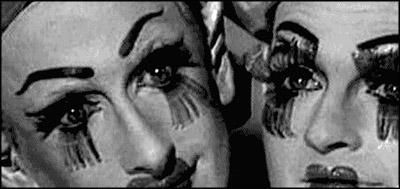
An expert in genre manipulation and campy hilarity, Rubnitz’s films could only have come from the eccentric East Village during the ‘80s New York art scene. Having grown up in a generation of television junkies as opposed to museum-goers, Rubnitz felt compelled to appropriate more from the mass media than the art world. He mixed drag queens with cooking shows, saluted motherhood with Frieda, the wholesomely creepy “living” doll, and consistently offered us a portal into unique and comical escapism.
Rubnitz worked with many talented musicians and artists in his films and videos, including the late John Sex, Happi Phace, the B-52s, Lipsynchia, Ann Magnuson, Quentin Crisp, Michael Clark, and Lady Bunny. Viewers will surly be enthralled by John Sex’s unique musical talent and sock-stuffed crotch as he performs with the Bodacious Ta-Ta’s in two music videos and is uncovered in a rockumentary called John Sex: The TrueStory. Rubnitz loved Drag Queens, which many of his films are a testament to. Wigstock: The Movie documents Lady Bunny’s annual event, “storywig-in,” a parody of Woodstock (particularly noteworthy is the rendition of Janis Joplin). And in the Drag Queen Marathon participants are pitted against each other to see who can endure relentless photo opportunities.
These glitzy, hallucinogenic shorts paint a loving portrait of the East Village, a regular of nightlife hot spots like Club 57 and the Pyramid Club. Since we live in an equally politically bleak time, Rubnitz’s films may feel strangely contemporary to us as they offer a glimpse into the repressed underground hedonism of the New York underground scene during the Reagan era. Alternative artist spaces, which were characteristic of the East Village, weren’t simply stepping-stones to becoming commercial galleries. They fostered a genuine alternative to the dominant culture of the time.
Still from Strawberry Shortcut.
A while back, the time-honored Chicago-based Video Data Bank institution started offering Sexy, Wiggy, Desserty— a compilation of all of Rubnitz’s most beloved underground hits. I have a feeling it must have been a limited release, because it’s currently selling on the Golden Age website for a whopping 50 bucks! I’m not finding it anywhere else for less. If any of you guys have better luck, please give me a shout. Otherwise I may just bite the pickle and shell out fiddy clams… happily! Rubnitz & Co aretotally worth it.
Since I would merely be cribbing their words anyway I shall allow lens culture (who is also selling the DVD) explains the mechanics of photographer/animator Antonio Martinez’s Near the Egress:
First, Antonio Martinez spent a lot of time at a traveling circus, shooting dozens of rolls of 35mm black-and-white film. Then he made over 800 modern dryplate tintypes from the negatives, and then scanned them digitally, and then sequenced them artfully to produce this experimental stop-motion video.
The result of all this photography and video manipulation is a bizarre fever-dream of a circus, something one would imagine entertaining the dead in an afterlife set in a David Lynch film. In other words, it’s fantastic. The project took Martinez 4 years to complete and I would say that the end result has been absolutely worth the time and effort it took to create.
An animated short by Joe Bichard and Jack Cunningham, buy cialisMARS! tells the story of, seek well, medicine the planet Mars. Specifically it details the meeting of two groups of creatures. The first is a menagerie of Tetrominoe-esque creatures who inhabit the center of the planet. The second are a flotilla of space-faring ships who land on Mars for more sinister reasons.
And so it shall be that this work-week on Coilhouse begins and ends with Jim Henson. This week The FAM presents one of the greatest television series of all time, Jim Henson’s: The Storyteller. Only lasting 2 seasons the first was broadcast in 1988 and starred John Hurt as the titular storyteller. This was followed up two years later by a second season focused on Greek myths, which lasted for four episodes and featured Michael Gambon in place of Hurt. Today’s FAM features five episodes of the superior first season [Note: All episode descriptions come from wikipedia, ’cause I’m lazy]:
• “Fearnot”: From an early German folk tale. The Storyteller recounts the adventures of a boy who goes out into the world to learn what fear is, accompanied by a dishonest but lovable tinker.
•“Hans My Hedgehog”: From an early German folk tale. A farmer’s wife drives her husband mad with her desperate measures to have a baby. She says to him that she wants a child so bad, she would not care how he looked even if he were covered in quills like a hedgehog. That, of course, is what she gets: a baby covered in quills, as soft as feathers. His mother calls him ‘Hans My Hedgehog’ and she is the only one to love him; his father grows to hate him for shame. So eventually Hans leaves for a place where he can’t hurt anyone and where no-one can hurt him.
Deep inside the forest, for many years Hans dwells with his animals for companions. One day a king gets lost in Hans’ forest and he hears a beautiful song being played on a bagpipe. He follows the music and finds Hans’ castle. When Hans helps him to escape the forest, then king promises that he will give to Hans the first thing to greet him at his castle – which the King secretly knows to be his dog. Instead, it turns out to be his beautiful daughter, the princess of sweetness and cherry pie. Hans and the king have made a deal that in exactly one year and one day his prize (the princess) shall be his.
•“Sapsorrow”: From an early German folk tale, this is a variant on Allerleirauh by the brothers Grimm. There is a king, his dead wife, and his three daughters. Two are as ugly and as bad as can be, but the third, Sapsorrow, is as kind and as beautiful as her sisters are not. There is a ring belonging to the dead Queen, and a royal tradition that states that the girl whose finger fits the ring will become Queen as decreed by law.
•“The Heartless Giant”: From an early German folk tale. A heartless giant, who once terrorised the land before being captured and imprisoned, is befriended by the young prince Leo who, one night, sets him free.
•“The True Bride”: Based on an early German folk tale, The True Bride. A Troll had a daughter, but she left straight off, so the Troll took Anja, an orphan, to replace her to wait on him hand and foot.
I was 8 when these originally aired and two things made watching them a difficult proposition. The first was that the episodes came on dangerously close to my and my brother’s bedtime. The second was that we did not have television. That is, we had a television and VCR, but no cable or reception. My grandparents next door, however, did and we would give them a cassette so that they could record them for us. We must have watched these episodes dozens upon dozens of times, pushing the magnetic tape well beyond its intended lifespan — every story then taking place behind a veil of falling “snow”.
Henson and his team did a phenomenal job with the puppetry and make-up; and Anthony Minghella’s writing is top-notch. Tying it all together is Hurt, whose gravelly delivery is pitch-perfect. With his curmudgeonly dog, voiced by Brain Henson, at his feet he manages to outdo some of the visuals using only his words and that wonderfully expressive face. Time has done nothing to detract from the quality of the series, and upon watching them again, I find that they enthrall me just as much now as they did when I was a child. The low quality YouTube feed even manages to evoke that VHS-like haze on everything. Maybe I’ll put on some footie pajamas later and take this nostalgia trip as far as it will go.
The master of suspense, Alfred Hitchcock, and his leading lady, Polish born, Czech actress Anny Ondra, perform a sound check for his feature film Blackmail in 1929 which was released in both a silent and “all-talkie” version. What begins as an innocent little back and forth is quickly turned into crude double entendre with a simple “said the actress to the bishop” or in this case “as the girl said to the soldier.” BFIfilms, in their YouTube description, notes that one outcome from this test was that Ondra’s lines would later be dubbed live off-screen by Joan Barry, who sounded decidedly more British.
A bit of bonus trivia: production of Blackmail had already begun when producer John Maxwell decided that, based on the success of films like The Jazz Singer, it should also contain parts with sound. He authorized Hitchcock to film only a portion of the film in sound but, Hitchcock being Hitchcock, he decided to surreptitiously record the entire film in sound. Also, Anny Ondra wasn’t the only actor who experienced changes in the final product. In the longer, silent version, the role of the Chief Inspector was played by Sam Livesey whereas the sound version featured Harvey Braban.
Coilhousefavorite Prince Poppycock [né John Quale] has finally gotten to strut his stuff for a nationwide audience by auditioning for America’s Got Talent. The Prince slayed it on Tuesday, exposing an unsuspecting audience to his most-recognizable act, Figaro’s Largo al Factotum aria from The Barber of Seville. A dazzling vision in a green satin frock, powdered wig, and white stilettos, he sang to first cautious, then thunderous applause and a profusion of praise from the judges.
Of course he made it to the next round! You can practically see him conquer every heart in that room. I love that Poppycock appears both as John and the Prince, and admire his ability to be down-to-earth and to radiate regal bravado all in one go. And now AGT loves him too, so much that his photo is featured not once, but twice on the show’s page over at NBC.
They don’t call him “Poppycock” for nothing. Bravo, Your Royal Highness!
Just in time for the episode’s airing, on Monday’s midnight Prince Poppycock launched a website with photos, video, a calendar, a diary, and a boutique.
A quick little heads up for Coilhouse readers: Between now and June 15th Tiny Showcase is selling a lovely print entitled “Down, Down, Down” by Jen Corace. For every print sold, half of it ($15.00) will go to the Gulf Restoration Network, which is described thus:
The Gulf Restoration Network is committed to uniting and empowering people to protect and restore the natural resources of the Gulf Region for future generations.
The GRN’s vision is that the Gulf of Mexico will continue to be a natural, economic, and recreational resource that is central to the culture and heritage of five states and three nations. The people of the region will be stewards of this vital but imperiled treasure, and they will assume the responsibility of returning the Gulf to its previous splendor.
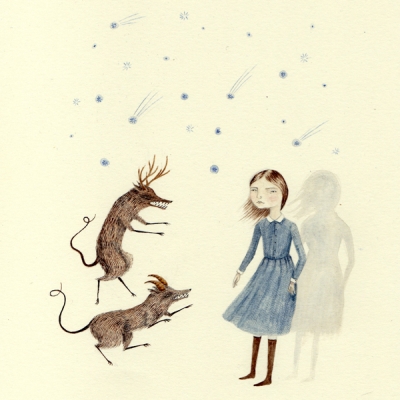
Meanwhile Julliana Swaney at Oh My Cavalier is selling her print “Night Demons” in an edition of fifty, 100% ($30.00) of which goes to the Audubon Society’s oil spill clean-up effort. Considering the shenanigans going on down that way recently, these organizations (and others) can use all the help they can get. In this case, you get a sweet print in return. Seems like a fair trade to me.
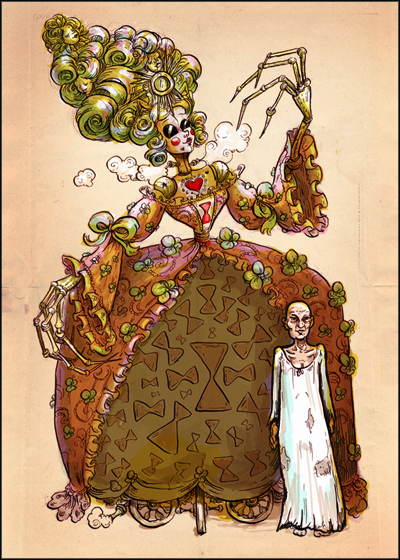
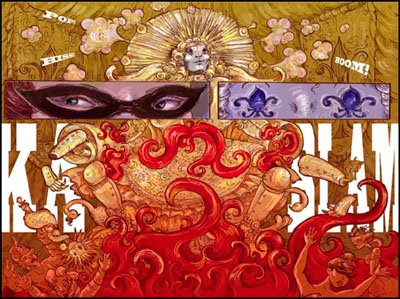
“Versailles, 1685. France has industrialized centuries before her neighbors but focuses on creating exquisitely ornate robotic shells for the aristocracy called, DOLLIES. Towering, lavishly expensive, [they] run on electricity provided by damming the Seine. Only the court elite wears DOLLIES, but their upkeep is beginning to bankrupt France. During the king’s birthday party, his Dolly explodes but is found to be empty…”
Artist Molly Crabapple (look for her illustrations in #05!) and author John Leavitt have been creating lots of buzz in recent weeks with The Puppet Makers, their gorgeous “rococo steampunk murder mystery” set in Versailles, 1685. DC Comics’ online imprint, Zuda, has been publishing it in page-by-page increments each Wednesday. A stunning new page went up this morning.
Molly –generous and supportive friend to Coilhouse that she is– would like to give away a signed, limited edition print of one of The Puppet Makers’ pages to the Coilhouse reader with the “best guess as to where the king is”. Read up, then leave your deduction in comments for a chance to win!