George W. Bush’s grandmother, Pauline Pierce, was a remarkable woman known for her “extravagant tastes.” In the 1920s, she adventured in France with writers Frank Harris and Aleister “The Wickedest Man in the World” Crowley; this much, we know, is fact.
During this time period, Crowley was dealing in sex magick - really, when wasn’t he? - and in 1924, possibly with Pauline at his side, he underwent “the Supreme Ordeal,” an important and mysterious rite which, clues from his diary suggest, may have been an orgiastic extravaganza of carnal debauchery. That same year, Pauline returned to the United States. In 1925, she gave birth to Barbara Bush. That’s the short version of the story. Read the long one, complete with diary excerpts from Crowley, here (via Jerem).
I want to believe!
EDIT: Aww, as Mr. Dowson points out in the comments, this was an April Fools’ Hoax! And thus, George W. Crowley-Bush rides unicornback into the Sunset of Too-Good-To-Be-True, where feejee mermaids, Cottingley fairies, and Milli Vanilli wave to him in greeting. Granpaw Crowley is there too; he buys him balloons and together they go to watch The Big Donor Show on the telly. All is well.
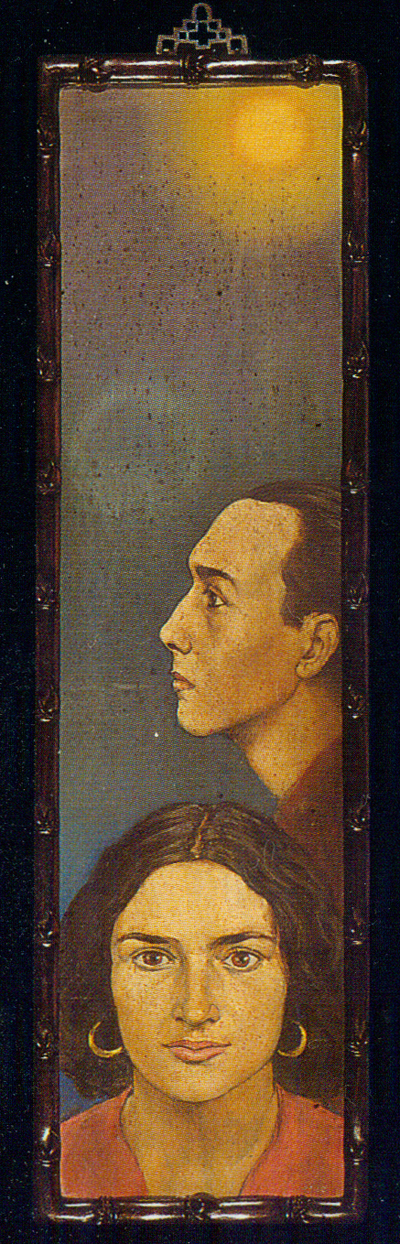
The mystical paintings of Madeline von Foerster invoke names like Van Eyck, Brueghel, Bosch, Remedios Varo, Ernst Fuchs. It’s vibrant, multi-layered work, filled with Occult and Medieval symbolism and rendered in the painstaking egg tempera oil tradition of the Flemish Old Masters. Ageless, yet thematically timely, scholarly but always deeply personal, hers is simply some of the most moving work in the medium that I’ve seen from anyone of my generation.
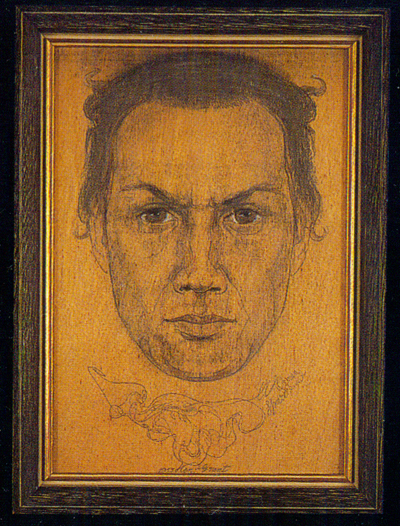
I remember the first time I viewed the following self-portrait at a gallery showing in midtown NYC:
“Self Portrait (Trepanation)” 2005 by Madeline von Foerster
It’s a fairly large piece, 34″ x 42″ (not including the lavish frame, which she constructed and painted as well). If you’re familiar with the technique of egg tempera, closely examining a painting like this can be mind-boggling… all of those smoothly-placed, minuscule brush strokes, patiently layered, culminating in subjects that can only be described as having an unearthly inner glow. The enigmatic subject matter of trepanation thrilled me as well.
It was your typical overcrowded NYC gallery opening. Plenty of cheap wine and fabulously dressed people, all talking a little too loudly over one another. Then there was Madeline, standing off to one side, as gracious, elegant and mysterious as one of her paintings. Since that time, I’ve come to know her as one of those exceedingly rare examples of a person whose life reflects purely in their art.
Some of her recent work is currently up in a group show at the Strychnin Gallery in London. Take a peek at it and some other pieces behind the cut.
From late 1896 through early 1897, a full ten years before the flight of the first known powered dirigible, thousands of people across America claimed to see strange lights in the night sky, heard voices and music emanating from a mysterious airship. Some accounts described a cigar-shaped gasbag, others noted vast flapping canvas wings and large wheels like a paddle steamer’s. One early eye witness even insisted he’d glimpsed two men suspended in the ship’s undercarriage, furiously working bicycle pedals. From Sacramento to Chicago, folks from all walks of life strove to convince skeptical journalists that what they’d seen was not, in fact, an elaborate hoax.
The most carefully researched book written to date about the phenomenon is probably The Great Airship Mystery by Daniel Cohen. Cohen gives a well-rounded account of the circumstances and evidence before concluding –quite sensibly– that the airship probably never existed. (Bummer.)
Several other authors have offered up far more juicy theories. Michael Busby maintains in his own book Solving the 1879 Airship Mystery that a secret society of mad genius inventors joined forces to build a handful of highly advanced aircraft worthy of Jules Verne, each of which, after being viewed by countless drunken farmhands in the Midwest, inexplicably crashed and burned over the Atlantic ocean.
Noted ufologist/parapsychologist/journalist John Keel includes the sightings in the book UFOs: Operation Trojan Horse as compelling evidence for his long-standing hypothesis that certain “non-human or spiritual intelligence sources” have been staging elaborate events for centuries to manipulate and misinform the human pysche. (Other examples he cites include the fairy folklore of Middle Europe, vampire legends, black helicopter sightings, poltergeist phenomena and UFOs.)
Although the initial sightings in the US ended in 1897, several more sightings occurred in England, Europe and New Zealand from 1909 through 1913. In 1912, vaudeville superstars Elsie Baker and Billy Murray penned a little ditty about the airship fervor entitled “Mysterious Moon” and recorded it on wax cylinder.
A comprehensive list of newspaper clippings from 1897 newspapers can be found here. Wikipedia’s got a good entry on the subject as well.