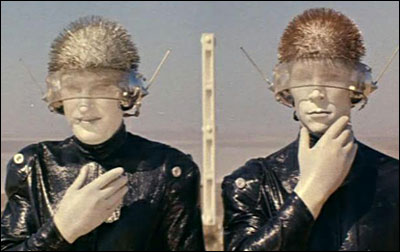
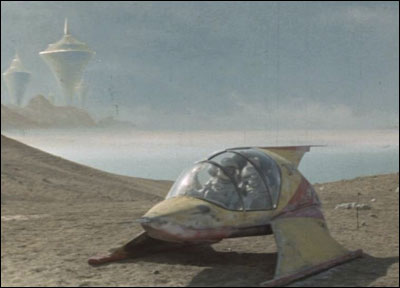
“Teenagers in Space” (?????? ?? ?????????) is a 1974 Soviet children’s sci-fi film about evil robots. In the film, a group of clean-cut teenage “pioneers” embark to a distant planet in the Cassiopeia constellation. There, they discover that robots have taken over the planet and enslaved the humans with one intention – to make their masters happy, as the robots understood happiness.
In one memorable scene, stylish robots offer to give the young cosmonauts a “Happiness Makeover.” In the futuristic operating room, sleek white sarcofagi encase the teens while robots calibrate the machine to erase their feelings of love, sorrow, shame and self-doubt. It turns out that their robots’ understanding of happiness is the satisfactions of basic needs, and the elimination of all “disturbing” emotions.
The teens learn that a small group of humans had escaped from the “Great Enhappening” and that their descendants have been orbiting the planet for generations. Together, they figure out a way to bring down the robots’ oppressive regime.
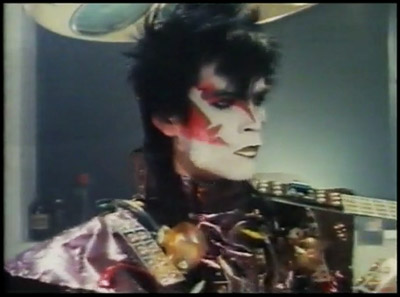
The film is available in its entirety on YouTube, but perhaps the best way for an English-speaking audience to experience the film is through the video below, which combines footage of the film with Kraftwerk’s “Robots.” See below.
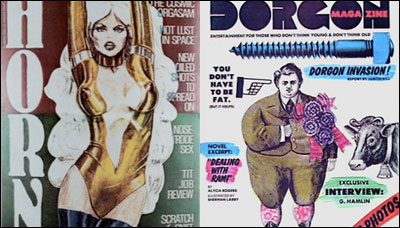
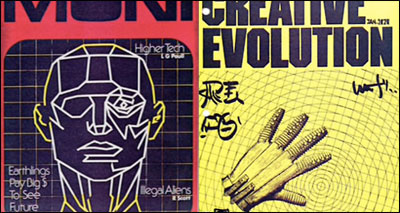
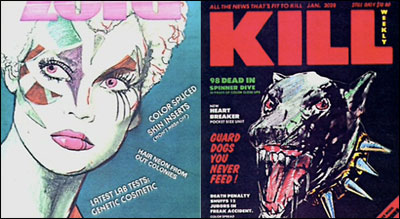
A series of magazine covers that appeared in Blade Runner have been making the rounds. Like most of the film, many of the covers (especially Dorgon, Creative Evolution and Kill) have a modern or even futuristic feel. The fashion magazine advertises “color spliced skin inserts,” while Kill Weekly promises color close-ups of deadly accidents. You can see all the covers here.
Over at The Atlantic, Alexis Madrigal traces the images’ internet origins. These covers were created by production designer Tom Southwell in 1980/1982. However, the web versions that you see here were painstakingly reconstructed by a superfan known only as Kevin. You can see a side-by-side comparison in the Atlantic article.
Posted by Nadya Lev on May 28th, 2012
Filed under Sci-fi | Comments Off on Blade Runner Magazine Covers Resurface!
This one of the best products in the market with the added value that refrigeration is not necessary. ! Our Online Canadian Pharmacy is also accredited by the Canadian International Pharmacy Association (CIPA).
Black Mirror is a grim, satirical dystopian horror miniseries that aired on Channel 4 in the UK last year. Consisting of three one-hour episodes, the show, created by Charlie Brooker, is a “a hybrid of The Twilight Zone and Tales of the Unexpected which taps into our contemporary unease about our modern world”, with the stories having a “techno-paranoia” feel. From the program description on Channel 4’s site:
Over the last ten years, technology has transformed almost every aspect of our lives before we’ve had time to stop and question it. In every home; on every desk; in every palm – a plasma screen; a monitor; a smartphone – a black mirror of our 21st Century existence.
Our grip on reality is shifting. We worship at the altars of Google and Apple. Facebook algorithms know us more intimately than our own parents. We have access to all the information in the world, but no brain space left to absorb anything longer than a 140-character tweet.
Black Mirror taps into the collective unease about our modern world.
The writing is smart, the plots just plausible enough to send a chill down your spine. In the first (and arguably best) episode, “National Anthem,” a video of the kidnapped Princess Susannah, a beloved member of the Royal Family, is uploaded to YouTube with a ransom demand that would do 4chan proud. “15 Million Merits” shows us a dehumanizing world in which green energy, gamification and reality TV intersect. Finally, “The Entire History of You” shows us a near-future in which all memories can be recorded, replayed, stolen and shared.
As piracy continues to be a service problem, there’s no easy way to purchase/view this show outside the UK. Below are the links to streams of each episode. Watch the episodes here, before they’re gone. You won’t regret it:
Great tool. Normalizes erection very well. . Today, oral tablets are the most common ED treatment. This is one of them.
Good morning. Pretend for a moment that this is not, in fact, the Spring of 2012, but rather the Spring of 1982, now thirty years past. We’re in England. New Romance is budding. Rocky Horror is a’rockin’. The likes of Gary Numan, Spandau Ballet, and Klaus Nomi rule subterranean radio.
Under the banner of SHOCK, two young London lads with very excellent bone structure and pop ‘n’ lock skillz named Tim Dry (who would one day become Tik from the robotic mime duo Tik & Tok) and Richard James Burgess (who would go on to produce all manner of sophisti-pop) have joined forces with two young London lasses with very large hair and dovelike coos called Carole Caplin (who shall one day become far better known as the tormented fitness and fashion consultant to Tony and Cherie Blair) and Barbie Wilde (who is soon to be immortalized in celluloid as the creepyhot female Cenobite from Hellraiser II).
It’s hard to believe Dick Clark is gone. Is it safe to surmise that secretly, many of us kids who grew up watching him on the boob tube decided long ago that Clark (or, at the very least, legions of indiscernible vat-grown clones of Clark kept in a top-secret underground facility located a few miles beyond the city limits of Fresno) would be Rockin’ our Eves for centuries to come? Alas.
In (somewhat oblique) honor of the departed (and because NO halfway decent excuse to feature the Mael Brothers on Coilhouse should ever be passed up) here’s a fabulous performance of “Pulling Rabbits out of Hats” by Sparks on Dick Clark’s American Bandstand in 1984, followed by a unexpectedly sweet and silly “interview” between three very disparately distinguished gentlemen. SO GOOD.
Previously on Coilhouse:
“This Town Ain’t Big Enough For the Both of Us” Top of the Pops, 1974. (A very old post, wherein I get grumpy about Bedford Ave. hipsters and the SPARKS energy drink. Ignore that bit. S’all about the MAEL LURVE.)
His latest endeavor focuses on superheroes. Specifically, superheroes from comics’ Golden Age, which lasted from 1935 to 1949. The project is calledThe Encyclopedia of Golden Age Superheroes, and Jess is currently raising funds on Kickstarter to produce a book and a website (which will include a free download of the book’s manuscript) to catalogue 2000+ superheroes: everything from “floating eyeballs and centaurs” to “robot brains and super rabbits.” Jess needs to travel to Michigan State University in East Lansing to study up on all of these wondrous things, and estimates that it will take two weeks to get the research done. The money raised by Kickstart will go towards subsidizing Jess’ travel and building the site. The project may have hit its modest funding goal, but believe us, the bare minimum is never really enough. Plus, Kickstarter projects that raise substantially more than the required amount often have a way of evolving and deepening into even bigger, more beautiful work (for instance, Molly Crabapple’s Week in Hellor R. Stevens’ Diesel Sweeties e-book).
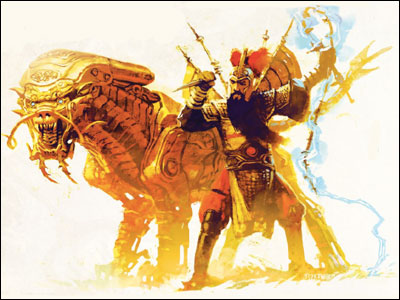
In celebration of Jess’ ambitious new project, we are releasing a full, free PDF of his article from Issue 05, titled “Sherlock Holmes vs. The Fox Woman: A Brief Tour of Chinese Pulp”. Lushly-illustrated by Greg Broadmore and Paul Tobin, the article provides a sweeping overview of Chinese Pulp from, from moon colonies to pirate queens. Enjoy!
We can’t wait to read this book, Jess! Go git ’em.
Space Stallions, a bachelor film project from the 2012 Animation Workshop, plays like every Saturday morning cartoon from my childhood boiled down into one four minute concept. Created by Thorvaldur S. Gunnarsson, Jonatan Brüsch, Ágúst Kristinsson, Arna Snæbjørnsdottir, Esben J. Jespersen, Touraj Khosravi and Polina Bokhan, it appears to have everything: spaceships, spandex-clad heroes, rainbows, unicorn-shaped hoverbikes, moustaches, and laser eggs. It’s like someone put peyote in your Lucky Charms.
A quick Google search shows that this video is pretty much everywhere, but I just can’t resist putting it here. Following up their Star Wars themed Passat commercial for last year’s Super Bowl, Volkswagen returns this year, and once again puts “The Imperial March” to excellent use, in this case having it performed by twelve dogs, some in various forms of Star Wars costumery. It’s so very silly but I love it so very much; especially the grand entrance of the twelfth and final member of this canine chorus. So. Good.
Hooray for flarpy synths and dubious Danish E.T. impressions!
This cover of John Williams’ E.T. theme was recorded in 1983 by two yacht-rockin’ electropoppets known as the Future World Orchestra. It is, IMHO, so utterly beyond happystupidwonderful, some of you may have trouble restraining yourself from spasmodic flailing or propulsive flatulence.
Behold, below, as the space-age lotharios radiate raw moustachioed magnetism while performing their hit single “Desire” on the Italian music show Discoring:
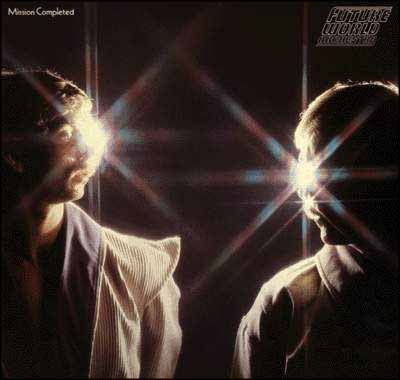
Here is the amazeballs cover of their 1982 album, Mission Completed:
And this, comrades, is the last offical Better Than Coffee of 2011. If the FWO ain’t afraid of the future, then let us not be, either. Onward and upward and o’er we go!
This week, he has stepped up to urge a sneering admiral and a provoked princess to put aside their petty differences and join forces to battle a looming, sparkly vampiric threat. (All while standing in front of a mysterious oil-painted, pleated-khaki-pants-clad crotch.)