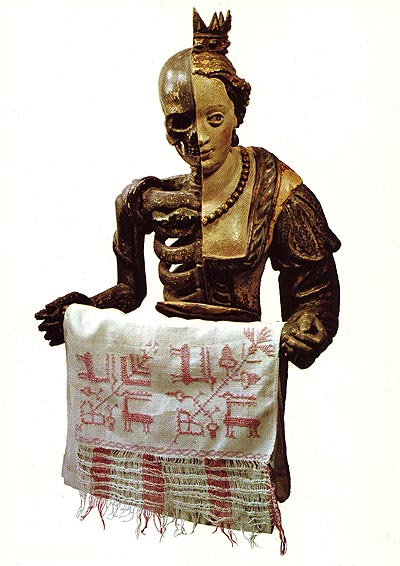
Start the day off right by simultaneously drying your face and contemplating mortality with a little help from the Tyrolean Towel Rack of IMMINENT DOOM. DOOOOM:
This fetching piece of Germanic history can be found in the Tiroler Volkskunstmuseum in Innsbruck, Austria. The sprawling complex is chock full of similarly bizarre pieces of functional art, like intricately painted antique cabinets, traditional ceremonial costumes, jaunty beast-headed sleighs, embellished tools, and lavishly personalized weaponry. Several historic walk-through “rooms” dating back to the Gothic and Rococo eras have been reassembled, replete with original hand-carved wood paneled walls, stoves, kitchenware and benches on which one can sit for a moment to rest.
My traveling companions and I spent several blissful hours ooohing and aaahing over everything. At one point, Dawn, an accomplished yodeler, was actually moved to song, her joyous yips reverberating up and down the long stone hallways.
George W. Bush’s grandmother, Pauline Pierce, was a remarkable woman known for her “extravagant tastes.” In the 1920s, she adventured in France with writers Frank Harris and Aleister “The Wickedest Man in the World” Crowley; this much, we know, is fact.
During this time period, Crowley was dealing in sex magick – really, when wasn’t he? – and in 1924, possibly with Pauline at his side, he underwent “the Supreme Ordeal,” an important and mysterious rite which, clues from his diary suggest, may have been an orgiastic extravaganza of carnal debauchery. That same year, Pauline returned to the United States. In 1925, she gave birth to Barbara Bush. That’s the short version of the story. Read the long one, complete with diary excerpts from Crowley, here (via Jerem).
I want to believe!
EDIT: Aww, as Mr. Dowson points out in the comments, this was an April Fools’ Hoax! And thus, George W. Crowley-Bush rides unicornback into the Sunset of Too-Good-To-Be-True, where feejee mermaids, Cottingley fairies, and Milli Vanilli wave to him in greeting. Granpaw Crowley is there too; he buys him balloons and together they go to watch The Big Donor Show on the telly. All is well.
While these days everything Disney isn’t exactly perceived as cutting edge, things were different back in the day. Just think of gloriously creepy Fantasia and Pinocchio, both the fruit of Disney’s collaboration with Bauhaus painter Oskar Fischinger.
Disney intended to continue bringing in artists to further expand his studio’s horizons, and Destino was meant to be his next step in that direction. Salvador Dali thought very highly of Disney and cherished the project, completing for it 2 paintings at 135 sketches. A surrealist love story conceived and subsequently shelved in the 40s, Destino was finally unearthed, finished and released in 2003 on orders of Walt Disney’s nephew.
Update! If you’re in LA, you can see Destino for yourselves at LACMA through January 6. Thanks for the tip, 5000!
Though personally I would have preferred Dali traveled in time and worked with Peter Chung, this remains a fine testament to both Dali and Disney’s former glory. One more video beyond the jump.
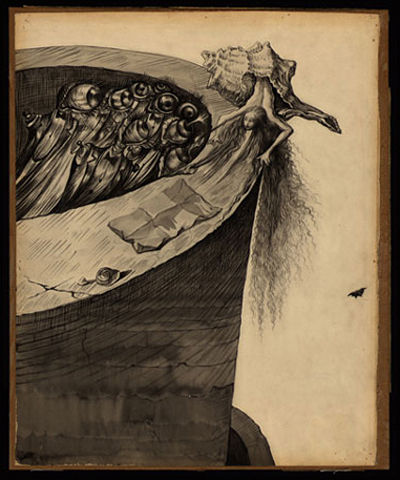
This picture made me hungry! Gazing upon this delicious image I googled “insect recipes” and believe me, friends, the Internet does not disappoint. At eatbug.com you can find a lovingly-compiled list of recipes, including Mealworm Chocolate Chip Cookies, Ant Brood Tacos and more. This Thanksgiving, surprise your family with a home-prepared meal that they won’t soon forget.
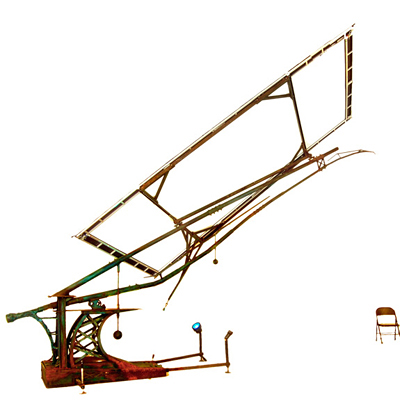
The Engine Theater is a wondrous thing conceived by underground director Burke Roberts and a team of artists. A mechanical screen and projection system, designed to be portable inside a small trailer, described on the official website as a film screening unit with a complex, kinetic sculpture as the centerpiece to hold the screen.
I found out about The Engine Theater only recently, through a series of seemingly unrelated events, people, and emails. This was, apparently, going to be the next Thing but the the lure was in the title itself; “The Engine Theater Global Underground Cinema Series Part 1: Berlin Subculture films from 1977 – 2007” , too curious to pass up, even on very short notice! The night’s schedule read like this:
I realize the fog machine/polyester armpit vapors of my last post are still fresh in your nostrils. Apologies if the following clip is officially too much of a good thing. Then again, can’t everyone can use one more reason to love this man?
Yep. That’s Richard Pryor fronting a deadly funk/metal band that looks like Sunn O))) on national television in 1977. This is indeed a strange and glorious universe.
Sometime last spring I vowed to only buy dresses to simplify shopping and slow closet growth. That’s all been forgotten now, though I did faithfully stick with the plan all of the summer. But, as with any drastic regime, there were side effects.
Once I finally realized just how sick of dresses I’d become, I began purging anything frilly and light-colored along with most dresses I’d accumulated. Now I actually need to get a flashlight to navigate my closet, like in the olden times of Zo-spookiness. This means muted colors, layers back in effect along with pants paired with heels. Less overt girlyness with a lot more attention paid to interesting construction and detail, even when I’m wearing skirts or dresses. A new era?
My mantra’s become “quality over quantity” this season. I’m not really shopping and am donating a lot to Goodwill thus leaving myself with fewer, better options. Though in all likeliness this is simply hibernation and my shopping appetite shall return, ravenous!
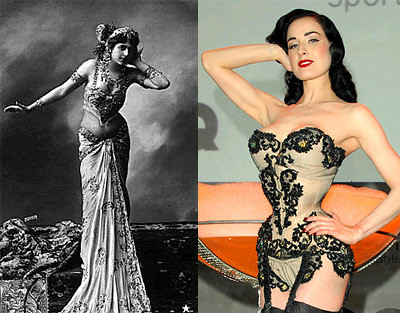
Fetish performer Dita von Teese has been cast to play the role of WWI-era exotic dancer/spy Mata Hari in a new film directed by Martha Fiennes. The full story is here.
Before we get to whether or not Dita can pull this off, a bit of history: the original femme fatale, Mata Hari was born Margaretha Zelle to a humble family that ran a hat shop in Holland. She moved to Java as a newlywed at age 18, but family life was not in the stars for Mata Hari; after a divorce, she resurfaced in Paris, poised to reinvent herself as a sultry dancer princess.
She first performed as a circus horse rider under the name Lady McLeod, but reached true fame when she introduced herself as an exotic dancer under the name Mata Hari (“Eye of the Day” in Indonesian, “Mother of God” in Hindi). An overnight success, she was famous for her seductive performances, elaborate costumes and Oriental origins; she posed as a princess from Java, initiate in the mystical art of erotic ritual dance. After her rise to stardom as a dancer, Mata Hari became a courtesan, then a spy, and ultimately, by some accounts, a double agent.