If Joseph Merrick had solved the Lament Configuration.
“Dear Coilhouse,
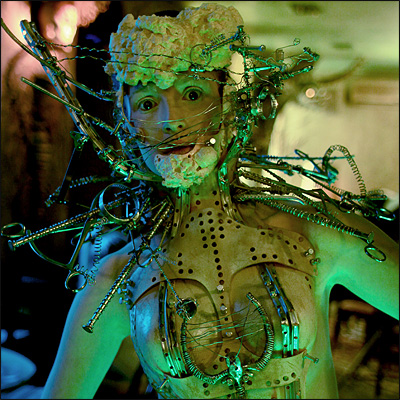
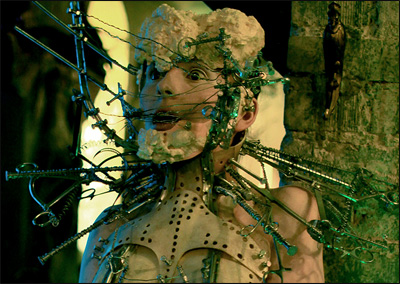
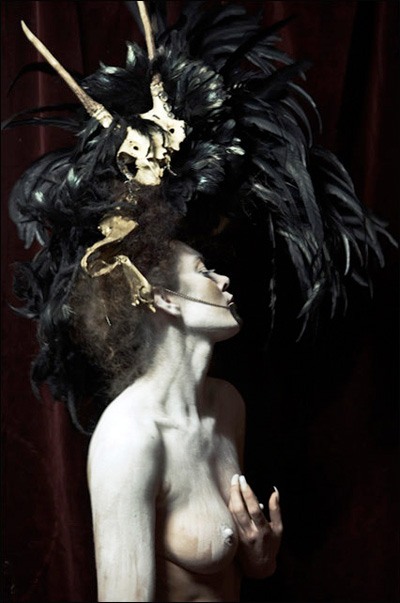
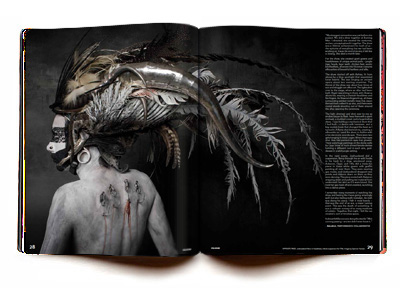
My name is Katarzyna Konieczka, I am an avant-garde fashion designer from Poland. I have been browsing through your website and while reading the blog I came across photos of Joseph Merrick’s head sculpture. I would like to take the opportunity of inviting you to consider some of my work which took his inspiration from his life and condition. In particular, one of my models from the ‘Very Twisted Kingdom’ collection. The costume depicted in the attached illustration consists of a metal ruff and other elements resembling orthodontic medical equipment in reference to his illness which had not been diagnosed at the time.”
SOLD. Ten minutes later, I’m still picking my jaw up off the floor after perusing Konieczka’s site. Many more images, after the jump. In addition to the images on Konieczka’s page, many more images can be found in Marcin Szpak’s portfolio.
Introspection and retrospection reign supreme on this day, the Ninth day of July in the year of our Lord Two Thousand and Ten. Today the FAM presents Krapp’s Last Tape starring John Hurt and directed by Atom Egoyan for the series Beckett On Film for Irish broadcaster RTÉ, British broadcaster Channel 4, and the Irish Film Board and which began showing in 2001. The project’s aim was to film 19 of Samuel Beckett’s 20 plays; the exception being the early play Eleutheria which at the time remained unperformed and, in fact, was only staged for the first time in 2005, 58 years after Beckett wrote it. Along with Hurt and Agoyan, Beckett On Film featured an impressive stable of acting and directorial talent. Seriously, look at that list.
We, however, are here to focus on one. Krapp’s Last Tape is the story of Krapp, who is celebrating his sixty-ninth birthday and, is his habit, has hauled out his reel-to-reel tape recorder in order to review the tapes he has made upon every instance of the “awful occasion”. Those are the words used by Krapp, but the Krapp of 30 years previous and from whom we learn the majority of what we know about the man. It is this man, pompous and sneering, who narrates most of Krapp’s life and Krapp sneers along with him, laughing along condescendingly with his 39 year-old self at the idealism and naivete at the 20 year-old man he used to be. We learn from this incarnation of his mother’s death and the women he has loved.
But even Krapp at 39 cannot escape the bitterness that he hurls at his youth. At 69, there is little else left in him but bile and regret; his last book has sold next nothing, his sex life revolves around the periodic visits of an old prostitute. He has no years left for idealism. The only future for Krapp is death; and now in full light of that realization he retreats to the dim memories on those tapes. As the tape ends he can only sit frozen, the only sound the hiss of the reel as it runs down.
The most famous production of Krapp’s Last Tape, no doubt, is 1972 for the BBC, starring the late, great Patrick Magee. In fact, Beckett wrote the play specifically for McGee, it’s original title being “Magee monologue”. I must admit that, much as I love Magee’s work, Hurt seems almost as if he was born for this role. Watching him is hypnotic, every movement seems to take incredible effort and it seems as if he’s willing he joints to creak. Hurt is also in possession of an incredibly expressive face and he uses it to great effect here, betraying the sadness and despair of character with a subtlety that keeps the whole affair from becoming maudlin. It also contains the only instance in which I have laughed at the slipping-on-a-banana peel gag.
It would be hard for most to rank this as Beckett’s greatest play, especially when compared to his most famous play, the incomparable Waiting For Godot, but there is a reality present in Krapp’s Last Tape that is absent from the tale of Vladimir and Estragon that I find deeply affecting. Much of Beckett’s life is reflected in Krapp’s Last Tape and at the time he wrote it his outlook was, one could maintain, quite grim. Perhaps therein lies crux of my position. It’s effectiveness may hinge on just how much of one’s self one sees reflected here.
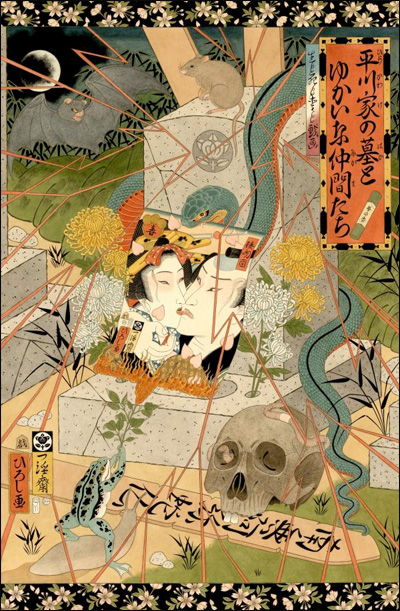
When an artist as prodigiously talented as Chris Conn Askew* tells me that I’ve got to check out an artist, I don’t hesitate … especially when he tells me, “he’s been on fire lately!” I couldn’t agree more. Hiroshi Hirakawa has that rare and delicious combination of ferocious talent, tempered by a deep appreciation of historical techniques and precedent. Ukiyo-e or “pictures of the floating world” is a traditional form of Japanese painting and printmaking whose subject matter reflects a deep appreciation of earthly beauty, coupled with an acknowledgment of it’s transience. Hirakawa’s paintings, with their frequentallusions to mortality seem to fit into this genre – or at least to represent a vividly contemporary re-imagining of it. In addition to his epic allegorical works, there is also enough cephalopod love, tattooed odalisques, oblique geishas, and dissolute rapture to enchant and mystify even the most discerning viewer. As far as I can tell, the man behind the images is utterly mysterious, although his website provides a tiny peephole into his world. Luckily for all of you, there is a new print edition by Tattoo Elite International of his ravishing piece, Shrine, now available.
*Be sure to check out our upcoming feature on Chris Conn Askew in Coilhouse #5!
We proudly present a short video created by and co-starring Coilhouse creative director/graphic designer Courtney Riot and a minty-fresh copy of Coilhouse #05. Courtney writes, “The other day I purchased a new camera. This video is the first result. I have no experience in motion/film, but after seeing a featured clip from Tell No One, I decided to give it a go.” Rock on, Riot.
On to our next item of interest– since Issue 05 went on sale last week, we’ve sold 866 copies and counting. As of this moment, a mere 134 copies remain in the online shop. First of all: HOLY SHIT. Guys. Thank you. We are humbled and grateful. We hope that you enjoy this issue, and we can’t wait to hear your feedback. Secondly: HOLY SHIT. We did not anticipate this. We knew it would go fast, but not this fast. To put it in perspective, we had the same quantity of Issue 03’s in the online store as we do Issue 05’s, and that one took an entire year to sell out, while this one is almost 90% sold out in a little over a week.
Our circulation director, Gretta Sherwood, is working around the clock to ship the copies to everyone. But even with three assistants and two printers for shipping labels, it’s going to take her a while to get through these orders. We’d like to ask for your understanding if your copy takes a little longer than usual to arrive. Here’s how to estimate when your magazine’s getting shipped: as noted on the day Issue 05 went on sale, due to the special additions (signatures, limited-edition postcards) included with each issue, we’d only be able to begin shipping on Wednesday the 7th (yesterday). The bulk of the orders came through in the first few days, so orders from the 30th are still going out, with the last ones being shipped out tomorrow. On the 12th, we’ll ship out the majority of the orders from the 1st, on the 13th we’ll ship out the orders from the 2nd, and from that point on, we’ll probably be able to ship the orders from several days all at once. If it is a True Emergency and you need your issue sooner rather than later, please email Gretta, and we’ll see what we can do.
Finally, it’s PARTY TIME! Southern California readers, please save this date: Saturday, July 17th. That’s when we (as in, all three of us in the same place and at the same time, which happens about once in a blue moon) will be hosting an evening at Meltdown Comics with Issue 05 contributors in attendance. It’s our first official event since the launch party back in 2008! A limited supply of magazines will be available. We’re thrilled to have artist Chet Zar signing, and Chronic Anxiety –his original painting featured as the fold-out poster in #05– will be on display. We’ll also be announcing some surprise guests in the week to come. Stay tuned.
PS: Anyone planning to be at the San Diego Comic Con? Roll call. (We should have our signing schedule sussed out by next week.)
Presented here without commentary is this clip of from 1991’s “25 Year Mission” tour, in which Leonard Nimoy relates the story of how the cruel and unscrupulous William Shatner stole his bike.
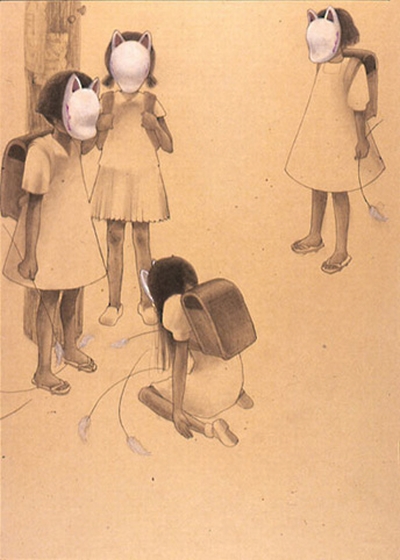
The women in Fuco Ueda’s work are, more often than not, in great peril. Sometimes they appear on the cusp of disaster; though many times they are square in the midst of one. Inhabiting the blank, surreal deserts of a Dali painting, we find them caught up in a great calamity. Alternatively we find them, as we do in her series “The School”, in familiar locales, though seemingly they are prisoners, of someone else or each other. “The School”, as evidenced by the images below, remains my favorite. It is a place so familiar (despite being decidedly Japanese, with it’s shoe cabinets) and yet it occupies a Purgatorial universe, something I can imagine floating in a sea of nothingness. The danger here is more personal. It is a violence between themselves; punishments meted out according to rules only understood by those involved. It may be that aspect of her oeuvre that so appeals to me. Every piece seems to send me into flights of fancy, trying to discern the events preceding and succeeding them.
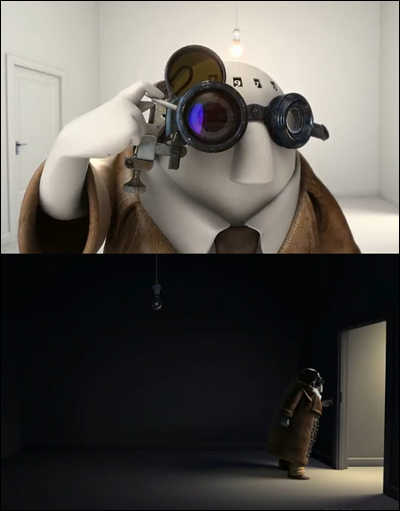
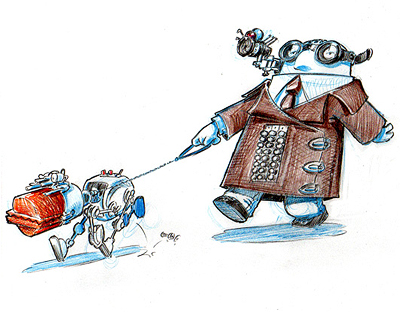
French sculptor and Coilhouse Issue 02 featured artist Stéphane Halleux is trying his hand at a new medium – animation. In response to countless questions, pleas, and threats he’s created a digital character after one of his leather and scrap metal sculptures, Monsieur Hublot. There is no word yet on the release date of the eponymous, seven-minute short, but we do know that Mr. Hublot [named thusly as a nod to Jacques Tati’s tragically inept Monsieur Hulot] is a bachelor accountant suffering from a host of obsessive-compulsive ailments. He lives in a small, gadget-packed apartment with his robotic dog, loves his leather trench coat and despises noise.
Together with Zelit Productions, Stéphane hopes to eventually develop the project into a feature-length film. Meanwhile, a frame-sponsoring system is in place, allowing interested fans to take part in the short’s development at up to 9EU per frame. From the Monsieur Hublot website:
In exchange, among other things and depending on the amount of images sponsored, they will get updates on the film’s production, a print of one of their sponsored images signed by Stéphane Halleux, the opportunity to appear in the the credits, etc. As for ourselves, this quid pro quo will enable us to complete the financing of the short film and to prepare the release of the feature film.
I love this idea!
Two charming animation tests from Monsieur Hublot have been released into the wild, so far. Watch below as the character gets his bearings and faces off with a light switch, then check out his outfit in more detail.
Америка! Get those fireworks, make sure you don’t blow any fingers off, slap a Teabagger. Enjoy! Meanwhile, for us, it was a weekend of milestones: we signed all 1,000 copies of Issue 05, Mer met Courtney for the first time in meatspace after years of remote collaboration, the three editors reunited for the first time in almost a year, and we charted a path for Issue 06 and beyond. For the rest of the weekend, we’re in a post-productivity stupor, but we’d like to leave you with the above: from the same land that brought you Lady Yu and Asgarda, the ballad “America” by Ukranian punk band Brothers Gadyukin. Translations are welcome in the comments.
It’s another summer holiday weekend, here in the United States. Independence Day weekend no less, the 4th of July being the day when Americans get inebriated and spend the day basting themselves in the hot juices of meats, both various and sundry. Such is the joy we feel when we think about how we could still all be English. We at the FAM are here, however, with you pre-basting. We are unbasted, clean and virginal at least for the moment though this will no doubt soon change. For now, however, you may sit near us and enjoy today’s offering knowing you will be unsullied.
Today the Friday Afternoon Movie presents the first four episodes of Satoshi Kon’s weird and wonderful television series Paranoia Agent (Mōsō Dairinin) from 2004, which represents the entirety of the Complete Collection’s disc one, entitled Enter Lil’ Slugger. Paranoia Agent begins with a mysterious attack on Tsukiko Sagi — a character designer best known for the incredibly popular pink dog Maromi — by an assailant who will become known as Shōnen Batto (Bat Boy in the original Japanese and Lil’ Slugger in English). Soon detectives Keiichi Ikari and Mitsuhiro Maniwatwo become involved as more people report attacks by a boy on golden skates, armed with a golden baseball bat.
What follows is tried and true territory for Kon, beginning all the way back in 1997’s Perfect Blue and, some might say, culminating in 2006’s Paprika. Given it’s thirteen episode run, Paranoia Agent gives him the most room to explore it. Kon’s work is primarily concerned with the examination of the lies we tell ourselves and pop culture. It’s the symbiotic relationship between these two aspects of day-to-day life that form the crux of all his films and is firmly entrenched in the story of Paranoia Agent. Indeed, the main thread that emerges, connecting all the attacks by Lil’ Slugger is that all the victims are attacked during a time of great stress and, moreover, seem almost relieved once an attack has occurred. It is this commonality that will eventually lead the detectives to the truth, long after the case has almost completely destroyed both men’s careers and personal lives.
Kon is a masterful storyteller and he proves it here. Nothing is out of place in Paranoia Agent, each episodes fitting in neatly with the others at a measures pace; taking time here and there to focus on events happening at the periphery of the case, only to deftly weave them back in. Best of all unlike many television mysteries of this sort, anime or otherwise, Kon is aware of the importance of a satisfactory conclusion; and while there are still some smaller aspects left open for interpretation, the main plot of the series is lead to a logical, if surreal, conclusion. The rules of Kon’s world may be different from ours, but they are well defined and his tale adheres to them.
Five years out from the English release I still find new things to enjoy in Paranoia Agent. The animation is top notch, the story is of a caliber rarely seen on television, and the acting (at least the Japanese) stays away from what most people think of when they think of Japanese animation. This may be one of the few cases of FAM in which I feel I need to be outright evangelical about the piece on display. Paranoia Agent is a series worth your time. Even if you don’t like anime you should give this a shot. More so than any other director, I feel that Satoshi Kon manages to transcend the medium. The stories he tells, by and large, do not require animation but he uses it to spectacular effect. Few others choose to use it to examine the human psyche in such detail beyond having androids ponder the subtleties of being human in opaque pseudo-philosophical prose. This isn’t a story about what it is to be human; but about just how hard we make it for ourselves.